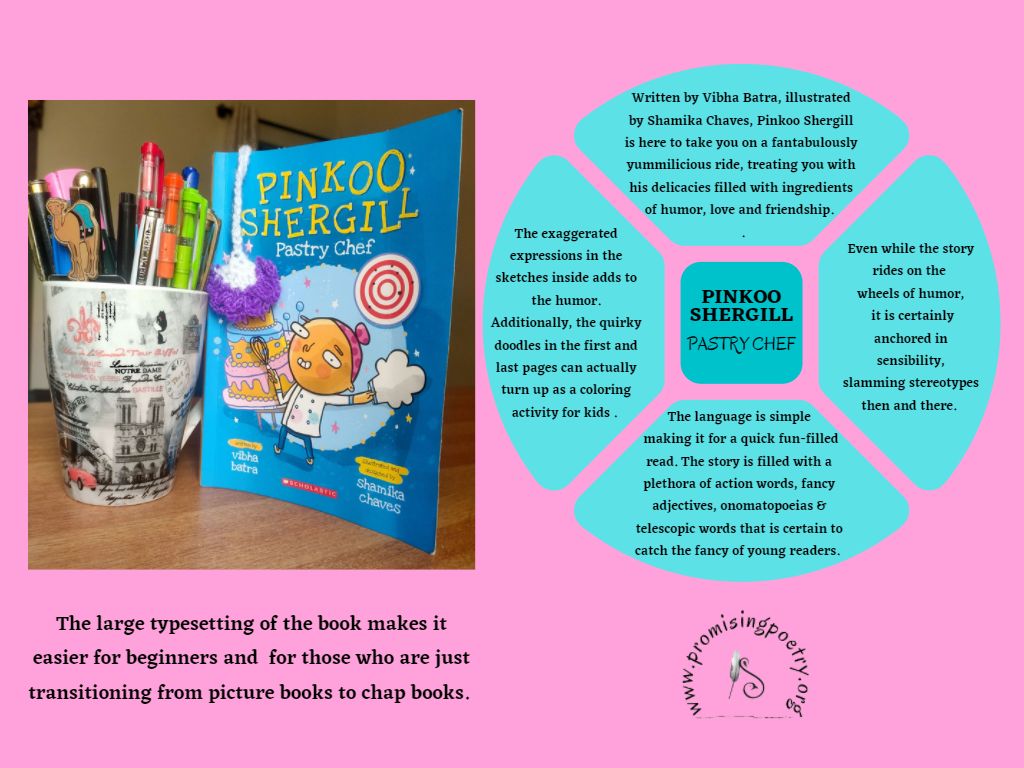
Pinkoo Shergill, a quick look. Image Source: Designed by self on Canva
Pinkoo Shergill is here to take you on a fantabulously yummilicious ride, treating you with his delicacies filled with ingredients of humour, love and friendship.
Pinkoo, the 10-year-old boy breathes, dreams and lives for baking while his Papaji is conditioned to believe the kitchen is not for boys to step in. How Pinkoo overcomes all the hurdles to enter the Great Junior Bake-a-Thon with an unexpected surprise waiting at the end is what the story is about.
Even while the story rides on the wheels of humour, it is certainly anchored in sensibility slamming stereotypes then and there. To do so without sounding preachy, to be able to talk in the language of children is the biggest plus of the book.
The characters are well defined and much relatable. The blabbermouth cousin Tutu, the supportive friend Manu, the annoying-girl-turned-friendly Nimrat are all very much liked by my daughter as she could relate to one of each from her own friends’ circle.
My daughter, Miss M was fascinated about the joint family set-up and the Punjabi way of addressing the relatives. Also, the generous use of onomatopoeias (like buuuzzz, pinggg, whooosh) and telescopic words (like giganterous, coolsome, irritatinnoying) caught her fancy at once and now she has her own list of such words.
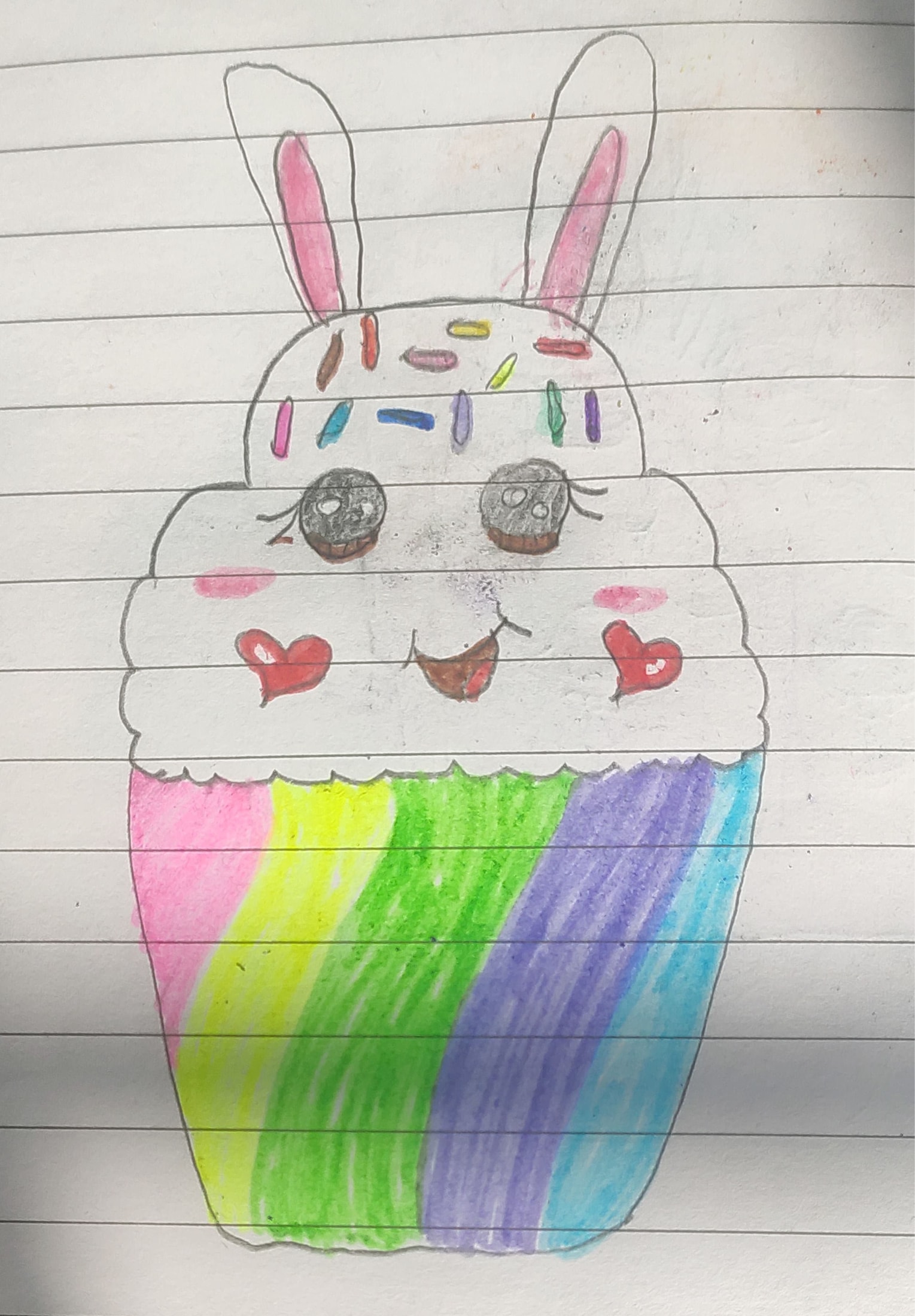
What you see above is some Pinkoo Shergill inspired cakes and cupcakes drawn by my daughter. Also yes, she is a big-time unicorn fan!
My personal favourite happens to be the conversations between Pinkoo’s and Tutu’s eyes.
Yeah right, conversation between eyes! They have a dialogue going. I told you, this book is hilarious.
A word of caution: The book takes you through a ride of yummilicious cake preparations, all so drool-worthy and is best enjoyed with at least a cupcake or gulabjamun by your side.
The author, Vibha Batra, has kept the language simple making it for a quick fun-filled read. She has also filled in the story with a plethora of action words and fancy adjectives that is certain to catch the fancy of young readers. It can also come in handy for teachers too to introduce the same in a fun way through the story.
The only minus I see in the book is the overuse of capitalizations which felt sore to my adult eyes though I’m not sure if I can call it a minus as my daughter found it just fine.
The cover page by the illustrator Shamika Chaves is vibrant and beautiful. The exaggerated expressions in the sketches inside adds to the humour.
Additionally, the quirky doodles in the first and last pages can actually turn up as a colouring activity for kids (idea courtesy, Miss.M).
Altogether, Pinkoo Shergill makes for a quick fun read with ingredients of humour, love and friendship added in the right proportions making the story a relishing experience. The large typesetting makes it easier for beginners or for those who are just transitioning from picture books to chapbooks.
P.S. Don’t miss out on the creativity of the author come out even in the acknowledgements at the end.
You may think that you consume poetry consciously but there may come along a book, like Gitanjali, where poetry will consume you, wholly, making you feel both lost and found, leaving you with a gratified feeling.
It’s with a feeling of reverence and fondness that I attempt at writing about this book. This book is one that I don’t want to view from a reviewer’s lens. Though this post may be tagged under the category of a book review, let me be clear that this is not a book review.
This is more like a childlike joy of sharing a found treasure with friends. This is exactly that.
Rabindranath Tagore’s Gitanjali is a treasure to be shared and enjoyed, consumed and let be consumed, discussed in platforms and yet relished in silence.
Written by the Bengali poet Rabindranath Tagore, Gitanjali (which translates to “Song Offerings”) is a collection of translated poems of Tagore’s collection of Bengali poems titled Gitanjali. Well, the Bengali collection had 157 poems while the English translated collection has only 103 poems.
The collection of poems captures the conversations of the poet with God in its profoundness even while keeping the language simple. It’s the simplicity in which Tagore brings out hope and the possibility to have conversations with God that makes it extraordinarily beautiful.
The poet Rabindranath Tagore won the Nobel Prize for Literature for Gitanjali in the year 1913 which put Indian Literature in high regard across the world.
Where the mind is without fear
I was introduced to Tagore’s work in my school through this poem “Where the mind is without fear” from Gitanjali–
Where the mind is without fear and the head is held high;
Where knowledge is free;
Where the world has not been broken up into fragments by narrow domestic walls;
Where words come out from the depth of truth;
Where tireless striving stretches its arms towards perfection;
Where the clear stream of reason has not lost its way into the dreary desert sand of dead habit;
Where the mind is led forward by thee into ever-widening thought and action
Into that heaven of freedom, my Father, let my country awake.
This poem, written by the visionary during the period when the British ruled India, at first looked like written as a yearning for freedom from slavery. But what made me feel relevant even now, making it a timeless classic is that it yearns for freedom from our very own limitations of the mind.
This poem and all of the other poems in Gitanjali too helps work on an individual level of freedom.
As a nation, we might be free from the shackles of slavery seeing progress in the fields of science, technology, medicine, sports, etc. But are we free from discrimination at the grassroots levels?
Do we even realize what freedom of mind may actually mean?
Gitanjali gently nudges us to question ourselves leading us to the heaven of freedom where the heaven is found just within us, where God sits right inside of us making conversations with Him possible, right now.
Gitanjali-Biggest influence on my poetry (and life) journey
As mentioned in one of my previous posts, Rabindranath Tagore’s Gitanjali is one of the biggest influences on my poetry (and life) journey and honestly, I don’t remember how I landed up with this book. But one thing that I clearly remember is that the very first poem in it had me in tears. Here is that piece:
Thou hast made me endless, such is thy pleasure,
This is my prayer to thee, my Lord-strike,
strike at the root of penury in my heart,
Clouds heap upon clouds and it darkensThou hast made me endless, such is thy pleasure
Thou hast made me endless, such is thy pleasure.
This frail vessel thou emptiest again and again,
and fillest it ever with fresh life.This little flute of a reed thou hast carried over hills and dales,
and hast breathed through it melodies eternally new.
At the immortal touch of thy hands
my little heart loses its limits in joy
and gives birth to utterance ineffable.Thy infinite gifts come to me
only on these very small hands of mine.
Ages pass, and still thou pourest,
and still there is room to fill.
— Tagore
More interestingly, I couldn’t move on to the rest of the poems and I didn’t force myself to do so too. I sat with the poem.
Some poems come to you to prepare you for an intense experience
while some others come in as an assurance that your path is headed the right way.
Gitanjali has poems that make me feel both ways.
A relationship with God
More often or so, our relationship with God stems from fear or an obligation or a traditional practice but this anthology will make one seek God from a space of love.
There are times when the complexities of life may drain us, making life a dreadful solo journey. But one read of even one poem from Gitanjali can make you feel comfortable assuring that it needn’t be a solo journey while He is by your side.
Tagore brings in the beauty and joy of having an honest relationship with God through his lines effortlessly and efficiently.
I ask for a moment's indulgence to sit by thy side. The works that I have in hand I will finish afterwards.Away from the sight of thy face my heart knows no rest nor respite, and my work becomes an endless toil in a shoreless sea of toil.To-day the summer has come at my window with its sighs and murmurs; and the bees are plying their minstrelsy at the court of the flowering grove.Now it is time to sit quiet, face to face with thee,and to sing dedication of life in this silent and overflowing leisure.
- Tagore in Gitanjali
Ain’t it just amazing? I sometimes feel that kids have such conversations easily while we as adults lose the connection with God because of our learned ignorance. Kids keep it simple like this conversation in the poem above. They say their fears openly, approach and own God which we as adults fear to do, afraid of being judged.
Gitanjali makes those real-time conversations with God possible and helps experience the childlike joy that comes with believing in magic and being open to it.
On another note, I would also love for you to listen to the song below penned by Tagore (not from Gitanjali though) which gives one the hope and courage to make the right choices and walk alone if the right thing is to stay away from a wrongful crowd.
What makes Gitanjali a must read
This book has an introduction to Gitanjali by the Irish poet W B Yeats is more than enough of a reason to make Gitanjali a must-read. Yeats’ introduction clearly shows his fascination for the mysticism in Tagore’s poems and calls it the work of a supreme culture.
Where most of the divisions and discriminations creep into society out of a religious divide, this anthology has the power of changing perspectives working on an individual level to free us from such limitations.
Even for an atheist, this book has an appeal as there’s no definite portrayal of God here and it’s more of an abstraction and personification. And the poems can make one easily personify God the way they want or simply relate it to an idea they believe in.
It’s more of an experience than a depiction. It’s more of a personal belief than a traditional practice.
Gitanjali helps you shift from a religious trip to a spiritual voyage with hope and love as comfort.
Concluding Notes
Our prayers end in a hurry, we take time to do rituals but not the time to sit alone to contemplate or have a conversation with God. We don’t even think about the possibility of having a conversation with God.
We distance ourselves from God not knowing of His residence just right in our hearts. Gitanjali helps you find Him, fall in love and make Him your forever friend.
We do things out of fear but not with an open-mindedness to seek, to be called wrong and to learn right from the wrong. We forget to learn to unlearn. And it can be hard from a lot of conditioning since birth but that is where Tagore’s Gitanjali comes in as a gentle nudge and a comforting blanket.
Some poems come to you to prepare you for an intense experience
while some others come in as an assurance that your path is headed the right way.
Gitanjali has poems that can make you feel both ways.
–
P.S. Not every poem in Gitanjali has to be read in one go. Nor every poem of Gitanjali may appeal to you all at once. It is a growing experience.
Sit alone with one poem at a time and experience the magic it brings along. I bet, it will grow upon you and the poems will start talking to you (not necessarily in the same order of writing) right at the time when you least expect it.
Swatantra is not just about the title of the poem. It’s not just another Independence poem. It’s about the motherland, the land, the mother, you and me, and us all together. Hope you find yourself in Swatantra, become one and feel free from all boundaries and conditioning.
This poem is an attempt for you to seek Independence from within. To ask yourself every now and then if you are really free? What binds you? What makes you feel Independent?
Do you feel swatantra at the soul level? If yes, then don’t shy away from singing this Song of Swatantra, happy & high! If not, just ask why?
Let’s own & celebrate Independence every day, consciously 🙂
Happy Independence Day 🙂
I can be the barren land-isolated
or a fertile field-decorated
deep inside lies my untouched soul
the essence of being immortal

From dust I become-to end
into the dust, a cycle of pretend
in ‘tween, a soul-free, identity independent
singing the song of freedom, eternally coherent

The shackles of your conditioning
never do they define my being
I stretch, I flow, I change yet forever glow
in the gentle breeze, even in a stormy blow

In lying bare or in clothing finery
naked truth being my only accessory,
I pride myself on telling my history
for in the roots of this land lies my glory

I might be your survival food or savouring feast
Yet don’t you dare label me beauty or beast
Neither food nor feast, neither beauty nor beast
I’m the solitary soul you know the least

I’m the universe I’m the atom
My spirit undivided in a stratum
It’s not in you to bind me
For I’m free, I’m free, I’m free

From dust I become-to end
into the dust, a cycle of pretend
in ‘tween, a soul-free, identity independent
singing the song of freedom, eternally coherent

I’m the universe I’m the atom
My spirit undivided in a stratum
It’s not in you to bind me
For I’m free, I’m free, I’m free

I’m free
I’m free
I’m free
For the spoken word version of the poem, click below:
While poetry in itself can have undertones, giving us various perspectives, a cento poem goes further ahead to bring on an entirely new dimension.
A cento poem is nothing but a collage poem with lines picked up from other sources of poetry/prose to combine and come up with patched-up poetry. It is total fun and also challenging.
To come up with a cento poem, one must read many other poems/prose pieces and come up with an idea or central theme that can hold the lines from various sources under one theme.
Here’s a cento poem that I came up with during an advanced poetry writing workshop. Hope you enjoy it. Also, I have mentioned the sources from which these lines are taken, at the end. To make the flow seamless, I have also added few lines from my side 🙂
Every Storm Brings Along a Calm, Thereafter
My desires are many and my cry is pitiful,
My body's wisdom tells and tells again
A voice inside, briefly, soothing the pain-
“These men bearing flags were thirsty for love.”

There was never a consent, nothing of me
They grow on me like leaves on a tree.

“That virus is not for you
They decayed before they were born”
nothing can mend, I’m already torn.

They never seem to stop their coming,
They grow on me like leaves on a tree,
There was never a consent, nothing of me
That I shall find my rest, my sleep, my peace
the voice fountains, thrusting brevity at ease...

“The infinite knows what you hunger for
Ask Him to carry you across”
My conflicting mind dives into a pause
From a silence, somewhere deep within.

Strength surmounts, knowing whom to let in
saving me from perils of weak, uncertain desire.

“Day by day thou art making me worthy
 of thy full acceptance”- I surrender
For men may come and men may go,
but I go on forever…
List of poems the verses are taken from; numbered per the flow of poem:
“Strong Mercy”, from Gitanjali by Rabindranath Tagore.
Taken from the book of Bhakti Poetry Eating God, edited by Arundhathi Subramaniam. This particular verse is taken from Lal Ded’s poetry and translated by Ranjit Hokote.
Taken from the book of Bhakti Poetry Eating God, edited by Arundhathi Subramaniam. This particular verse is taken from Lal Ded’s poetry and translated by Ranjit Hokote.
Taken from the book of Bhakti Poetry Eating God, edited by Arundhathi Subramaniam. This particular verse is taken from Lal Ded’s poetry and translated by Ranjit Hokote.
A blend of emotions,
flashing randomly in mind,
with deeply set eyes,
gazing past every speck,
sitting behind the bars,
analyzing and introspecting,
whilst the physique bouncing-
with the pace of tallyho
my eyes still wandering,
out of the window-
 yet another bus ride!

Yet another bus ride...
with monotonous gazes
irritating stares
formal smiles and whatsoever...
with my reluctant self
pondering profound on things -
that never change,
my eyes still gazing out and...
VOILA!

I stopped to blink-
to capture the flash of smile...
Yes...
A red giant pulsar,
speeding through its way,
accelerated by pot-bellied man
and that's not all...

It's she who sat behind
spread the cheer...

Her dress patterned with mud,
shirt-half tucked
her hair-braided & tied up
with ribbons partially open..

She sat with bulgy bag on shoulder
claiming her to be a school girl...
her hands-
soft & tiny
stretching out to maxim
to grasp her dad's stomach
that tummied out
beyond her tiny hands...
But still
she tried hugging tight,
with her face resting on him,
and her eyes glimmering-
out of pride and joy
with her ride with dad...

He now grasps her hands
with utmost care and love
from his front
to bring her more closer
and as her presses her palms
with his affirming touch,
SHE SMILES...

she smiles with joy,
she smiles with love,
she smiles with trust,
she smiles with pride...
and they fade through their way
leaving behind a trace of smile
as oft I reminisce this flash...
வெவ்வேறு தருணங்களில் எழுதிய நாலு கவிதைகள் (கிறுக்கல்கள்), இன்று ஒன்று சேரும்போது புதியதோர் பரிமாணம்கொண்டு அவதரிக்கின்றன.
ஏனோ தெரியவில்லை, சில தத்துவார்தங்கள் தாய் மொழியில் மட்டுமே தெளிகின்றன .
பகிரவும், சிந்திக்கவும், இதோ சில கிறுக்கல்கள்…
வாழ்வின் வெற்றிகள்
வெறுமைகளை அகற்றுமென
வாழவும் மறந்து
ஓடி களைத்து
வாழ்வாதாரத்திற்கும் மேலாய்
சேகரித்தப்பின்
மதி ஒளி பெருகும்-
நிறைந்த வெறுமை ,
வெறும் வெற்றின்பங்களே!!
தோழா
நிலையானதை தேடிச் செல்
தாமதங்களும் தாங்க தகுவாய்
வெறுமையையும் விரும்பி ஏற்பாய்
பிறவிகள் பல
பிறந்தாயிற்று
பிடிப்பில்லாமல்
ஃபீலிங்க்ஸற்ற
ஃபீனிக்ஸ் பறவை
இடி மின்னல்
புயல் மழை
நனைந்த நான்,
நனையா துறவி
மறப்பதெல்லாம்
மாயையாகுமென்றால்,
மாயனே,
மெய்ப்பொருள் முன்னிட்டும்
உன் நினைவுகள் மட்டும்
மறவாதிருக்கட்டும்.
A book review is an unbiased, critical analysis of a book focusing on the style, theme, strengths and weaknesses of the book, criticizing the content and not the author and also not giving away the whole story (or content) of the book.
Book reviews are meant to help you find the right book that can find answers to your seeking (be it joy, knowledge, curiosity or truth). It also helps as a bridge between authors and readers without compromising on each other’s purposes.
The need for a book review
What’s the need for a book review you may ask when there is the choice of reading the blurb or few pages into the book if you are buying offline or checking out author’s or publisher’s talks as part of a promotion? To answer in short, blurbs and promotional talks are carefully curated to impress you.
Now take a look at these two situations:
Situation 1: Have you ever grabbed a book just by one look at its enticing cover and one read of its cleverly written blurb only to regret the buy? I have done that and all I wished was then was to have had/read an honest book review of the poetry book earlier.
Nevertheless, the poetry book actually served the purpose of inspiring me in an unexpected way because it’s only upon reading few pages into that book that my husband said I write much better and that I consider writing poetry seriously.
Situation 2: If you are a parent buying book for your kid and you read the blurb, carefully scan the contents on the index page and also glance through few pages of the book only to end up with your kid pointing out inappropriate content with awkward questions after the buy, won’t you feel upset? Well, I have been there.
The blurbs and promotions won’t tell you much about the settings, the sentiments that run through the book, the feelings that the book may evoke or if there is any content that may be right as per the context but seem inappropriate for a kid to see it out of the context.
It’s to avoid such regrets and embarrassments that one needs honest book reviews.
Also with over a million books published every year and the number just growing exponentially, it becomes difficult for a reader to find the right book just like it’s difficult for an author to reach the right audience. This is where book reviewers come to play.
Book reviewers bridge the gap between an author and a reader.
What’s in a book review for a reader
As a reader, a book review can help to understand the theme, settings and style of writing to know if it’s something of your interest.
It helps you understand the age appropriateness of the content, especially in children’s literature it’s a key deciding factor.
A good review can help you explore new genres which otherwise you might not have picked up.
When it comes to books of debut author’s a book review can be the key deciding factor.
An honest book review can save you from buying a wrong one.
What’s in a book review for an author
It helps in reaching your book to the right audience.
A good book review helps in bringing greater visibility to the book.
Reviews help open up discussions around the book, thereby helping authors to identify the pulse of the audience.
It also helps authors get an idea to what write next.
An honest review even helps the author identify the weakness in the plot/writing and come up better next time.
What’s in a book review for a reviewer
To be able to analyze a book critically and share a review gives the pleasure of revisiting the content/story again.
For a reviewer, it helps as an aid to hold on to key aspects of the book for a longer period of time.
It helps a reviewer explore new genres and also be open to new ideas.
Over time, with reviewing, it helps the reviewer to view their own work with critical lens.
If the reviewer has a good track record for honest and critical reviews, he/she/they get books for free (for reviewing) and also get the chances to be paid too in exchange of a genuine review.
Concluding Notes
With an ocean of books available online and offline, book reviews have the potential to make or break a deal. As much as it’s important to have book reviews, it’s also important on a reviewer’s part to keep it honest.
Let me know your experience with book reviews or book reviewing!
பிறந்தான் அவன் அவனாய்
வளர்ந்தான் அவன் அவளாய்
கம்பீரம் கொண்டான் அவனாய்
நளினம் கண்டான் அவளாய்
மாற்றங்கள் கண்டான் அவனாய்
ஒதுக்கப்பட்டான் அவளாய்
விமர்சனங்கள் ஏற்றான் அவனாய்
முன்னேற துடித்தான் அவளாய்...

அவனும் அவளுமாய்  ஓர் உடலில்
தன்னுள் கண்டான்
அவனும் அற்ற அவளும் அற்ற
திருநங்கையாய் அவன்(அவள்?)!!

மூடர்கள் உலகம்
கோஷங்கள் முழங்க
அர்த்தநாரீஸ்வரரை ஏற்ற மனம்
பக்குவம் அற்று
ஒதுக்கி தான் வைத்தது திருநங்கையை
திரு எனும் மரியாதை
வார்த்தையில் மட்டும் கொண்டதாய்...

தூஷணைகளும் தூற்றல்களும்
துரத்தும் சமூகத்தில்
துணிதலும் தன்னம்பிக்கையுடனும்
துரத்திச் சென்றாள் தன் கனவினை...

இன்று
எதிர் கோஷங்கள்
எத்தனையே முழங்கினாலும்
இவள் சலங்கையின் சலனம்
பதிலாகும்
மரண அடியாய்!!
Heads up, Heads up, my crew of crop!
With snug fit white polka dot crop top
& frilled, solid mustard, skirt in sway
Little Miss.Amaira comes our way
Heads up, Heads up, my crew of crop!

Oh! Her dark sulking eyes,
Unkempt hair with loose ties
A walk dead slow, looking lost
Sans a whistle, cold like a frost
Look at her, it’s a rather unusual sight—
Flora fellas, time to cheer her up bright!

                                  One day I’m Miss.Fat, the other day a spoilt brat
                                  Understanding me is never in their aims
                                  What pleasure does it give in calling names?
                                  Is my worth just that of a dusty doormat?

Listen, do you remember calling me "wandering jew"
And my tender friend beside, as "adamant creeper"
In an effort to help your friend identify who’s who?
Not to blame, not to shame, learn your lesson, however!

                                  Ignorance I may say, forgiveness I plead
                                  Let me know how ye greet me with smile
                                  Let me know how ye greet me with smile
                                  & gift me blooms whilst hurt’s what I seed?

Miss.Amaira, imagine name calling as a branch
Just a part of life tree, why struggle & stay hung?
Tell me, if you were to judge from the banch
Is the mother-in-law’s tongue
Any less calm than the peace lily
just ’cos they call it thus, all so friendly?

Let go, LET GO, there’s shade neath the tree
To sit & behold of blooms as you look up to see
Let go, LET GO, there’s shade neath the tree
To sit & behold of blooms as you look up to see


                                    I get, I get it! Yet after a while
                                   As I flail through misery’s trail
                                   I fear, fail & forget to smile
                                   When the dreams get shattered
                                   Where life ain’t anymore roses in bed
                                   I fear, fail & forget to smile

Oh dear, look at me,
Today I talk with thee
& tomorrow I may die with a sigh
A weed like me, mushrooming in every pot
Is never given a place any high
I may wither or be weeded if they like me not
I still smile & talk to thee
Life is all about in the now — to be

Now come, let’s do our little dance
Sing and smile at every chance
Life is short, worth not to fear nor fret
Living in the moment is our only best bet

Now come, let’s do our little dance
Sing and smile at every chance


                  a twist and a turn
               watch the setting sun
         raising the arms up and high
     waving the sun, a see-you-soon-bye
                  a twist and a turn
               watch the setting sun
                        a whistle
                         a rustle
                 a spin and a wave
              together, our Miss.Fave
                    a twist and turn
               watch the setting sun
          rasing the arms up and high
    waving the sun, a see-you-soon-bye...
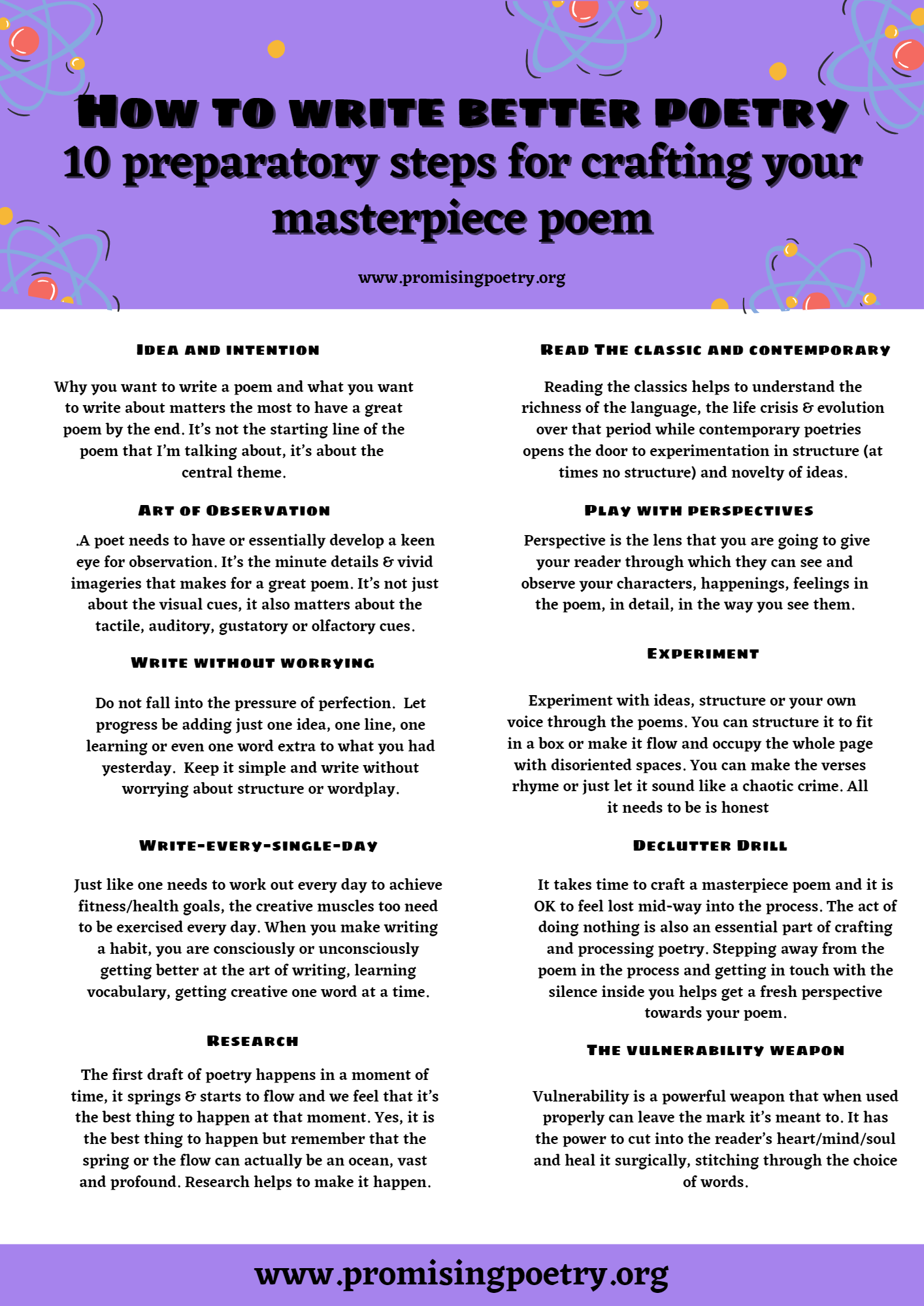
10 preparatory steps for crafting your masterpiece poem
Designed by Author on Canva
It’s every poet’s dream to write better poetry and craft that masterpiece poem every time they sit to pen one. But what’s stopping them from doing so? Is it the pressure that comes with it or is there a need to find and fix the basics right?
In this article, we shall see how can a poet get better at creating a masterpiece poem without coming under pressure and what are the basic essentials for it.
Poets, especially the ones whose works are unpublished and who are just beginning to get a grip on the art form, don’t easily call themselves a poet.
There is always a feeling of being less or being incompetent to call themselves a poet, call it impostor syndrome or whatever you may fancy, but it is true.
They might be calling themselves a writer or even a freelancer, but never a poet. They will be creating masterpieces but may call poetry writing a side hustle. Mainly because poetry is not that rewarding monetarily in spite of poetry making it to the mainstream these days.
But does that make one any less of a poet?
If you are one who is still not convinced to call yourself a poet or if you do call yourself one and make sure you get better at being a poet, then this is for you.
Let me get you through some background before sharing some experiential knowledge through this year’s poetry month experiment.
My experience with NaPoWriMo gave me the conviction of calling myself a poet
The first time that I came to know about National Poetry Writing Month (NaPoWriMo) was in the year 2017 when I came across two of Pune’s best poetry circles, Pune Poetry Slam and Bullockcart Poetry. I had been following their pages on Facebook for months and used to try their prompts regularly even though I had not posted it much, thanks to the impostor syndrome.
Then came national poetry month and out of some adrenaline rush, I just took up the challenge to try and write 30 poems in 30 days.
The first few days were a poetic high. I had my friends and relatives cheering up. My mind was fresh and I had enough words to play around with. It felt as though I was back to my college days with that competitive spirit.
It was certainly my first big step towards taking poetry on a serious note. I was experimenting and enjoying it all along. And then after 13 days into writing or so, it started getting difficult. The prompts got tougher and I was also going out of ideas.
But if there was something that kept me through then it was the accountability factor of taking an open challenge in an online space.
After over a week’s time, my Facebook audience had actually started developing an interest in reading my posts and more than myself, they were looking forward to the poems. That, in fact, kept me going and helped me push through the dry days.
But least did I know then that there wasn’t actually any necessity to create a masterpiece every day. The point was to be consistent, explore, experiment, learn and get your idea out. Something that I didn’t know as a first-time entrant into the challenge. But that year, that challenge laid a strong foundation for what was to come in the years after.
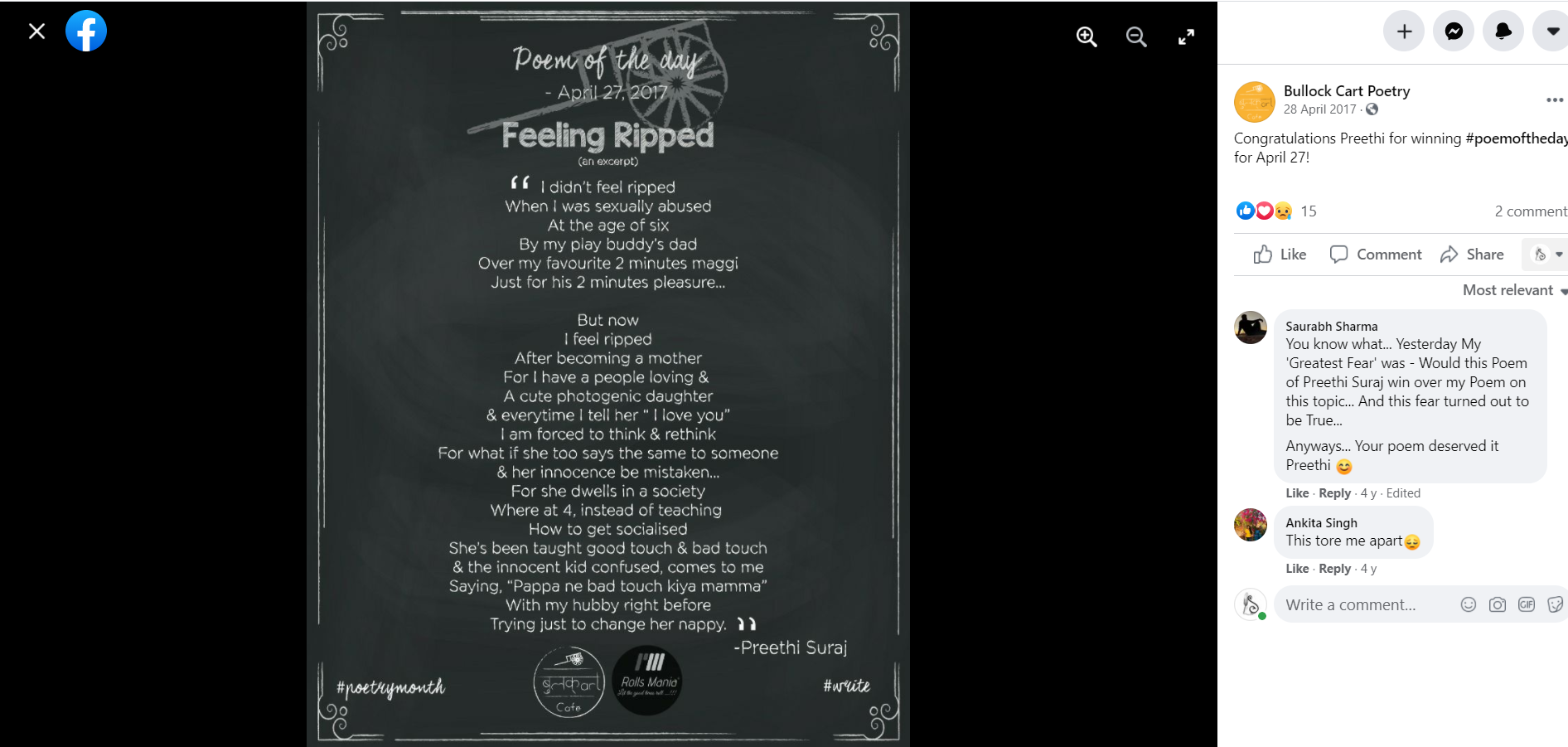
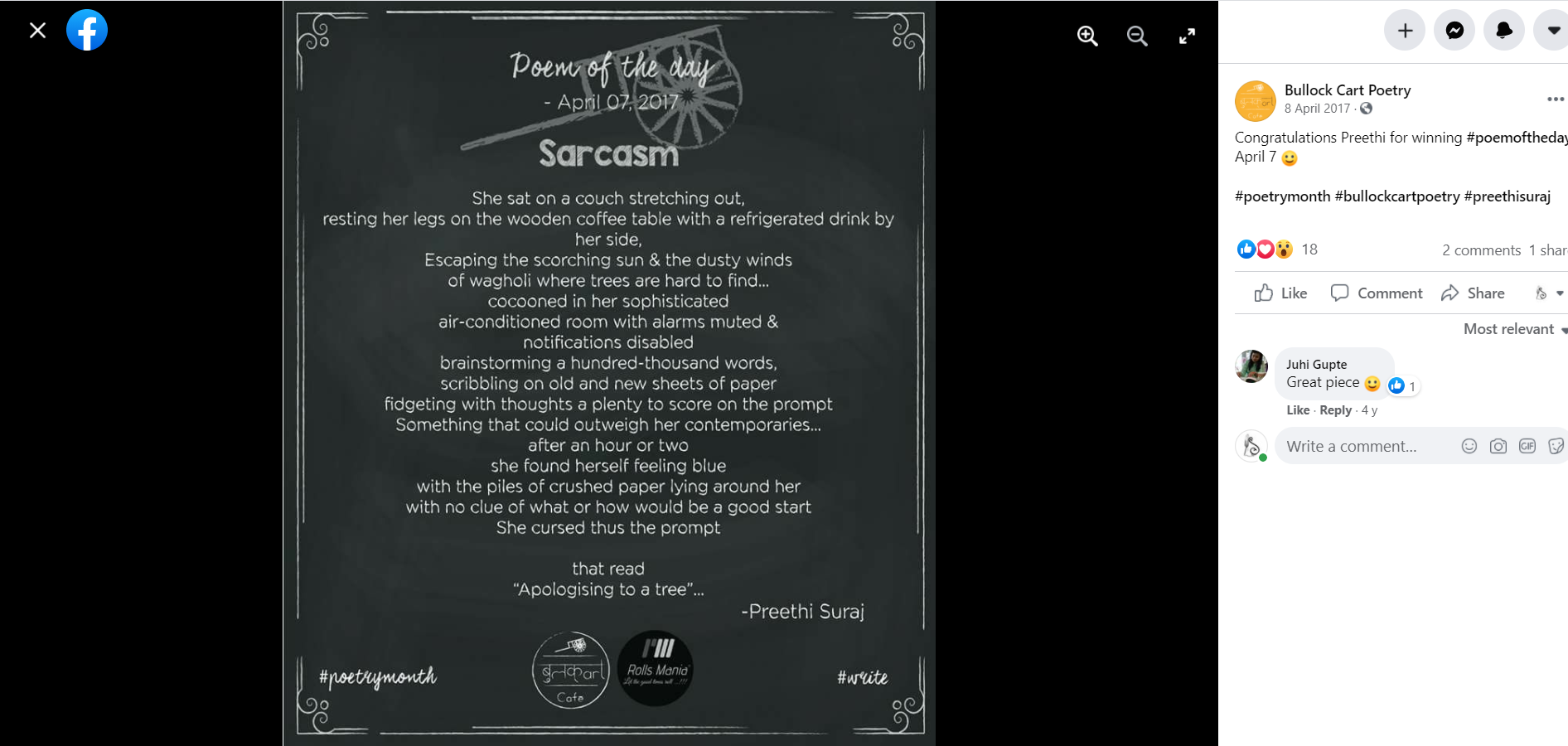
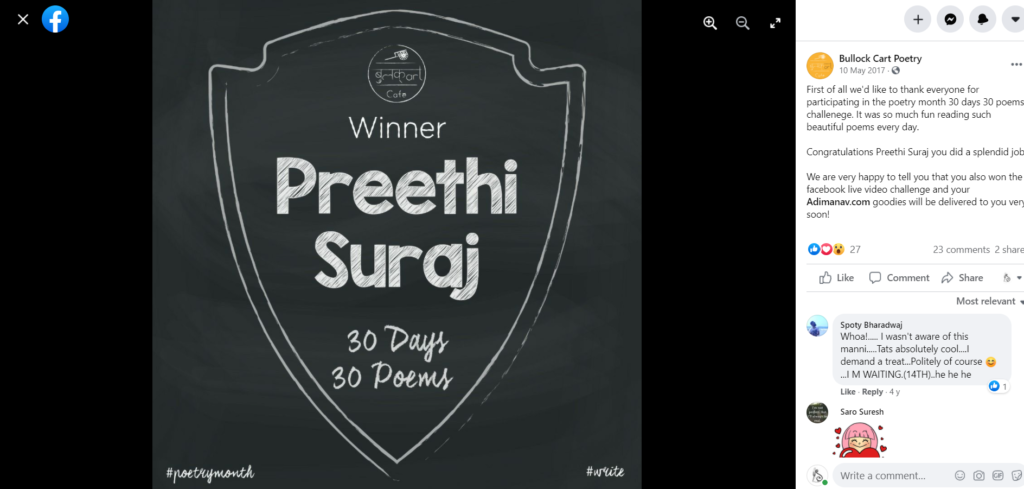
Surprisingly, I also got to win the month’s challenge of writing 30 poems in 30 days for the prompts shared by Bullock Cart Poetry with a few of my poems making it to the “poem of the day”.
From NaPoWriMo, 2017, by Bullockcart Poetry
I couldn’t continue to write for PPS simultaneously and I just attempted for the first 6 days and one of my very short poems (written just in 2 mins right before getting off to sleep) got selected for the “poem of the day”.
With the high and experience that the challenge gave, I continued taking NaPoWriMo challenges since then, only that I kept the poems to myself and was not pushing to do 30 poems in a month’s time. Rather, I took the prompts, created over days.
At times, I went for creating multiple pieces for a single prompt. I started playing with the prompts and enjoyed and learned a lot over years. More than writing, I enjoyed reading and exploring new poetry pages and finding amazing talents.
NaPoWriMo led Poetpreneurship
Fast forward to 2020, the foundation that was laid years back had now helped me dive into the space of what I call, Poetpreneurship. As a poetpreneur, I now help others find solace in reading, writing and gifting poetry. Isn’t that cool?
While poetry and making money have always been thought to be poles apart, I could jump into my solopreneur journey with poetry as the only capital because of the experience of years of writing and NaPoWriMo has had a prominent place in it.
More on my entrepreneurial journey, Promising Poetry, in the future but here is something that I did this year that I wanted to share with you.
NaPoWriMo-2021- An Experiment
April 2021, as with every year, was a month of poetic high with writings for NaPoWriMo (National Poetry Writing Month) prompts doing their rounds online. This year, I thought why not do NaPoWriMo with a difference.
So I went ahead to experimenting and sharing the process of writing one poem from scratch on my Instagram handle. As part of it, the first 10 days were about the preparatory steps for crafting a better poem.
10 preparatory steps for crafting your masterpiece poem
Idea and intention
So what comes first is the idea and intent. Why you want to write a poem and what you want to write about matters the most to have a great poem by the end. It’s not the starting line of the poem that I’m talking about, it’s about the central theme.
Personally, I write poems for multiple purposes, like for learning, experimenting with a particular technique or style, writing for my customised products or for prompts. But my favourite pieces of poetry are those that flow freely out of overwhelming emotion or an experience.
To help you get started, here are a few questions to ponder and reflect on:
What does poetry mean to you?
Why do you want to write a poem?
What are some lived experiences that you can talk about in-depth?
🤩Ask yourself these questions and if you don’t get an answer still, sit in silence. Try focusing on the emotions you go through at the moment. Be a witness, don’t judge. Let the silence in you do the talking and reflecting.
😊Remember, poetry has to flow. For that to happen, allow yourself to be vulnerable and just BE!
Read The classic and contemporary
To be a poet/writer, reading matters. To be a writer, you need to be a reader too.
For me, in poetry, reading the classics has helped to understand the richness of the language, the life crisis & evolution over that period while contemporary poetries have opened the door to experimentation in structure (at times no structure) and novelty of ideas.
For me, reading in between the process of writing helps me come out of the boundaries of my own voice/perspective and helps me look at the piece that I’m working on with newer perspectives & possibilities.
💫 Here are a few reasons why you should read for better writing:
It helps widen/break your boundaries giving wings to your imagination.
Helps improve your vocabulary.
Helps identify multiple approaches to the same idea.
Gives exposure to various genres and styles of writing.
It’s fun, relaxing and enriching.
😊 And yes, reading is also counted as progress in terms of crafting a poem.
Art of Observation
Poetry is essentially an art that helps us view the world from a different angle.
It helps broaden our views and to make the views clearer and specific with observation playing an important role.
. 😊A poet/writer essentially needs to have or essentially develop a keen eye for observation. It’s the minute details & vivid imagery that makes for a great poem.
🖋One of the classic examples for observation is William Wordsworth’s poem “I wandered lonely as a Cloud” where he just didn’t pass by a stretch of daffodils, rather he took time to observe and capture it in his words.
💫By observation, it’s not just about the visual cues, it also matters about the tactile, auditory, gustatory or olfactory cues.
🌟Here are a few questions that can help you in getting better at the art of observation:
Where/what was the first moment did you eye on the subject/object of your poem? Do you remember the context? What picture does it paint in your mind?
How do you make the subject/object in your poem come alive through visual/emotional/auditory/tactile cues?
Does the subject/object of your poem symbolize anything beyond the obvious?
😊 Remember, there is always more to the subject than the obvious.
Play with perspectives
Perspective in a poem is a tool wherein you get to decide how you want your readers to look at a particular object/subject that you are talking about in your poem.
Perspective is the lens that you are going to give your reader through which they can see and observe your characters, happenings, and feelings in the poem, in detail, in the way you see them.
Say, for example, if you decide to capture the love between a couple as your theme, you can play with multiple perspectives like being either of the people in love or take an observer’s stance and pen a poem as a witness to their love or maybe you can talk from the perspective of the couch that watches the couple love, fight, unite & spend time together.
🤩Perspectives can be aplenty, at times irrational too but what’s poetry without a bit of craziness?
So try to find a unique perspective to get your poem started. Dare to be different😊
🌟Here are a few questions that can help you get started:
Who/what is the subject/object in your poem that’s going to talk to the reader?
What is the emotion that the subject/object wants to instil in the reader?
Does the subject/object want to talk in first person/second person/third person?
Write without worrying
There is a tendency to have the impostor syndrome and be critical of our idea to an extent that we kill the idea even before letting it breathe.
We judge ourselves quickly and see progress from the lens of criticism.
🤩Let us keep progress to be very simple here. Let it be just one idea, one line, one learning or even one word in addition to what you had yesterday. Simple.
Now why I say that is poetry happens when we let it happen. And worrying about the structure, elements or finish since the start doesn’t help in any way. For the first few days let the idea sit.
Let an idea come in waves of wonders.
😌What matters is that you start, where & how don’t matter much. This can apply to that one piece of poem that you are thinking to pen or the journey itself as a poet.
💫Interestingly, if I remember properly, I started writing poetry (for me then, poetry meant ending with rhyming lines!) around the age of 13 or so and I remember writing this: Nature, nature, nature/You are God’s creature (now don’t ask me if that even makes sense!)
I laugh and criticize myself whenever I get reminded of my first poem but then I realize, that day, knowingly or unknowingly, I made a start and I’ve progressed to where I’m now today and I’m happy about it.
And I’m sure your poem is going to be far better than the one I started with. So, pen & progress.
🌟Here are a few questions that can help you add another word/verse/idea to your poem:
What are the words that come to your mind when you think about the theme of your poem? Jot it down.
Make a mind map of the theme or the flow of the poem with only words that come to your mind at once you think of the poem.
What inspired you to come up with this theme/idea of the poem? Reflect & make a note.
Experiment
For any art form to survive through the ages, experimentation is a constant criterion.
When it comes to poetry, the very first impression that comes to us is that of rhyme, rhythm and a sense of aesthetics it gives us. But poetry has evolved from being a lyrical ballad or classic sonnet to being a more fluid version—be it in structure or aesthetics— with experimentation.
The best thing about poetry is it is not bound by grammar or any other rules, which makes it more interesting and a great canvas for experimentation.
Well, you can experiment with ideas, structure or your own voice through the poems. You can structure it to fit in a box or make it flow and occupy the whole page with disoriented spaces. You can make the verses rhyme or just let it sound like a chaotic crime. All it needs to be is honest and just be.
🌟Here are a few questions to help you get started with experimenting with your poetry.
What does the structure of your poem convey? Can you break a few lines, add a few spaces and restructure to have added symbolic meaning?
Does your poem necessarily need to read from left to right or flow from top to bottom?
Is it necessary for the whole poem to convey one single idea? Can it have multiple/contradicting ideas?
Write—every—single—day
If you are an aspiring Poet sitting out there and finding it difficult to string words and blame it on writer’s block, then I’m sorry. Let me tell you that writer’s block is nothing but a myth.
😊Just like one needs to work out every day to achieve fitness/health goals, the creative muscles need to be exercised every day.
To do so, you need to understand that you need to just write every day and not necessarily create a masterpiece every day.
When you make it a habit, you are consciously or unconsciously getting better at the art of writing, learning vocabulary, and getting creative one word at a time.
🌟Here are a few things that can help you get into the habit of writing every day:
Accept that writer’s block is a myth.
Do not fall under the pressure of creating a masterpiece every day. Just write.
Have a fixed time to put words into paper. Make it part of your routine, make it religious.
If you feel you are stuck, just write about it—how you feel being stuck. As simple as that.
It doesn’t necessarily have to be poetry. It can be prose too.
Journaling or writing for prompts helps too.
If nothing works, just try this. Take a favourite piece of writing from a book and put pen to paper, just copying the content. And trust me, the mere act of putting pen to the paper itself helps relax the creative muscles and gives a fresh flow of thoughts.
Hope you don’t forget to exercise your writing muscle every day.
Declutter Drill
Let us understand that crafting a masterpiece is not a single-day thing. It takes time and it is OK to feel lost mid-way into the process.
Let me tell you, in spite of not thinking, reading or writing poetry, the act of doing nothing is also an essential part of crafting and processing poetry.
Stepping away from the poem in the process, calming the chaos in your mind and getting in touch with the silence inside you helps get a fresh perspective towards your poem.
In fact, it helps in a much better way during the process of editing. A day/week/month away from the poem and then getting back to it helps us have an objective look at the poem and helps ease the editing process.
Editing is better and easy when you are detached from your poem (essential learning for me, from the recent poetry workshop by @boundindia facilitated by the amazing poet @bhagatpragya ).
So remember, in this case, no progress is also progress.
🌟Here are a few tips for a declutter drill during the process of crafting poetry:
Don’t write just because you are feeling pressured to write one. Just stop wherever you are.
Do not look into your poem. Forget it for a day/week.
Sing, dance, doodle, play guitar or pull out some weeds. But just don’t look at your poetry.
Try something different. Like, if you were writing in English, take a break, and write anything in your mother tongue instead. Or if you were penning a poem on heartbreak, why not read or write a humorous poetry/fiction.
Take a stroll or play badminton. Get some fresh air. Just don’t worry about the poetry. Not yet. Not until you may find the kind of rush (not pressure), the day you started with the idea of your poem and felt that poetic high.
Research
The first draft of poetry happens in a moment of time, it springs & starts to flow and we feel that it’s the best thing to happen at that moment. Yes, it is the best thing to happen but remember that the spring or the flow can actually be an ocean, vast and profound. Research helps to make it happen.
By research, I don’t mean going about researching and looking out for poetic techniques or literary elements. I’m asking you to research the subject/object or idea of the poem.
For example, when I started with the idea of the experimental poetry in this series, “Words of Wisdom From the Wandering Jew”, I was in the mindset of writing something unique and from an observer’s stance of a gardener. It was instinctive that I use or talk about this plant wandering jew as I see it grow like a weed in all the pots in my garden and I just love it.
Then out of curiosity, I googled to learn more about the wandering jew and ended up reading an article on why the plant is called so. In fact, there were writings that say many stand against calling the plant so and prefer to call it a wandering dude. It’s after that that the poem took a specific direction and “calling names” became a part of the poem’s theme.
So research helps you think beyond the confines of your acquired/ experienced knowledge. It helps you picture better and craft with depth.
🌟Here are a few tips on how you can utilize research for crafting better poetry:
Zero down on the subject/object of your poem and research on it to get more specifications on the character/behaviour.
If your poetry is set to evoke a particular emotion research/look out if there are objects/colours that symbolize it and try incorporating them into your poem.
If your poetry is set in a particular place, research the place to get fine images of the place. It helps bring the place alive even if you have never been to the place.
If you are writing an English poem about a Tamilian as a subject of your poem, research the language (more specifically, the regional dialects) and try incorporating the poem to give the magical touch of the vernacular element.
These are just a few tips but you can just go about researching anything and get your work better. Just remember not to get into the rabbit hole of simply reading one article after another. Have your intention set before getting into researching, take notes and get back at your poetry.
The vulnerability weapon
Do you remember that one piece of poetry that made you feel intense and made you feel as if it was talking to/about you? I’m sure that one poem would have made you fall in love with poetry. Maybe if you revisit that poetry today, you may notice the magic element in the poem would be the poet’s vulnerability.
Poetries that make a difference, that touch a chord with us, that are bound to stay are the ones that are intense and honest and it’s a poet’s vulnerability that makes the poem intimate and promising poetry.
Vulnerability is a powerful weapon that when used properly can leave the mark it’s meant to. It has the power to cut into the reader’s heart/mind/soul and heal it surgically, stitching through the choice of words.
🌟Here are a few tips on how you can utilize vulnerability in your poem:
If you are going through a particular emotion, observe it and try putting down the emotion in words. Keep it raw.
Go with your gut feeling to know what exactly you want to write.
Putting a piece of your vulnerable self out in a poem can be scary, especially when you think it’s going to be read by a wider audience. Rather, think this way while you pen. Think that it’s an intimate letter or piece of writing to be shared with just only one person. The perspective of writing/reading to one person helps lower the fear of being vulnerable.
To feel more empowered even while being vulnerable, think this way that you have the power to give voice to someone else (a voiceless soul) who may also be experiencing the same thing as you are and for them, your vulnerability might mean support, a journey of togetherness. Think that way and I’m sure you will be more ready and authentic in exposing a part of yourself in your writing.
Remember that being vulnerable can be more of learning for yourself and for others too. It can be healing and helpful.
A printable on key takeaways
To make it easy for you to remember and try it out, here is a printable on the 10 points discussed above. Feel free to download and save it. Even better, take a print and put it on a wall to make it easier to access every time you sit to pen poetry. It helps.
So there you go with 10 tips that you can implement right away. Hope you find this useful.
We use cookies on our website to give you the most relevant experience by remembering your preferences and repeat visits. By clicking “Accept All”, you consent to the use of ALL the cookies. However, you may visit "Cookie Settings" to provide a controlled consent.
This website uses cookies to improve your experience while you navigate through the website. Out of these, the cookies that are categorized as necessary are stored on your browser as they are essential for the working of basic functionalities of the website. We also use third-party cookies that help us analyze and understand how you use this website. These cookies will be stored in your browser only with your consent. You also have the option to opt-out of these cookies. But opting out of some of these cookies may affect your browsing experience.
Necessary cookies are absolutely essential for the website to function properly. These cookies ensure basic functionalities and security features of the website, anonymously.
Cookie
Duration
Description
cookielawinfo-checkbox-analytics
11 months
This cookie is set by GDPR Cookie Consent plugin. The cookie is used to store the user consent for the cookies in the category "Analytics".
cookielawinfo-checkbox-functional
11 months
The cookie is set by GDPR cookie consent to record the user consent for the cookies in the category "Functional".
cookielawinfo-checkbox-necessary
11 months
This cookie is set by GDPR Cookie Consent plugin. The cookies is used to store the user consent for the cookies in the category "Necessary".
cookielawinfo-checkbox-others
11 months
This cookie is set by GDPR Cookie Consent plugin. The cookie is used to store the user consent for the cookies in the category "Other.
cookielawinfo-checkbox-performance
11 months
This cookie is set by GDPR Cookie Consent plugin. The cookie is used to store the user consent for the cookies in the category "Performance".
viewed_cookie_policy
11 months
The cookie is set by the GDPR Cookie Consent plugin and is used to store whether or not user has consented to the use of cookies. It does not store any personal data.
Functional cookies help to perform certain functionalities like sharing the content of the website on social media platforms, collect feedbacks, and other third-party features.
Performance cookies are used to understand and analyze the key performance indexes of the website which helps in delivering a better user experience for the visitors.
Analytical cookies are used to understand how visitors interact with the website. These cookies help provide information on metrics the number of visitors, bounce rate, traffic source, etc.
Advertisement cookies are used to provide visitors with relevant ads and marketing campaigns. These cookies track visitors across websites and collect information to provide customized ads.