When I was a child, I loved doodling, playing with colours, and crafting without worrying about how it would turn out or how Instagrammable it would look. I didn’t think about whether it could earn me a penny, become a business, or fit into any philosophy of what “art” should be. I never asked if my work was sustainable or eco-friendly.
The only thing that mattered then was the joy of creating. The only interruption? My Amma yelling a bit about the mess I made around the house but that too was part of the game. And it was aaaaaaaaaaaallllllllll worth it when I got to see my finished work: good, bad, or gloriously ugly.
“Every child is an artist. The problem is how to remain an artist once we grow up.” – Pablo Picasso
Back then, I felt joy—pure, unfiltered joy—just being immersed in creating something, whether it turned out the way I imagined or not. I felt proud whenever I had something I’d made from scratch. I simply tried, without seeking validation, likes, or hearts.
But somewhere along the way, growing up changed that. Hobbies became content. Creativity turned into a checklist: Is it aesthetic? Insta-worthy? Can it earn something? And slowly, the joy faded under the weight of those expectations. My interest in creating began to slip away not because I didn’t love it anymore, but because I was subconsciously trying to give it “value” that others could see.
But the thing is, the moment you start judging your art, you stop making it for yourself.
It took me years to realize that the real value of art lies not in its product but in its process—in the effort, in the flow, in the quiet joy of losing yourself to something you love. It’s about becoming one with what you create, about that mindful stillness that only comes when your hands are busy and your heart is light.
And once that truth hit me, there was no stopping. I went back to scraps and bits, to junk journaling, to binding papers into journals, to making poetry zines, to splashing colours just for the fun of it. Art came back, not as a hustle, but as healing.
“Art is not a thing; it is a way.” – Elbert Hubbard
The comeback art is here to stay, and this time, it’s not here to impress but to express. To play, to breathe, to simply be.
Let’s not pretend we don’t know each other. You’ve been that uninvited guest who shows up without notice, overstays your welcome, and leaves a mess behind. For the longest time, I let you sit around, take up space, and even believed your lies that I couldn’t write.
According to Oxford Languages, you’re “the condition of being unable to think of what to write or how to proceed with writing.” Sounds polished, almost respectable. But honestly? I’ve come to believe you’re either a scam or proof that someone hasn’t yet found their rhythm as a writer.
And before you take offence, let me confess—I’ve been your loyal subscriber. I’ve blamed you for my half-written drafts, delayed posts, and that long list of “to-publish” pieces quietly sitting in my drive. You made it easy for me to say, “Oh, I have writer’s block,” instead of admitting I was afraid, uncertain, or simply distracted.
But things began to shift when I noticed something. Even on days I told myself I wasn’t writing, I was still writing. Maybe not on paper, but definitely in my head. I was collecting ideas, processing emotions, scribbling lines on my phone, and underlining words in books that stirred something in me. I was living as a writer, just without pressing publish.
That’s when I realised that you’re a scam. Not even a myth, just a well-marketed excuse. Writers talk about you, glorify you, and secretly hide behind you when fear takes over. I know because I did exactly that. You gave me comfort when I didn’t want to face my own resistance.
And if by any chance you’re not a scam, then maybe I’ve simply outgrown you. Because a real writer, I’ve learned, doesn’t wait for perfect words. We write when the sentences stumble, when the metaphors don’t click, when the page looks unimpressed. We read, rewrite, pause, and return. We collect pieces of the world quietly until one day, everything starts flowing again.
So, dear Writer’s Block, this is my official goodbye. Thank you for showing up when I needed someone to blame. But I don’t need you anymore. This time, words have returned with conviction, with clarity, and with the calm of someone who knows she was never really blocked… just becoming.
With affection (and a hint of relief), A Writer Who Finally Stopped Waiting for You
It felt like I was married to one and having an affair with another, and it was hard to accept the truth or let go of either. Before you jump to conclusions, I’m talking about my marriage with Math and my love affair with writing.
Having graduated with a master’s degree in Math, I had dreams of becoming a mathematics professor. I even worked as a Math SME and tutor for college students for a few years. So, when life took a turn and I became a blogger and poetry customizer, it felt… weird (for lack of a better word).
My autoimmune condition demanded that I slow down, and the brain fog that came with it made teaching harder than before. Writing, on the other hand, became my refuge—my way of processing and expressing. Even when it wasn’t public, it lent a quiet shoulder to lean on. Little did I know, I had been in love with writing all along.
My amma often recalls how, even at the age of five, I would scribble and sign my name across pages of notebooks or any random scrap of paper I could find. She used to joke that I’d make a good stenographer someday. None of us knew I’d end up becoming a writer, least of all me. But now, looking back at all my childhood essays, the journals I still hold dear, and even the random bus tickets and tissue papers I scribbled on and secretly saved, I realise I was born in love with words: their sound, their shape, the meanings they hold, the silences they evoke, and the music they create. I just hadn’t taken them seriously… until now.
So, after years of being married to Math, officially committing to writing came with its share of guilt trips and self-doubt. Even until a few months ago, whenever someone asked about my profession, my answer kept changing—“freelancer,” “I write customised poetry for gifts,” “I translate research papers”—but never simply, writer.
The reason? I didn’t have a structured education or certification in writing. The irony? Everyone else already saw me as one. My clients were returning clients. My friends and family referred others to me for writing assignments.
It was only recently after reading a testimonial from a client who’s trusted me with poetry gift orders for over ten years, that I realised something important: I’ve sustained and grown in this field for a decade, without any advertising. That’s a success I hadn’t seen for myself, but others had seen all along.
That testimonial, with its mention of ten years, was my aha moment —an epiphany soon followed by enrolling in Bound’s publishing course, which finally helped me move toward an official marriage with writing.
Now, if you’re wondering whether that means I’ve broken up with Math, no, not at all. We’ve reconciled. In fact, through my writing, I plan to explore Math too. It’s no longer a case of a secret affair—it’s more like a beautifully balanced equation where both sides finally make sense.
And this time, words returned with conviction, not as a passing muse, but as a lifelong partner I’m finally ready to acknowledge.
Participating in the Write A Page A Day (WAPAD) campaign by Blogchatter, where you write every day in February to reach a target of 10,000 words, has been an incredible growth journey for me. This year marks my third participation, and with the benefit of hindsight, I can see just how much I’ve evolved over these three campaigns.
Year One: Chasing Word Counts
In my first year, I was enthusiastic about the challenge of writing daily, but the 10,000-word target gave me jitters. My primary reason for participating was to cultivate a daily writing habit.
Most days, I journaled my reflections, keeping them private. Yet, on days when I didn’t feel like writing, the thought of logging a zero-word count pushed me to write at least 50 words. Throughout the month, I was obsessed with tracking my word count and calculating my progress, focusing more on reaching the target than enjoying the writing process itself.
Year Two: Seeking Validation
By the second year, I was more confident about meeting the word count. I planned ahead and decided to write love-themed poems, sharing one each day on my blog. I genuinely enjoyed interacting with readers and fellow bloggers, but the pressure to post 28 poems in 28 days started feeling overwhelming by the third week.
Though I persisted—editing and posting older poems on low-energy days—I realized that writing for validation wasn’t fulfilling. Trying to force creativity into a time frame didn’t always bring out my best work.
Year Three: Writing for the Joy of It
This year, I approached WAPAD without a rigid plan. Writing has become second nature to me, and past experiences with Blogchatter campaigns have established me as a writer within my circle. I no longer feared word counts, and having various writing projects, from poetry editing and translation to website copywriting and book formatting, I felt liberated to write purely for the joy of it.
I embraced days with zero word counts without guilt or panic. I also experimented with long-form content, including writing for a book and journaling for self-reflection, without feeling the urge to post online instantly. This year, I learned to sit with my words, ruminate, and reflect before editing, fully enjoying the writing process.
The Evolution
Reflecting on these three years, I realize how much I’ve grown. From anxiously tracking word counts to seeking validation, and finally, to writing for the love of writing itself, my journey with WAPAD has been transformative. I’ve learned to embrace the process, let go of self-imposed pressures, and find joy in simply putting words on paper. And that, to me, is a win worth celebrating.
In this digital era, providing a safe internet environment for tweens can be a stressful job for parents. Here’s a familiar scene unfolding in households across the world. Picture this: It’s an evening filled with back-to-back meetings and deadlines, and you engage in a passionate conversation with your tween about their internet usage at home. You’re concerned about their online safety, while they argue for more freedom and independence. It’s a classic clash of generations, where parents yearn to shield their children from the dangers lurking on the web, while tweens strive for autonomy and access to the vast online world.
In this blog post, I will take you through the intricacies of navigating this delicate balance, exploring essential tips and tools for ensuring a safe internet environment for your tweens. Welcome to the “Safe Internet for Kids” world, where the journey begins with understanding and communication.
Keeping the communication open
As the parent of an 11-year-old daughter, one of the fundamental and unwavering principles in my parenting journey has always been maintaining open lines of communication. The stark reality of today’s world, whether it’s in the online or offline realm, is that our children will inevitably encounter ever-evolving threats, and we can’t be by their side at all times. They, like we did growing up, are susceptible to making mistakes. However, as parents, well-wishers, and educators, our role is to remain accessible and offer guidance. We must keep those communication channels wide open so that our children feel comfortable turning to us whenever they encounter any challenges.
I vividly recall a recent incident. My daughter was engrossed in playing an online game that was not only age-appropriate but also approved by us. However, to our surprise, an adult-content advertisement suddenly appeared in the midst of her gameplay. Without hesitation, my daughter promptly brought it to our attention, sparking a flurry of curious questions from her. This unexpected event led to an impromptu, age-appropriate sex education session from our side. It was on that day that we truly grasped the importance of maintaining open lines of communication and engaging in candid discussions about typically taboo topics. We realized that by doing so, we create an environment where she feels at ease turning to us whenever she encounters uncertainty or potential threats.
Screen-time for tweens
Believe it or not, television isn’t a prominent feature in our household. Although we do possess a TV, its primary function revolves around serving as a second screen for our work-related tasks, devoid of any cable connection. It’s been almost six years since our family consciously opted to forgo regular TV consumption. This choice was motivated by our desire to limit our child’s exposure to screen time and nurture a genuine passion for reading. What makes this approach effective to this day is that it wasn’t merely imposed as a rule; it was a collective decision made as a family. We firmly believe that instilling good habits starts with us, as parents, setting the example.
Our Treasure Trove
Now, I understand if all of this might sound too idealistic to be true. To be completely honest, while we earnestly strive to uphold these habits, we too occasionally falter.
The Surge in Screen Time During the Covid Pandemic
Just as we were patting ourselves on the back for successfully nurturing our child into a young book enthusiast, the Covid pandemic blindsided us. Shifting to online learning became a necessity, leading to a surge in mobile usage for communication with friends, studying, and discreetly exploring online games. It was an unforeseen baggage that accompanied these challenging times.
It was during this time that we found the need to strike a balance between online and offline activities. Here are several steps we took to create a secure internet environment for our child:
1. Embrace Offline Activities
Our foremost objective was to reduce screen time significantly. To achieve this, we encouraged reading books, engaging in arts and crafts (which helps clear mental clutter), playing board games, and gardening. As parents, we actively participated in these activities.
2. Stay Informed
It’s crucial for parents and educators to stay informed about the latest online trends and popular apps among kids. This knowledge helps us stay ahead and understand potential risks.
3. Choose Big Screens
We acknowledged that completely isolating our child from the online world was impractical. Instead, we encouraged her to use a laptop placed in the living room under our supervision, rather than a mobile device in isolation.
4. Co-Browsing
When our daughter began exploring the internet for both studies and play, we adopted co-browsing. We sat with her, guided her through websites and content, and helped her identify age-appropriate material.
However, as she entered her tween years, co-browsing became less appealing. We had to explore other options.
5. Teach Online Internet Safety to tweens
Open communication remained our ally. We educated her about the importance of not sharing personal information, avoiding contact with strangers, and recognizing online threats. We also made sure she felt comfortable sharing any encounters with adult content.
6. Set Clear Rules
We established specific time limits and website access rules, with strict restrictions on social media usage. Again, consistently reinforcing these limits to a tween was challenging, but we found a solution.
7. Discover Happinetz
As a recent addition to our digital safety toolkit, we introduced Happinetz, a Wi-Fi router that monitors digital usage and content on connected devices. It’s linked to our regular modem, and we’ve connected our mobiles and laptops to it.
The standout feature of Happinetz is its ability to create age-appropriate content zones, including kids mode, teen mode, and adult mode. It also allows us to set time limits for internet usage and get insights into the browsing history. With Happinetz taking care of most monitoring and guidance based on our pre-defined limits, we’ve eliminated the constant need to remind our tween, making parenting a lot smoother.
After nearly two weeks of using Happinetz, we’re pleased with its effectiveness in providing a safe internet environment for our child. I’ll share a detailed review of Happinetz after a month of usage. If you’re interested in learning more about this product, you can find additional information here.
If you’re considering purchasing Happinetz to ensure a safe internet environment for your tween, feel free to use this link or the coupon code – ‘SEETS01’ for a discount. I assure you, it’s a worthwhile investment in your child’s online safety.
Wrap up words
In the ever-evolving digital landscape, the journey to create a safe internet environment for tweens is an ongoing process. It requires adaptability, vigilance, and, most importantly, a commitment to open communication. As parents, we must continue to explore and utilize tools like Happinetz to strike that delicate balance between freedom and safety in our children’s online world. While challenges may arise, it’s our shared responsibility to empower the next generation with the knowledge and skills needed to navigate the digital realm securely.
Remember, as technology advances, so too must our parenting strategies. With dedication and the right resources, we can pave the way for our children to thrive in the digital age while ensuring their online experiences remain safe, educational, and enriching. Here’s to fostering a generation of digital citizens who are well-equipped to embrace the opportunities and challenges of the modern world.
I’m sure if you are reading this, at least for once you would have written poetry or attempted to write one. Whether a student, teacher, parent, someone from a literary background, homemaker or an uneducated person, everyone makes an effort to write a poem at some point in their lifetime. The simple reason behind this is that poetry is a means of self-expression, to capture emotions, thoughts, and experiences in a creative and imaginative way. Here’s a beginner’s guide to writing poetry from scratch.
Poetry can be used to tell a story, convey a message, evoke a feeling, or simply play with language. Writing poetry can also be a form of therapy, allowing people to work through difficult emotions and explore their inner selves. Additionally, poetry has been a significant part of human culture for thousands of years, passing down stories, beliefs, and traditions from one generation to the next.
Where did I start?
So whatever your reason for writing poetry be, know that you are not alone and every expression matters. You don’t need a degree in literature or great writing skills to pen poetry. If you don’t believe me, let me tell you how I started writing one. It is a little embarrassing for me to put it here but then if it could help you see a possibility for your own poetry-writing journey, then why not, right?
When I was around 11 years old (that’s 23 years back) I started writing and my very first fascination was nature and it still remains to be so. My ‘idea’ of poetry at that time was just about lines ending with rhymes. This is how my very first poem, started (don’t laugh at it; it was a kid’s expression then!):
Nature, nature, nature
It's God's creature
If we destroy nature
Who will save the future?
A path of creative self-expression
Do you see that? At this age, after years of writing experience, I can see so many things flawed in the above stanza. For one, it has to be God’s ‘creation’ & not ‘creature’ and the whole thing looks like a ‘forced rhyming’ just to call it poetry. Don’t even ask me about the rest of the stanzas. But wait, does it matter that it was flawed? Absolutely no; because I see it as a ‘start’.
Yes, that day, a small kid started her journey towards self-expression and all that mattered to her were words that helped her make sense of what was happening around her and also inside her mind. And my dear friend, that’s all that should matter to you too when you are starting to pen poetry.
Writing poetry is a path of creative self-expression.
Choose a theme that talks to you
Now that you know what really matters, let’s get to the act of writing. All you need is an intention to write one. Firstly, choose a theme that talks to you or tap into an emotion that you are currently experiencing. That way you can easily get into the flow of writing instead of getting about it mechanically. Start somewhere, anywhere but just start. It really doesn’t matter if you write a great starting line or not, trust me!
Hack
If you are still stuck wondering where to start, then simply borrow a line/phrase from any book you read or a poem you liked. You can later replace the first line with something of your own; it really works. And yeah, it is not copying, it’s simply taking inspiration.
Forget editing & go with the flow
If you ask any of the writers or poets, they will tell you how most times their first drafts end up nothing but crap. So fret not about perfection and simply add one word after the other. Remember, just one word after the other. Easy, right? For beginners, free verse is the best bet but if you are in the mood for experimentation with different forms like haiku, lyrical poems, etc, then go for it. Just don’t let the structure restrict the flow of your ideas.
Poetry is enriched with vivid imagery (descriptions). Showing and not telling is a writing technique used to create vivid and engaging descriptions by allowing readers to experience and interpret events and emotions, rather than just being told about them. All you need to do is to tap a little deeper into your sense of touch, vision, hearing, smell or taste. Here are some examples of showing and not telling:
Telling: The food was delicious. Showing: The flavors exploded in his mouth as he savored each bite of the perfectly cooked biriyani.
Telling: She was sad. Showing: Tears streamed down her cheeks as she sat alone, staring blankly out the window.
Telling: The view was breathtaking. Showing: The sun set over the mountains, painting the sky in shades of pink and orange and taking his breath away.
Write for one person
Every individual has different perspectives and it’s the ability to put our perspectives out loud and clear that matters. So, loosen up, leave your hesitations and write for one person-yourself. Even if you plan to publish, it’s just you and the other person who is reading that is involved in this equation. So write for either yourself or just one reader. That way, the connection between you and the reader is easily established.
Make it relatable
Have you noticed that a song lyrics appeals to you so much that it feels it was written just for you? Well, that’s where relatability comes into the picture. Even while you are writing your personal experiences, try and make it relatable to the reader.
To make a poem written from personal experience relatable to the reader, you can focus on universal themes and emotions that are common to many people. This can include topics such as love, loss, joy, fear, hope, etc. Additionally, you can use concrete and specific details that paint a vivid picture of your experiences and help the reader connect with them on an emotional level.
Avoid using jargon or uncommon terminology that may confuse or alienate the reader. Finally, you can use literary devices such as imagery, metaphor, and simile to enhance the emotional impact of the poem.
Read it aloud
Reading your poem aloud can help you to identify and correct any issues in your writing, and to gain a better understanding of how the poem will be received by an audience. This is when you will get an idea of how the usage of words complement each other or not, whether is there a rhythmic flow to the poem, is the tone and theme of the poem are conveyed or not, etc.
So, own your poem and read it aloud to help you understand the nuances intuitively. It may sound difficult but try and see. You will get better at it with every poem.
Edit and evolve
Now that you know how your poetry has turned out and how it sounds while reading, it’s time that you make the edits and polish your poem. Though editing may take time to learn, it’s still your poem to experiment and evolve. Take charge of it and check the tone and mood of the poem. Make sure they match the content and the emotional impact you want to convey.
Read the poem several times, paying attention to each line and stanza. Look for areas that could be improved, such as awkward phrasing or unclear meaning. Consider using synonyms, metaphors, and similes to add depth and impact. Check the structure of the poem. Make sure each stanza and line break serves a purpose, and that the poem has a clear beginning, middle, and end. Finally, have someone else read the poem and provide feedback. This can give you a fresh perspective and help you to identify areas that could be improved.
Trust the process
Poetry is a creative form of self-expression. So, trust the process and evolve with each piece of writing. Also, poetry gives you the liberty to break the rules and simply have fun. So what stops you from writing a poetry, today? Get creative. Get bold. Get writing!
P.S. At the start of this post you read the childish poetry that I started with. To know how my writing has evolved over years, you can check these two poems (click on the below images) that are inspired by my all-time fascination with nature. You will see that with years, the experiences and perspectives have evolved. And, that is all that I wish for you to know, so you honour your expressions and emotions in verses without any hesitation.
Hope this post helps. If you are just beginning to pen poetry, feel free to post it in the comments or share it on Twitter and tag me @PoetryPromising.
If you are an established poet, do share your very first piece of poetry. Let others be inspired.
While I strongly believe that a blog with well and consistently written posts can help you ace the blogging game, it’s also true that a good SEO (Search Engine Optimisation) can be the catalyst for the google ranking. Though there are plenty of resources on how to go about on-page or off-page SEO, I have always found them to work best for long-format content and not poetry.
SEO gets trickier when it comes to poetry mainly because of its brevity and also of the difficulty to stuff keywords into it. So I thought why not share a few easy and actionable tweaks that I had applied in this poetry blog of mine and found them work well. So here you go.
“Succesful SEO is not about tricking Google. It’s about partnering with Google to provide the best search results for Google’s users.”
Phil Frost
My top ranking pages
If someone had told me a few months back that you can rank your poetry blog well with just SEO, I would have laughed at them. Like, who are they kidding, huh?
As poets, while we know how difficult it is to even get our work to be seen, it is even more difficult to believe in someone talking about getting our poetry blog on the first page of google, just by SEO. So I can understand if you are reading this article through the lens of suspicion.
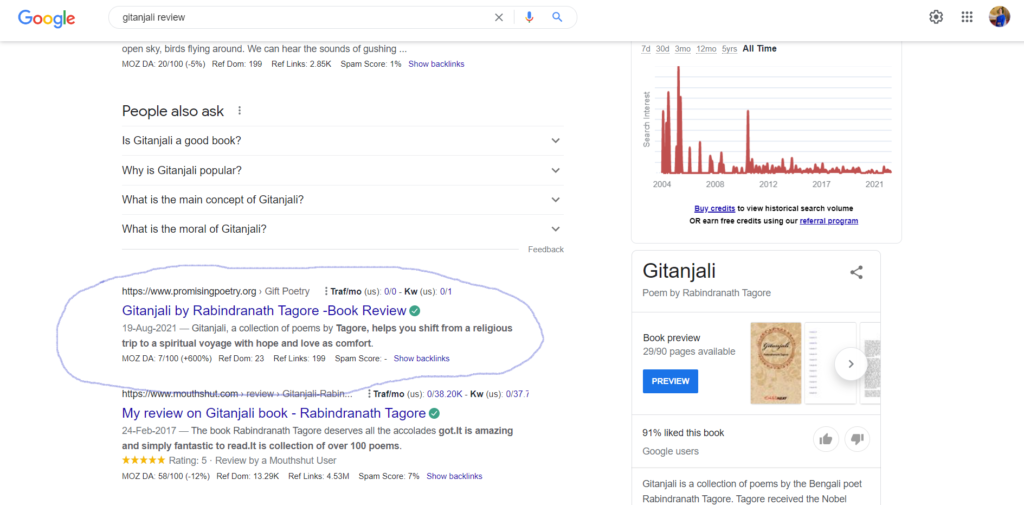
To ascertain that these tips work, let me start with sharing the proof first. Here are three screenshots where you can find,
My website ranking first for the keyword “promising poetry”.
One of my poems ranked on the first page of google images, for the keyword “lipogram poem”.
My review of the poetry book, Gitanjali is ranked on Google’s first page.
A screenshot of my website ranked first for the keyword “promising poetry”.
A screenshot of one of my poems ranked on the first page of google images, for the keyword “lipogram poem”.
Screenshot of my review of the poetry book, Gitanjali which is ranked on Google’s first page.
Now that you are convinced, let me just dive into the tips part.
5 Easy and Actionable SEO Tips for Poetry Blogs
Include intro/conclusion
Brevity is the biggest enemy of poetry which makes it not feasible to rank on the first page. A minimum of 300 words count gets traction for google ranking and the lengthier it gets (quality matters too!), the better the traction is. So, here is the tweak. Try to include an introduction and/or conclusion, before/after your poetry which can help you get the desired word count.
Choose your title wise
As poets, it can be very tempting to give unusual or abstract or mystic titles to our poetry pieces but let me warn you that it can be of no help when it comes to ranking. Say, for example, one of my poems, “Rasa” wouldn’t have ranked on google images’ first page, had I titled it just as “Rasa”. Come on, who on earth would search as “A poem on Rasa”?
So, the trick here was to title it, “Rasa- A Lipogram Poem”. Now, the keyword “lipogram poem” did the magic here and brought visibility to the piece. The key takeaway here is to have a lengthy title while describing what the poem is about or the poetry format. If you wish you can add your actual creative title of the poem as a subtitle.
Keep in mind that the user is mostly a layman, looking for poems using simple words/phrases like, ‘a poem on love’, ‘ a poem on domestic abuse‘, etc.
Wait, there is also another reason the poem, Rasa, was ranked and that’s the next tip.
Add ALT tags for the images
Well, as you could have seen in the screenshots above the poem Rasa was optimised for its image. When it comes to optimising your poetry, you got to make use of all the possible ways to do so and adding attractive images is one thing to do. But it just doesn’t stop there.
Add a description of the image used using ALT tags and also in the caption of the image. This way you are helping google find your page through the images. Sometimes while the content itself may not rank, the image may rank (as in the case of my poem, here) on the top page and bring in traction or views.
Check out this easy-peasy video to learn how to add ALT tags for images:
Include video
It’s not just about lengthening your poetry post but it’s also about keeping your audience hooked and staying on your page for a considerable amount of time. Since the brevity of poetry can’t keep anyone hooked for a long time, embedding a video can help retain the reader for some time.
So get creative and go for adding a video of the spoken word version of your poem or just add a related youtube video to the page. Make sure the content of the video aligns with your poetry and doesn’t look like a forced inclusion.
Get creative
Ok, now don’t get me wrong saying we are poets and doesn’t that mean we are already creative? Well, I agree. It’s not about getting creative about poetries that I’m talking about. I’m asking you to get creative with the format of your posts that you pen for your poetry blog.
Most times, one may think that a poetry blog is all about sharing poetries but it is not. Think about everything that has got to do with poetry and pen them. Write reviews for poetry books, do poetry analysis, get a poet interviewed and write about it, etc. This way, you are still soaking in the essence of poetry while also being able to furnish long-format content which is the key to page optimisation.
In the below post on my review of Tagore’s Gitanjali , you shall find all the above points incorporated.
My review of the poetry book, Gitanjali by Rabindranath Tagore.
Concluding Words
SEO of poetry blogs can be tricky but with little tweaks here and there, you can ace the game. If you had noticed, the underlying factor behind all the tips is to make the posts “reader friendly” by giving them an insight on how or what made you come up with a poem or adding user-friendly titles or ALT text for images or videos or bringing them into your poetry world through more related educative/entertaining information.
Hope you found this post useful. Do let me know if you want to learn more on SEO specific to poetry blogs.
This post was written for the prompt “Simple SEO tricks nobody told you”, as a part of #BlogchatterBlogHop.
Plants are generally grown in a mix of garden soil, cocopeat and compost. But for a change, I wondered, what if I could grow plants only in compost. So I went ahead putting my thought into action.
Compost is a mixture that is largely made of decaying organic matter like dried leaves and food scraps and is used as a fertiliser for plants. Mature compost is rich in readily available nutrients and is also lighter than soil.
Inspired by Vani Murthy ma’am, the composting queen, also known as the WormRani (follow her on Instagram here, for a daily dose of motivation) in the gardening circle, I took to composting 4 years back. One year later, I was so obsessed with the process of composting and compost that I wanted to try and experiment with growing plants only on compost.
In Bangalore weather and on an open terrace that gets a fairly good amount of sunlight throughout the day, growing only on compost did have a decent outcome. Mind you, I started with zero expectations and I always indulge in gardening just for the sake of it with not many expectations.
Here are some observations from growing plants only in compost
Pros of growing plants only in compost
Compost is lighter in weight compared to soil. Water drains through it easily thereby avoiding stagnation of water in potted plants. This in turn highly reduces the chances of root rots in plants.
The lighter nature of compost makes it easy to transfer or carry pots around while shifting. Trust me, it is something you may want to consider if you are someone who is into shifting houses, often.
The lighter nature of compost always makes it easy to till up while repotting or sowing or removing weeds, unlike working with soil that gets hard and crusted, making it difficult to till.
As a lot of chopped vegetable scraps goes into the compost, the nutrient availability increases in the end product, i.e, the mature compost.
Compost is something that is always in progress. It gets denser over time which means that the pot you might have filled to the brim with compost might have reduced in quantity in two weeks. This acts as an advantage as it gives more space to add more compost which in turn reduces any chances of excess wet waste from our households going to landfills.
Having compost in your pots or soil bed may surprise plants that might have grown from a seed from veg or fruit scrap that had gone into the compost bin and thrived to turn into a sapling. We had watermelons and papaya plants come that way.
As much as the lighter weight of compost is a plus, it is equally a minus. The lighter weight doesn’t help in providing firm support like soil, especially to climbers and some tender stemmed plants like tomatoes.
Compost, if added prematurely, turns acidic which may harm plant growth.
Again, adding premature compost may also end up having the growth of unwanted plants (courtesy, the seeds from veg & fruit scars gone into composting & chosen to survive) along with the ones you intentionally sowed.
Adding premature moist compost may invite grubs and affect the roots of the plants.
The easy to dig property of compost may have your furry friend dig it all away and have a good night’s sleep in the warmth of the pot (true story!).
Have a look at the garden that thrived only on homemade compost.
As much as compost is rich in nutrients and can be tempting enough to grow plants only in compost, we should know that it may not provide firm support which too is vital for healthy plant growth.
So my key takeaway from the experiment was to have a mix of garden soil and matured compost, say in the ration, 4:6 and it has been working well for me till now with decent yields without the need for any chemical fertilisers.
Happy garden, happy me!
Hope you find this helpful. Also, I am all ears to know about your gardening experiments and hacks. Indulge me!
Signing off with this interesting quote:
Kings and cabbages go back to compost, but good deeds stay green forever.
Baffled reading the heading that says, ‘Poetry makes nothing happen’? Well, you are not alone if you come across this for the first time. I was confused too when I heard it for the first time, especially from a renowned poet like Sampurna Chattarji while quoting it to explain the purpose of poetry. It may sound contradicting but in actuality it is not. To get the essence of it, read ahead.
Poetry is the spontaneous overflow of powerful feelings; it takes its origin from emotion recollected in tranquility.
~WilliamWordsworth
Celebrating World Poetry Day on the 21st of March, 2022 with a conversation with the poet and translator, Sampurna Chattarji, as part of the #BlogchatterWritFest2022, turned out to be a blissful and resourceful session. The one-hour session flew in a jiffy only to make us, the poetry enthusiasts, more thirsty for the poetry conversation.
What is the purpose of poetry? Does poetry essentially mean a spontaneous overflow of emotions or does it include crafting too? What are some essential basics for becoming a better poet? Can multiple formats of poetry be included in a single poetry book? Do we follow trends when it comes to writing poetry? How much can a poet experiment with the format of poetry? If these are some questions in your mind, read along to get resourceful insights gained from a conversation with the amazing poet, translator and editor Sampurna Chattarji.
Here is a quick recap of the session with key takeaways from it. The session saw Sampurna Chattarji take up participants’ questions and answer them with insights from her personal experience as a poet, translator and editor.
Purpose of Poetry
The conversation had an interesting start with the poet answering the question what is the purpose of poetry. Chattarji indulged us in a poetic conversation by saying that it’s a perennial question and quoting, “Poetry makes nothing happen”, from the famed poem ‘In Memory of W.B.Yeats’ by W.H.Auden
Chattarji went ahead to explain beautifully on how poetry survives, transcending time and in essence becoming a way of happening. She said that words are a way of happening; dynamic and not static. The happening though can either be slow and meditative or choose to explode. Ultimately, poetry is in the now.
With reference to the poem, Sampurna Chattarji highlighted that
it’s a poet’s responsibilityto be the mouth of truth but not a mouthpiece.
Poetry as a spontaneous overflow of emotions versus poetry as a craft
When asked if poetry is just about the spontaneous overflow of emotions or does it need to be crafted, pat came the reply from the poet insisting that only an overflow of emotions may just be a hot mess on paper and that there is a need for formatting and crafting.
Chattarji emphasized that both the emotions as well as the crafting be given equal importance to get captivating poetry. She went on to share the following tips generously:
Basics that a poet needs to follow to get better at the art of poetry
Know the nuts and bolts of the language: the grammar, spellings, punctuation, etc.
Have a deep love for the language and the craft. Devour others’ works before starting with yours.
Write to rewrite. Don’t be satisfied with the first draft. Develop the ability to take criticisms and work on bettering the craft.
Equip yourself to become your own editor. This comes with years of experience though.
Have patience and persistence.
PRO TIP: As suggested by Sampurna Chattarji, check out and learn about different poetry formats by searching through the glossary here.
Multiple formats of poetry in one book
On the question, of multiple formats of poetry can be included in a single book, Sampurna Chattarji explained that it can be done with careful consideration. She added that the poet must be aware of the inner logic and flow behind the intertwining of multiple formats. Chattarji went on to explain how in her book“Space Gulliver” multiple forms of poetry imbibed in one book and it was absolutely helpful.
On that note, she mentioned that her favourite poetry forms are prose poetry—for its tensile & dynamic nature—and also non-sequential, non-narrative forms of poetry.
At this point, a special mention of Inger Christensen’s book Alphabet got me even more excited as it is based on the Fibonacci Sequence. At that moment, the Mathematician & the poet in me was like- ‘Aaaaah…I can just go on & on with this conversation!’. Sampurna Chattarji also mentioned writing a poem based on the prime number 37, also a star number, and her reasons and thoughts behind it. It only got interesting and I was just wishing that the conversation doesn’t end.
On a side note, one of my recently published poetry in “The Great Indian Anthology” by the Half Baked Beans has that Mathematical touch to it, titled “Number & numeral are not the same”. (winks!!)
Experimenting with “trends” in poetry: Yay or nay?
With the constraint of time, the poet moved on to answer the next question if it was wise to go with “trends” for beginner poets. Chattarji mentioned that one should be wise enough to know that what can be trending can end up forgotten too. So, it’s better to plunge into the deep end, hone your craft first and experiment with language and forms first-hand. Clearly, her emphasis was on getting better at the craft instead of just going by the trends.
On poetry translation
Here are a few important tips that Chattarji shared when asked for advice regarding poetry translations, especially when there is a cultural difference in the languages involved:
Firstly, it is highly important to understand both languages inside out.
For words that are hard to translate, she urged the poets to be inventive. She added that of all the translators, poetry translators are the best.
When it comes to untranslatable nuances, she suggested that one gets into the skin of the other poet, strike a conversation, gets to know the back story of the poem and then come up with a translation.
In case of uncertainty when it comes to translating a poem of a dead poet, she insisted that we go with our instincts, follow our heart and trust it.
Make research and dictionary your friends.
Most importantly, she emphasized that we have the courage to walk away from translating a poem. She said not to destroy a poem by bad translation and it’s better to leave it alone.
Create strategies, try hard and find solutions, like adding footnotes for cultural references or vernacular words.
Finally yet primarily, care enough for the poem as if it is your own and do justice to it.
On pitching poetry for magazines
As Sampurna Chattarji is also a Poetry Editor, it was more than apt to know what she looks for in a poetry submission as an editor. To start with, she made a note that one should not consider submission as “pitching” as the word pitching gives a sense of selling. She said the better word would be poetry submission and mentioned that primarily she looks for a certain amount of craft in the poetry.
She added that she looks for a voice — honest, new and startling — and a willingness to work with the editor in partnership.
As a pro tip, Sampurna Chattarji suggested not to overdo the cover letter or bio and rather work harder on the poem instead. Finally, she said to keep the poem true, simple and distinct.
Towards the close of the session, when asked for poetry reading suggestions, especially for kids and beginners, Chattarji left us with the following reading list:
Coney Island of the Mind: Lawrence Ferlinghetti
Old Possum’s Book of Practical Cats: T.S. Eliot
Beastly Tales from Here and There: Vikram Seth
Revolting Rhymes: Roald Dahl
The Fried Frog and Other Funny Freaky Foodie Feisty Poems: Sampurna Chattarji
Learn from the Almond Leaf: Eunice de Souza
The Penguin Book of Indian Poets edited by Jeet Thayil (for a wide variety of themes, styles, generations: out in April)
Indian Love Poems selected and edited by Meena Alexander (Everyman Pocket Poets)
Wordygurdyboom! The Nonsense World of Sukumar Ray translated by Sampurna Chattarji (Puffin Classics)
On a final note, Sampurna Chattarji mentioned looking up for first books of those you consider established poets now and reading more anthologies.
The session then ended with a reading of her poem “Evil Eye” in her magical voice.
Overall, it was an exciting and engaging session that I just keep ruminating upon and this blog post is one way to do so. Hope you find this useful.
I just can’t thank enough the Blogchatter Team for making such conversations with poets/authors possible through the BlogchatterWritFest. As my fellow blogger Harshita would put it here, the BlogchatterWritFest is a different level of crazy!
Apart from providing us with this wonderful session where 3 to 4 of my questions got answered, Blogchatter did go one step ahead to choose me as one of the winners of a book giveaway. I am definitely on a poetic high and I’m sure you would have definitely got to know it by now.
Happy Me!
I leave you on that note and see you soon with Intuitive Poetries in the month of April (just a few more days to go!). Stay tuned.
From a recent survey by The Economic Times, it’s clear that digitalization & EcommerceInnovation has helped MSMEs sustain their business even through the pandemic. Having a digital presence for your products or service can help you scale your business in many ways.
If you are just planning to start your enterprise or already have one and want to take it online and don’t know how and where to start, then fret not. Here are a few tips and resources that can help you take those essential steps towards taking and scaling your business digitally.
1. Decide on domain name & keep logo ready
The website name for your product/service is going to be of primal importance as it is something that your customer will at once identify your product with. So it’s only wise enough to give it a thought and come up with a sensible, simple, catchy and preferably short name for your website that’s easy to remember.
Logo goes a long way in branding your product. Keep it simple and relatable to your product or domain name.
Pro Tip: You can create a logo all by yourself using the Canva app’s free version.
2. Get your business registered with Udyog Aadhar
Similar to the Aadhaar- a unique identification number for citizens of India, Udyog Aadhaar is a unique 12-digit Government identification number for your business enterprise. It is provided by the Government and highly beneficial especially for sole proprietors who don’t have official recognition for their business.
To get a quick idea on how to register and the benefits of getting your business registered, read this.
3. One-page website
It’s always wise to start small and then scale up a business. Likewise, how much ever tempting it might be to invest in a fancy and shiny website, it’s highly recommended to go with a simple one-page website.
What matters is that you get your own domain name and hosting. If this sounds Greek & Latin to you, here’s a detailed article that can hand hold you to create your ready-to-go, one-page website.
Now that you have registered your business, have an online face to it and you want to monetize it. This is where the need for a payment gateway comes in.
A payment gateway is nothing but an eCommerce application service provider service that makes money transactions between you and your customer feasible. Some of the common service providers that you might have come across are PayTM, RazorPay, Instamojo, etc.
To know what are the top 10 payment gateway in India and choose the right one for your business, check here.
You may like the below video on how an ECommerceInnovation has improved the Indian Economy!
5. Google business
To have more reach in your local area, go get yourself a Google business account. It’s free and it’s an easier way to put a word out and find some local customers. Just do this:
Step 1– Create a Google account. Pro Tip: Have a dedicated email id for your business.
Step 3– Tell google what areas you serve and your business hours.
Step 4– Choose a business category.
Step 5- Add contact details.
Step 6– Finish & verify your business. You will be sent a code to your address of correspondence in a week & once you enter it your account will be activated.
There you go!
6. WhatsApp business account
WhatsApp Business Account is the biggest boon for MSMEs for the way it adds professional as well as a personalized touch to the business. Its ease in accessibility and ability to connect with customers directly makes it a must for boosting business. Marketing and reaching out to a bulk of the targeted audiences is the biggest plus. All you need to get a separate phone number for your business account. No big deal right?!
Anyone and everyone are on at least one of the social media platforms. Given the wider reach of social media, you can take advantage of the free platform and connect with your customers there. Social media platforms are the best bets for your product/service launches and marketing.
Pro Tip: The analytics for each platform works differently. So, start with one social media platform at a time, grow your audience there over 3 months and then move on to the next platform.
8. Sustainability factor
The best part of having a small scale business is you have control over it totally and make wise decisions every step of it, choosing sustainable solutions. For example, I have seen small businesses like PracheenVidhaan and Kalpavriksha Farms choose sustainable packaging and also support local artisans. As a small business owner, you will definitely have the hold on making conscious choices towards sustainability.
In conclusion, this is the best time to take your next big step towards making your dream business come true with the government schemes and technology all in your favor.
Wishing you the best in all your endeavors. Let growth & success prevail!
This post is written as part of Blogchatter’s campaign #ECommerceInnovation. Read more posts in the campaign here.
We use cookies on our website to give you the most relevant experience by remembering your preferences and repeat visits. By clicking “Accept All”, you consent to the use of ALL the cookies. However, you may visit "Cookie Settings" to provide a controlled consent.
This website uses cookies to improve your experience while you navigate through the website. Out of these, the cookies that are categorized as necessary are stored on your browser as they are essential for the working of basic functionalities of the website. We also use third-party cookies that help us analyze and understand how you use this website. These cookies will be stored in your browser only with your consent. You also have the option to opt-out of these cookies. But opting out of some of these cookies may affect your browsing experience.
Necessary cookies are absolutely essential for the website to function properly. These cookies ensure basic functionalities and security features of the website, anonymously.
Cookie
Duration
Description
cookielawinfo-checkbox-analytics
11 months
This cookie is set by GDPR Cookie Consent plugin. The cookie is used to store the user consent for the cookies in the category "Analytics".
cookielawinfo-checkbox-functional
11 months
The cookie is set by GDPR cookie consent to record the user consent for the cookies in the category "Functional".
cookielawinfo-checkbox-necessary
11 months
This cookie is set by GDPR Cookie Consent plugin. The cookies is used to store the user consent for the cookies in the category "Necessary".
cookielawinfo-checkbox-others
11 months
This cookie is set by GDPR Cookie Consent plugin. The cookie is used to store the user consent for the cookies in the category "Other.
cookielawinfo-checkbox-performance
11 months
This cookie is set by GDPR Cookie Consent plugin. The cookie is used to store the user consent for the cookies in the category "Performance".
viewed_cookie_policy
11 months
The cookie is set by the GDPR Cookie Consent plugin and is used to store whether or not user has consented to the use of cookies. It does not store any personal data.
Functional cookies help to perform certain functionalities like sharing the content of the website on social media platforms, collect feedbacks, and other third-party features.
Performance cookies are used to understand and analyze the key performance indexes of the website which helps in delivering a better user experience for the visitors.
Analytical cookies are used to understand how visitors interact with the website. These cookies help provide information on metrics the number of visitors, bounce rate, traffic source, etc.
Advertisement cookies are used to provide visitors with relevant ads and marketing campaigns. These cookies track visitors across websites and collect information to provide customized ads.