I must begin by saying this is one of the first books I ever pre-ordered (essentially placing my trust in a book even before it reached the public). I did so because I have been following the author Sonia Dogra’s work (check out her blog here) for the past few years, and her words have consistently encouraged readers to pause, reflect, and feel deeply. I admire her observant writing and the way she speaks from a place of empathy and honesty. Now, on that note, let’s step into the review.
How often do we, as adults, tell children, “It’s okay… it’s a silly thing, just move on”? Many of us probably have. This book gently challenges that instinct and invites us to reconsider how we view children’s struggles.
What may seem trivial through an adult lens can feel immense and overwhelming to a child. The story encourages us to revisit our own childhood memories and recognise how significant those moments once felt and how deeply we longed for reassurance, empathy, and validation. In many ways, this book offers exactly that.
The story follows seven-year-old Kuhu as she navigates a rollercoaster of emotions and experiences. Whether it is preparing for a school interview, dealing with bullying because of her pahadi accent, or processing the complex feelings that arise when a new sibling arrives, each situation is portrayed with innocence, honesty, and compassion.
The book gives due importance to children’s emotions, feelings and problems that may appear small to adults but are deeply real and valid for young minds. Sonia Dogra steps convincingly into a child’s perspective, allowing their voice to come through clearly and authentically. The narrative also addresses bullying in a sensitive yet empowering way, teaching children to stand up for themselves with courage.
One of the most touching aspects is the portrayal of Kuhu becoming a big sister; her emotional journey is realistic, precise, and deeply endearing.
Snippets from the Book:
“Ma and Papa had always told her not to talk to strangers. Now, they are ready to bend their own rules, telling her to go talk to strangers and even answer their questions! Grrrr…” This moment beautifully captures a child’s thought process and highlights the sometimes confusing diplomacy of adults.
“Ma had only laughed in response; the way elders do when they don’t want to answer.” A simple yet powerful truth from a child’s perspective, one that resonates deeply with the adult reader.
Overall, the book allows us to see the world through a child’s eyes—honest, curious, and emotionally rich.
My Teen’s Perspective:
My teen found the book highly relatable and endearing, especially the parts where Kuhu navigates the big emotions that come with the arrival of a sibling. She read it in one sitting, smiling through the book and even long after she had finished it.
More importantly, it opened up a meaningful conversation between us about experiencing and expressing big emotions. To me, that feels like the true win of this book. She felt seen and understood, as the story acknowledges feelings that are often dismissed as trivial. It reinforces that children’s struggles are real, significant, and deserving of empathy, attention, and validation.
She also adds that the font size is comfortable on the eyes, and the language is simple yet engaging, making it an excellent choice for children transitioning from picture books to chapter books. The black and white sketches by Anisha Kotibhaskar are lively and add warmth to the narrative.
Parting words:
This book is an excellent companion for children as they learn to navigate life with empathy and resilience, while also offering adults valuable insight into a child’s inner world. It is a story that deserves far more love and attention, and I look forward to seeing where Kuhu’s journey leads next.
Quick Update: This blog post was recognised as the top blogroll for the week by the Blogchatter Team. Yay!
Authors: Rehana Sultana, Anuradha Shetty, Roma Gupta Sinha, Kajal Kapur, Deepti Menon, Chinmayee Sahu, Huma Masood, Nirmiti Narain, Tarang Sinha, Anushree Saha, Dr Alpana Das Sharma, Rahul Vishnoi, Harshita Nanda, Roshan Radhakrishnan, Suchita Agarwal
Publisher: Readomania
Type: Paperback
Page Count: 111
Blurb
What goes on in the minds of people on the threshold of doing something drastic? A woman convinced there’s a presence at her window that only she can see; a collector who has an unusual interest in fingerprints of her victims; an unsettled man blaming everything on his wife; a low-caste child trying to make sense of India’s freedom; a haunted guest house room and the ghost that goes away; a reclusive and aggressive teenager who loves lizards—the stories explore times long ago, realms we never knew existed, the deep recesses of the human mind, and fears that become aggressions.
The Blogchatter Book of Thrillers features 15 thrilling stories from Blogchatter’s community writers—these tales will chill, scare and stay in your head and heart. Featured Authors: Rehana Sultana, Anuradha Shetty, Roma Gupta Sinha, Kajal Kapur, Deepti Menon, Chinmayee Sahu, Huma Masood, Nirmiti Narain, Tarang Sinha, Anushree Saha, Dr Alpna Das Sharma, Rahul Vishnoi, Harshita Nanda, Roshan Radhakrishnan, Suchita Agarwal.
Book Review
I’ve had limited exposure to thrillers, mostly centring on either ghostly tales or crime mysteries. Therefore, when I began this book, I anticipated a similar theme. However, I was astounded by the diverse range it presented. Each story was distinctly unique, revealing that thrillers are capable of eliciting a myriad of nuanced emotions: fear, disgust, longing, guilt, anxiety, dread, paranoia, revenge, tension, and more. It’s this rich blend of emotions that contributes to the success of this anthology, complemented by the array of writing styles found within its pages.
Although the stories vary significantly in their settings, a recurrent thread of social injustices and biases emerges in most of them. This common theme elevates the thrillers, leaving readers with thought-provoking elements to contemplate.
The writing style is concise and fast-paced, rendering it an excellent choice for a quick read. However, due to the story’s brevity, some narratives could benefit from additional background stories or more detailed character sketches. Nevertheless, this limitation can also be viewed as a positive, sparking curiosity and encouraging readers to immerse themselves in their own imaginings, pondering the potential backstories of the characters.
Well, that said, here are brief reflections on each story and the emotions they stirred within me:
“Against My Windowpane” by Rehana Sultana delves into the profound impact on a doctor who grapples with psychological distress after losing a patient due to placental abruption. This narrative prompted contemplation about the often-overlooked mental trauma that physicians might endure while handling various patient diagnoses regularly.
“The Last Rasam” by Anuradha Shetty, set in pre-independent India, starkly exposes the horrors of the caste system and patriarchal oppression. The narrative reveals a mother’s harrowing decision to poison her daughter’s food to liberate her from societal evils. However, the chilling lines at the end, “You are all crazy. The truth is that there is no freedom, Raghu. There is No Freedom,” leaves an indelible, haunting impression, raising profound questions about true liberation.
Enshrouded in mystery,Roma Gupta Sinha’s “The Secrets Of Nandini Rutuja” delves into the life of a once bubbly teenage girl who turned recluse and hasn’t ventured beyond her room for the past two and a half years. This captivating tale explores the intricate bond between the girl and her caretaker, culminating in an unforeseen twist that will leave you shocked.
In Kajal Kapur’s “Memory’s Missing Piece,” we discover the harrowing ordeal of a young reporter who faces an attack while covering the clashes outside Jamia Milia Islamia in Delhi. What intensifies the horror is the enigmatic circumstances surrounding her pregnancy during her hospital treatment. What struck me most about this story was its conclusion—a subtle infusion of love and hope emerging amidst life’s relentless cruelty.
“What Tomorrow Holds” by Deepti Menon narrates the story of a foster child seeking revenge, finding solace in the love offered by an outsider, all while enduring mistreatment from her own family. What struck me about the story was its writing, particularly the concluding line that lingers hauntingly in one’s mind.
Chinmayee Sahu’s “The Encounter” cleverly disguises itself as a typical encounter episode, only to surprise and shock readers with its unpredictable twists. It compels you to eagerly turn back the pages for a re-read, showcasing the depth of its crafty storytelling.
“Fragments Of Yesterday” by Huma Masood follows the journey of a young woman who survives a fatal accident and endeavors to reclaim her lost memories. While the uncertainty about her past pains her, the eventual moment of realization goes beyond mere discomfort—it horrifies her.
“The Fields” by Nirmiti Narain stands out as one of my personal favorites, primarily due to its exceptional writing style. The vivid portrayal of the setting deeply immersed me in the narrative. The unexpected love story between an unconventional pair both surprised and horrified me simultaneously. The unique blend of poetic descriptions within a suspenseful horror story makes it a compelling read, compelling me to revisit this tale multiple times.
“One Night” by Tarang Sinha tugs at your heartstrings, evoking a sense of helplessness as you realize the narrator is a young, distressed girl on the brink of suicide. An unexpected intervention by a paranormal entity leaves you on edge, instilling hope. Just as a sense of positivity starts to emerge, the story concludes with a haunting revelation. This is the kind of narrative that lingers, sure to haunt your thoughts.
“The Dactyist” by Anushree Saha is undeniably the most disturbing and haunting story within this Anthology. The revelation of a psychopath among us, collecting people’s fingerprints as a macabre hobby to such extreme lengths is both unimaginable and chilling. I believe this story would have been best placed as the final entry in the Anthology. The concluding lines are so utterly terrifying that they are bound to send shivers down your spine and haunt your dreams. What better way to conclude a thriller than with such an unnerving narrative?
Dr. Alpana Das Sharma’s “Black”, true to its title, exposes the darkness of the evils faced by women in our society. However, the thrilling aspect of this story lies in how the protagonist discovers a glimmer of light within this darkness and harnesses it to liberate herself.
“A Husband’s Guide To Set A Wife Right” by Rahul Vishnoi depicts the story of an abusive husband who consistently manipulates and controls his wife. However, in a twist of karma, his actions lead to his own reckoning. This narrative is certain to evoke feelings of anger and disgust, as it uncomfortably reflects the unfortunate reality of the society in which we live.
Harshita Nanda’s “The Silver Anklet” transports readers to a world where mystery and mystical elements entwine along the banks of the Ganges. The story delves into the depth of a mother’s determination to protect her daughter. Beginning in a haunted guest room, the chilling narrative unravels a tale of revenge and betrayal as a ghost’s presence sets the stage for an intense thriller.
“What Runs In Our Blood” by Roshan Radhakrishnan is situated in the pre-Independence era, vividly portraying the horrors of the caste system. While this system’s evils persist even today, the story’s theme of seeking revenge to avenge the victims resonates deeply. It elicited a genuine emotional response, evoking a desire for justice, albeit within a hauntingly gory narrative.
Suchita Agarwal’s “Hartoli’s Duty” is situated in a supernatural and spiritual realm, depicting the story of a guardian whose sole responsibility is to transport dead people from one shore to the next. Beyond the captivating nature of this duty, the guardian’s interactions with the departed are poised to prompt introspection into his own actions. What could be more unsettling than a tale that holds a mirror to one’s deeds, compelling to examine one’s behaviours and choices?
From the haunting horrors of the supernatural to the stark realities of societal injustices, these tales grip the reader, eliciting a spectrum of emotions – from fear and disgust to hope and introspection. The adept storytelling and varied writing styles showcase the depth and versatility of the contributing authors. As the anthology concludes, it leaves an indelible mark, inviting readers to reflect not only on the intricacies of each story but also on the broader human experiences they encapsulate.
But, above all, what renders it particularly special for me is that I possess a book that is the collective result of a community of bloggers. The Blogchatter community has engaged in the mutual exploration of each other’s works, offering both critique and applause, fostering a space where growth is nurtured. It represents a triumph for the community, and I am delighted to be a part of it.
Blogchatter, you consistently astound me with your words and actions, and this specific line from the introduction overwhelmed me this time: “This book isn’t just about the 15 authors who have contributed their stories but also the rest of the community who are the wind beneath their wings.” So, yes, onwards and upwards for more such anthologies!
I am an Indian homemaker, mother, and writer armed with a pen, a flair for poetry, and a passion for peace. My works have been published on platforms such as Inkspire, Women’s Web, BeStorified, Gentleness Ambassadors and the Great Indian Anthology.
Title: Whispered Melodies: A Journey Through Verses
Author & Illustrator: Neerja Bhatnagar
Publisher: Self-published
Genre: Poetry
Type: Kindle
Price: ₹99
Blurb
“Whispers Melodies – A Journey through Verses” is a collection of English poems written by Neerja Bhatnagar. With profound insight and heartfelt expressions, Neerja takes readers on a poetic journey that explores the interconnectedness of nature, emotions, and the human soul.
The book immerses readers in the enchanting beauty of the natural world, where Neerja skillfully weaves words to paint vivid imagery. Neerja’s poems beautifully evoke the vast array of emotions nature can evoke within us. Beyond the realm of nature, the poet delves deep into the intricacies of human emotions, exploring the tapestry of joy, sorrow, love, and longing. With exquisite sensitivity, Neerja’s verses evoke empathy and resonance, offering solace and understanding to readers who have experienced similar emotional landscapes. Her poems serve as a bridge between hearts, reminding us that we are not alone in our experiences and that our emotions connect us to one another in profound ways.
As the collection unfolds, she delves into the depths of the human soul, delving into questions of identity, purpose, and spirituality. Through introspective verses, she invites readers to contemplate the mysteries of life and the profound connection between the outer world and our inner selves. Her poems inspire readers to embark on a journey of self-discovery, urging them to listen to the whispers of their own souls and find solace and meaning in the harmony of existence.
“Whispered Melodies – A Journey through Verses” is a poetic tapestry that celebrates the beauty and complexity of the natural world, unravels the intricacies of human emotions, and encourages readers to embark on a soul-stirring exploration. Neerja Bhatnagar’s eloquent verses serve as an invitation to pause, reflect, and reconnect with the enchanting essence of nature, emotions, and the eternal soul. This is Neerja’s first book of verses.
Book Review
“Whispered Melodies: A Journey Through Verses” by Neerja Bhatnagar is a collection of poems that draw inspiration from everyday life. These poems explore universal emotions and perspectives we encounter in our daily lives, and the poet skillfully captures these moments with beautiful rhyme and rhythm. In a literary era dominated by contemporary free verse, Bhatnagar’s work stands out as a refreshing departure with its emphasis on rhyme and rhythm.
Beginning with a poetic dedication to all lovers of verse, this collection embarks on a captivating journey through the world of poetry. Comprising over 50 introspective poems, these verses delve into the realms of nature, our deepest emotions, and the enigmatic bond we share with the cosmos. Each poem invites readers to pause, savour life’s moments, and contemplate the intricacies of our existence, fostering a deeper appreciation for both the ordinary and extraordinary facets of our journey.
I particularly liked the poems titled “Starry Nights” with one from a child’s perspective and the other from that of an adolescent. It’s intriguing to witness how our perspectives evolve from childhood to adulthood. While childhood is filled with wonder, adulthood often brings a sense of longing, and Bhatnagar skillfully portrays this contrast within the same starry nights.
In some of the poems like the one titled “Emotional Breakdown” with the following verses in between, the author packs in surprise elements.
The pain is all-consuming,
It's like a raging fire,
Burning deep within me,
And I can't help but admire.

~An excerpt from the poem "Emotional Breakdown"
Amidst descriptions of overwhelming pain akin to a raging fire, the last line of the stanza comes as a surprise element that hints at an appreciation for the resilience found within vulnerability, adding depth to the emotional narrative. There are many such places that would make one pause and reflect and more so, relate to what the poet says.
However, there are a few areas that could benefit from improvement. The formatting of the poems, while not detrimental to the essence of the work, could have been more reader-friendly, especially for screen readers. Another aspect that could be addressed is the repetition of certain phrases throughout the collection. Some of these repetitions may have been reworked to avoid redundancy and enhance the overall impact of the poems. A more thorough editing process would have resolved this issue.
Additionally, the last stanzas of the poems felt a bit forced and heavy-handed in delivering a moral message, more like prose. While it’s important to convey meaning in poetry, not every poem needs a clear moral. Leaving some poems open-ended can engage the reader’s imagination and sense of wonder.
But that said there are definitely pages and verses that are to stay with me forever. Here are a few from the collection:
The stars twinkle and shine so bright,
A galaxy of diamonds in flight.
Each one a world so far away,
Yet close enough for us to play

~An excerpt from the poem "Starry Night(as seen by a kid)
The night sky, a place to dream,
A space that's not quite what it seems.
It brings a sense of awe and grace,
And sets the mind and heart to race.

~An excerpt from the poem "Starry Night(as seen by an adolescent)
Self-love is a precious gew,
A treasure that we must all find within.
It's a journey of discovery,
To embrace our flaws and feel free.

~An excerpt from the poem "Self Love"


Reflection is a mirror that we hold,
A chance to see ourselves so bold,
And in the light of our own gaze,
We find the strength to change our ways.

~An excerpt from the poem "Reflection"
Wrap up words
In conclusion, “Whispered Melodies: A Journey Through Verses” offers a fresh perspective on elements of nature, human emotions and the mystic bond between us and the cosmos through its verses of rhyme and rhythm. As such, I recommend this collection to younger readers, such as middle graders and college students (thanks to the clean language in the poems) and also those who are just starting to explore poetry and appreciate true rhyme. As for seasoned poetry readers, accustomed to contemporary poetry that delves into free verse, this rhyming style might come as a refreshing change. If you are someone who is into reflective poetry and appreciates the beauty of rhyme, then this book is for you.
The exciting Kolam Kondattam Kontest is right around the corner. And Bharathi can’t wait to participate and show off, er, showcase his creative skills. Encouraged by his friends, Tabassum and Alagu, he registers for the contest (with a ‘k’).
Alas, the Residents’ Welfare Association, led by the fearsome Mrs Subramaniam, won’t hear of it. The contest is open only to the residents of Pravin’s Paradiso Apartments. And while Bharathi hangs out at the apartments all the time, he’s not exactly-technically-actually a resident.
Now it’s up to Bharathi to hatch an ingenious plan. Will he be able to get around the rules, get past the building bullies and get a shot at his dream?
Book Review
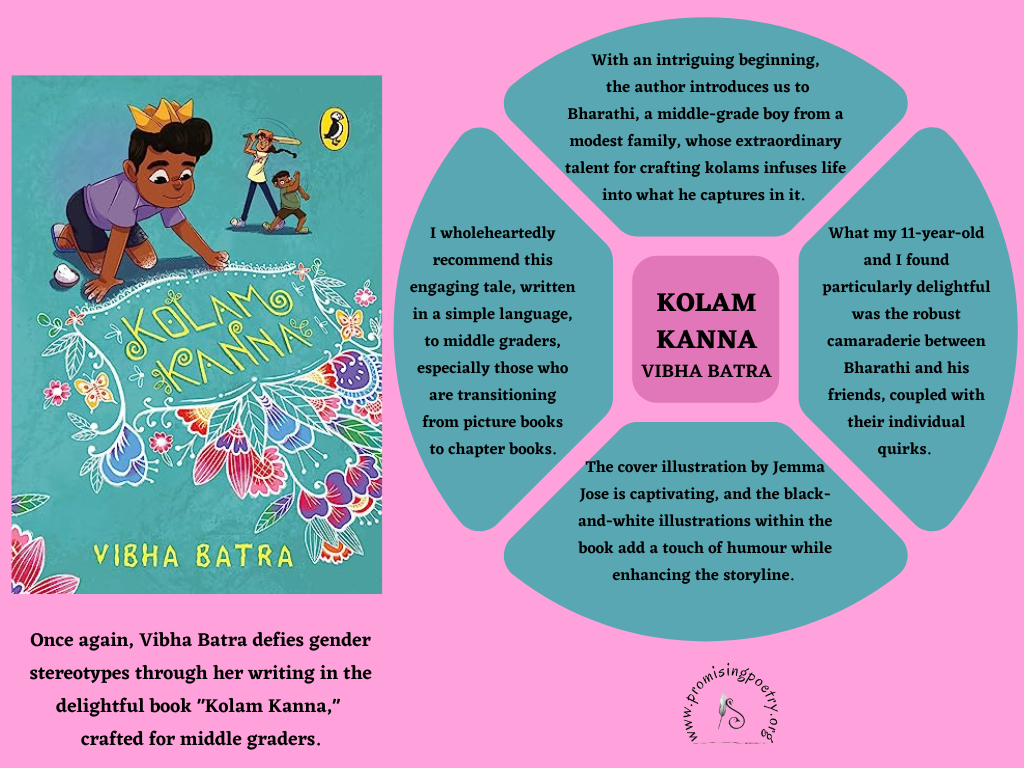
Once again, Vibha Batra defies gender stereotypes through her writing in the delightful book “Kolam Kanna,” crafted for middle graders. With her signature style, she presents a fun-filled and effortlessly readable narrative that challenges conventions.
The story begins by immediately seizing your attention with a thought-provoking question: “How do you catch a tiger?” What ensues is an even more captivating and mysterious response. With this intriguing beginning, the author introduces us to Bharathi, a middle-grade boy from a modest family, whose extraordinary talent for crafting kolams infuses life into what he captures in it. While Tabassum and Alagu, his close friends, readily recognize and support his exceptional talent for creating kolams, much like his mother does, many others in his vicinity find it peculiar and cling to their stereotypical biases.
Furthermore, as excitement builds for the Kolam Contest announced within Pravin’s Paradiso Apartments, where Bharathi’s mother is employed and his friends Tabassum and Alagu reside, Bharathi is brimming with hope and dreams. However, his enthusiasm is short-lived as he discovers that the competition is exclusively for the apartment’s residents. The rest of the story unfolds to answer whether Bharathi can overcome this obstacle and fulfil his dream by participating in the contest.
What my 11-year-old and I found particularly delightful was the robust camaraderie between Bharathi and his friends, coupled with their individual quirks. Their humorous pranks added an extra layer of amusement, enhanced by the author’s engaging writing style.
My daughter thoroughly enjoyed the tiny kolams adorning each chapter title and eagerly engaged in trying to replicate them. Additionally, she found great delight in the incorporation of Tamil words and phrases within the story.
Wrap up words
The cover illustration by Jemma Jose is captivating, and the black-and-white illustrations within the book add a touch of humour while enhancing the storyline. I wholeheartedly recommend this engaging tale, written in simple language, to middle graders, especially those who are transitioning from picture books to chapter books.
Buy here
Recommended Read (Another book written by the same author)
Let’s dive into some of my most personal bookish confessions. These revelations will give you a sneak peek into my one-of-a-kind connection with the world of books. So, grab a comfy seat, and let’s explore the quirks and peculiarities that make my reading journey a bit different. While I may not have followed the crowd when it came to classic novels or popular series, my unique experiences and idiosyncrasies in the world of literature have shaped my own delightful adventure.
Skipping the Classics
I must admit that I have never read the famous fiction books that many of my peers grew up with, such as The Famous Five, Nancy Drew, or The Secret Seven. My literary journey took a different path, and I’ve never quite stepped into their well-trodden pages.
Not a Potterhead (yet!)
I am not a Potterhead either. While the world was enchanted by the magical adventures of Harry Potter, I found myself drawn to different stories and worlds. Sometimes, being outside the mainstream can feel like a world of its own.
The Picture Book Predicament
On occasions, I’ve found myself purchasing picture books not for my daughter or as gifts for children but for my own personal enjoyment. There’s something enchanting about the illustrations and simplicity of these books that speaks to my inner child.
The Wordy Poetry Hack
When I encounter writer’s block while crafting personalized poetry gifts for clients, I turn to a peculiar trick. I select a book from my shelf, open it randomly, and choose a word from the first line. This word becomes the catalyst for my creative process. Sometimes it leads to poetry; sometimes it doesn’t. Regardless, it helps me overcome the block.
The Mix-and-Match Reader
Unlike many readers who prefer to immerse themselves in one book at a time, I find myself constantly switching between different genres and stories. It’s as if I can’t resist the allure of multiple literary worlds simultaneously.
A part of our collection!
The Eclectic Taste
While my daughter’s book collection is often in high demand among her friends, mine doesn’t enjoy the same popularity. It appears my taste in literature, which encompasses non-fiction, poetry, spirituality, and even mathematics (an unusual combination, I admit), is somewhat unique.
Emotional Resonance Over Names
More often than not, I find myself forgetting the names of characters or places in the plot. However, what I remember with remarkable clarity is how the book evoked specific emotions during my reading journey and the circumstances surrounding my immersion in its pages.
The Mysterious Connection
To add a final layer of intrigue, my bookshelf harbours books I haven’t completed and others I haven’t even started. Yet, books have a way of communicating with readers in mysterious ways. Some books remain dormant on my shelf for years, only to be rediscovered when the timing is just right, making them feel entirely new and inviting me to finish what I once started.
So, there it is- my bookish confessions. In sharing these personal revelations, I hope to show that there is no one-size-fits-all approach to reading. We all have our idiosyncrasies when it comes to books, and that’s what makes the world of literature so rich and diverse. Embrace your unique reading style, and you may find that books have their own way of speaking to you, too.
What are the Yoga Sutras? Instructions for bearded rishis who lived in the forests of ancient India? Or the complete manual of asanas?
Neither! In fact, the text may well have been called ‘Maharishi P’s Ultimate Handbook of Mind Control’, for it is really a set of techniques to help us – all of us – awaken and harness the explosive power of our minds, through our actions, our attitudes and our awareness.
And not our asanas? Those too, but not in the way you imagined it.
In this surprising, sparkling book, Roopa Pai unravels the secrets of Patanjali’s compact 2,000-year-old text in ways both fun and accessible. Walk down the well-marked paths into a dazzling world where a whole new version of yourself – self-assured, fearless and free – awaits you. Go on, then – what are you waiting for?
Book Review
Whether you’ve encountered Maharishi Patanjali’s Yoga Sutras before or not, the word “Yoga” is likely familiar to most. Just the mention of Yoga conjures images of twisted postures and serene faces in meditation. But here’s the catch: Yoga is far more than just practising physical asanas (postures). It embodies the union of individual consciousness with the Universal Consciousness, representing a profound harmony between the mind and body, as well as between humanity and nature.
The “Yoga Sutras” by Maharishi Patanjali serve as a valuable handbook to master your mind, containing 195 sutras thoughtfully organized into four chapters: samAdhipAda, sAdhanapAda, vibhUtipAda, and kaivalyapAda. These sutras are a pathway to quieting the mind, and spiritual growth enabling one to perceive reality as it truly is, rather than how it appears on the surface.
With that concise introduction to Patanjali’s Yoga Sutras, let’s delve into the review of “The Yoga Sutras for Children” by Roopa Pai.
The initial question that arises is why present such a highly philosophical text to children, especially when even adults sometimes struggle to grasp and apply its teachings. But trust me, it’s the younger generation, the kids, who face peer pressure, stress, decision fatigue, and other challenges (a few words we didn’t even know existed) that need this book the most. Why? Because their minds are inundated with numerous thoughts and emotions, and the concept of simply being at peace without any productivity seems foreign to them.
To begin, the author Roopa Pai has done an exceptional job of contextualizing the teachings of Maharishi Patanjali’s Yoga Sutras and captivating readers with a compelling elevator pitch that draws them in and keeps them engaged. Through her skilful approach, she makes the seemingly complex Yoga Sutras more accessible, providing relatable and practical applications for each sutra. As a result, readers can apply these teachings to enhance their lives and function at their best. The book serves as a valuable guide for personal growth and self-improvement, catering to readers of all ages and backgrounds.
In this book, she covers the first two chapters, samAdhipAda and sAdhanapAda, out of the four chapters (with the anticipation of a sequel for the remaining two) in the Yoga Sutras. Even these two chapters are thoughtfully broken down into sizable chunks for easy digestion of the concepts – or rather, the profound wisdom – that Maharshi Patanjali penned down centuries ago.
What makes it even more appealing is the impeccable structure and presentation of the book. Roopa Pai skillfully ensures that it resonates with both atheists and theists alike. Moreover, she adeptly draws comparisons across various religions and faiths, illuminating the striking similarities and underscoring the text’s secularity and universal principles. This approach adds depth and inclusivity to the book, making it relatable and insightful for readers of diverse beliefs and backgrounds.
Roopa has a profound understanding of her audience and expertly provides the necessary context for readers to comprehend the origins and nuances of these ancient texts. Simultaneously, she effectively highlights the relevance of the sutras in the contemporary era.
The interactive language she employs is exceptionally captivating, without compromising on clarity or depth. The book encompasses practical exercises that resonate with readers of all ages.
Notable Features from the book!
Notable Features
The unique chat boxes that simulate conversations between Maharishi Patanjali and the reader, creating an immersive experience that feels like someone is articulating our very thoughts and inquiries. This creative and engaging approach adds an extra dimension to the reading experience, fostering a personal connection between the reader and the teachings, making the book all the more impactful and enjoyable.
Additionally, the “Do It!” and “Think About It” boxes, containing relevant activities and exercises for our present times, encourage readers to apply the principles of Yoga Sutras in their day-to-day lives, enabling them to experience the benefits firsthand.
The pronunciation guide at the end of the book ensures that readers can correctly grasp and pronounce the Sanskrit terms (along with their English transliterations) used in the text, enhancing the reader’s understanding of the content.
Furthermore, the ready reckoner serves as a convenient quick-reference guide, making it easier for readers to revisit key concepts and insights as needed.
The black and white illustrations by Sayan Mukherjee are not only visually appealing but also aid in comprehending the information being conveyed, adding depth to the reader’s understanding.
These practical elements showcase the author’s dedication to making the book reader-friendly and accessible, further enhancing the value of this already excellent work. I absolutely love it!
Wrap-up words
Overall, “Yoga Sutras for Children” impressively caters to its target audience while holding the attention of mature readers as well. Roopa’s expertise shines through as she brings these ancient teachings to life, making them accessible and applicable to our modern lives. Whether you are a parent, teacher, or anyone seeking mental well-being and spiritual growth, this book offers valuable insights and practices to navigate the complexities of life. I highly recommend it for both children and adults looking to cultivate inner peace and harmony.
So what are you waiting for? As Maharishi Patanjali has said and the author Roopa Pai has beautifully decoded for us, “NOW is the good time to start!” अथ योगानुशासनम्॥1॥
Coco Comma is an English language ace. She keeps interrupting and correcting the townsfolk’s English, annoying everyone. With her nose buried deep in a book, she often walks into objects and bangs into people and furniture. Along with her best friend Sunny, Coco creates ridiculous rhymes, alliterates impossible sentences, uses hilarious idioms, and even encounters a magical alphabet tree!
Book Review
We received this book as part of the Blogchatter’s Book Review Program and my 10-year-old just dived into the book and finished it in a matter of minutes. Here’s what my 10-year-old had to say about the book:
This delightful book follows the adventures of a young girl named Coco Comma, who shares my love for reading! While I am a fast reader, Coco is more interested in speaking proper English and correcting those who don’t. She’s confident in her abilities and considers herself the town’s English expert. However, her love for books sometimes causes her to bump into things and people.
This book is comprised of four engaging stories that explore the use of rhyming words, alliterations, and idioms. Each story presents these language tools in an entertaining and accessible way, making it easy for readers to learn and understand them.
The stories in this book take place in a charming town filled with unique characters such as the comical twins Tilly and Trixie, the quirky Mr Tuktuk, and the funny Mrs Tippytoe. The names of these characters are just as amusing as their personalities, making the book a joy to read.
Coco’s loyal best friend, Sunny, stands out in the book as he is always there to support Coco. My favourite part of the book is when Coco and Sunny catch a rhyming bug, and they spread the fun and excitement to everyone they meet. It’s a fun and engaging read that I’m sure many young readers will enjoy.
The book’s illustrations, done by Sunayana Nair, are vivid, colourful, and comical, bringing the characters and town to life. The expressive illustrations perfectly capture the unique personalities of each character, and I especially loved the cleverly crafted facial expressions. Overall, the illustrations added an extra layer of enjoyment to an already delightful book.
In my opinion, this book is very relatable, especially for bookworms like myself. I highly recommend it to anyone who enjoys a good story and wants to learn more about the importance of proper language usage, rhyming words, alliterations and idioms with a dose of fun.
Here are a few points from my side:
This book brilliantly blends bewitching tales and beneficial knowledge, making it a beguiling read for budding brains.
The stories tenderly touch upon timeless truths without being tiresome or trite.
The author’s clever wordplay captivates children and doesn’t miss a beat.
The colourful illustrations are a cornucopia of creativity for curious kids.
The typesetting is top-notch and tailored to tiny tots taking their first steps in reading.
Did you notice what just happened? The book’s essence has rubbed off on my writing as well!
Wrap up words
Overall, this book strikes the perfect balance between entertainment and education. It would make a great addition to any language teacher’s suggested reading list, particularly for introducing children to idioms, alliteration, and rhyming words.
If there’s one suggestion I could make, it would be to lower the price of this 78-page illustrated chapter book, or offer it at a discounted rate for libraries and schools, so that more children can access this wonderful book.
‘I am the mother of a child who did not fit the school system, a child who was disabled by it. She was a child who made “errors”, “mistakes” that the school system was unforgiving of. We were told by the principal of an alternative school that they could not possibly admit “this kind of child”. My daughter went from being a child to “this kind of child” in that one moment.’
When she started working on the book, it was Srilata’s daughter who was its protagonist. But soon, she realised that there was no way she could stop with her daughter’s story. With each step ahead (or back), she became acutely aware of the larger story of the things we frame as ‘disability’.
‘I have learnt that disability is profoundly political, that it is heartbreakingly social.’
In This Kind of Child Srilata brings together first-person accounts, interviews and short fiction which open up for us the experiential worlds of persons with disabilities and those who love them. The book offers a multi-perspectival understanding of the disability experience its emotional as well as imagined truth, both to the disabled themselves as well as to those closely associated with them.
‘1 have learnt that stories are always bigger than they seem at first—bigger, wider and deeper.’
At the heart of this book is inter-being and the question: What does it mean to love and accept yourself or someone else fully?
Book Review
“This Kind of Child: The ‘Disability’ Story” by K. Srilata is a book that weaves together various perspectives on the disability experience through the voices of individuals with disabilities, their caregivers, families, and institutions that work with people with disabilities. The format of the book is fluid, incorporating first-person accounts, interviews, and short stories, which aptly capture the diversity of the disability narrative that cannot be summarized by a “one size fits all” approach.
As I began reading this book, I was immediately impressed by the author’s conscious decision to include a “note on terms used” that highlights their preference for people-first language. This gave me confidence in the book’s authenticity. As I continued to the Preface, I empathised with the author. A few pages into the narrative, I, as someone living with an autoimmune condition, felt truly seen when the author mentioned the invisible disability that often comes with chronic illnesses. I couldn’t agree more with the author’s assertion that self-representation is crucial to shaping the disability narrative.
The book initially began as a manuscript that focused on capturing the learning difficulties of Srilata’s daughter, who was rejected by a school due to the lack of provisions for “this kind of child.” However, the book organically evolved into a format that incorporates multiple perspectives and facets of the disability story, making it a comprehensive and inclusive representation.
The book is divided into 7 sections, each of which reflects on various aspects of the disability experience. The first section discusses how schools and colleges often disable our youth, while the second highlights the need to move away from the “charity” model towards recognizing disability as a legitimate right. The third section explores the concept of “seeing” and what sighted individuals may overlook, while the fourth section delves into the often-invisible care work associated with disability and its gendered nature. The fifth section features narratives from siblings of individuals with disabilities, providing an additional perspective. The sixth section focuses on creating roadmaps and spaces for individuals with a disability, and the final section includes interleaved stories, all of which come together to provide a 360-degree view of the disability narrative.
Wrap up words
Whether it’s Srilata’s personal experiences as a caregiver, her daughter’s story in her own words, or the other first-person narratives and interviews featured in the book, each one allows the reader to see the disability experience through an empathetic lens, helping us to be less judgemental. Through these narratives, the book allows us to unlearn any preconceived notions we may have had and teaches us to approach disability and individuals with disabilities with an open, non-judgmental attitude. This ability to foster greater understanding and empathy is the true victory of this book.
Also, the beauty of the book lies in its open-ended stories, which serve as a metaphor for the possibility of change and growth over time, both as individuals and as a community. ‘This kind of child’ is certain to be an important part of history and has the potential to create history by initiating larger, kinder, and more inclusive conversations about the disability experience.
Whether abled or disabled, Srilata’s writing leaves readers with a compelling question to contemplate: what does it truly mean to live in our bodies and minds, and to navigate the world?
Happimess is a collection of naughty stories that make us laugh while constantly poking fun at social peculiarities. Narrated mostly in the first person, the stories center around everyday situations that get oddly tangled up.
Once frantic efforts are made to wriggle out, things only get more messy. Flippant and irreverent, the net of satire is cast wide, spanning conspiring home-appliances, outlandish diseases, nosy insurance agents, die-hard hagglers, a botched farewell speech and the like.
It is the constant undercurrent of funny disorderliness that serves to spice-up and unite the stories.
Book Review
Warning: This book may cause laughter, which may be disruptive in certain public places such as hospitals, public meetings, prayer halls, etc. Please consider reading in a more appropriate setting to avoid causing discomfort to those around you. As a personal anecdote, I read this book in a hospital and my uncontrollable laughter garnered some disapproving looks.
Happimess is a collection of humorous short stories drawn from familiar everyday life anecdotes. What makes these stories so appealing is their relatability and the sardonic tone of the author, capturing experiences that we all share but often don’t express.
The author, Biswajit Banerji’s wit is evident from the Dedication and Introduction all the way to the Author’s Bio at the end.
“What’s remarkable about Happimess is how the stories take experiences that we might find irritating or frustrating and turn them into the lifeline of the book. From electrical appliances going haywire to haggling gone wrong, or pestering insurance agents or pesky neighbours, we’ve all experienced these things. However, the author’s exaggerated expressions brimming with satire and humour will make us take these experiences in a lighter vein next time, finding amusement in what once caused us annoyance.”
The narrative is in the first person, and the character sketches are spot on, reminding us of someone from our own circle. In addition, the author presents some brilliant ideas for common problems, such as the ‘Marriage Tolerance Test’ or the trick of inflicting insult without injury that the author learned from a friend and generously shares with us.
One story in particular that is sure to crack you up is the ‘Haggler’s Manual,’ which is full of typos. (Note: If you’re not familiar with the term ‘haggling,’ it means bargaining, which is something we, as Indians, are experts at.) Here’s a sample:”
Haggling is the king of fart-forms that ultimately leaves no bad taste in the behind, both for the buyers as well as the sellers. Price negotiations continue till both parties are mutually frustrated and one of them passes out to seal the deal.
Hagglers must leave their shelf-respect and pride outside when they enter any shop for haggling. Only then can they come out victoriass with smiling faeces and be successpool.
Overall, this debut book of the author Biswajit Banerji delivers the promised laughter, though, in some places, the writing can feel a little verbose. However, the exaggerations make up for it, and it’s definitely a worthwhile read.
I highly recommend this book for an effective dose of laughter, making it an ideal travel companion.
P.S. Meanwhile, I am just trying to unsee/unread the following lines from the book, especially the last verse that takes its inspiration from one of my favourite poems, Stopping by Woods on a Snowy Evening by Robert Frost.
The lines from the book:
Mr. Rao is pained by the general apathy to haggling. But he is not one to give up easily and further reiterates in a handout, “A true haggler never throws in his bowel and he has promises to keep and piles to go before he slips.”
Title: LIVE SMART:100 HACKS FOR A HEALTHIER AND HAPPIER LIFE
Author: Teja Lele
Cover Illustrations: Sayan
Cover Design: Amit Malhotra
Inside Illustrations: Surojit Bhattacharjee
Genre: Non-fiction
Type: Paperback
Page Count: 245
Price: Paperback- ₹399, Kindle- ₹223
Blurb
Are you trying to fix a leaky faucet? Wondering how to treat a bee sting? Looking to purify water without a fancy purifier? Making a chemical-free lotion bar? Wondering what to do with the pile of cardboard boxes left after online retail therapy?
If yes, then Live Smart: 100 Hacks for a Healthier and Happier Life is your go-to guide! Here you will find user-friendly DIY solutions for everyday problems and interesting tips accompanied by illustrations that will help you navigate the how-to-do-its in a step-by-step manner.
Live Smart is an invaluable manual for those looking for practical ways to organize and improve their daily life—and having a little fun while they’re at it!
Book Review
As someone very fond of DIYs and minimalism, I’m always on the lookout for doable hacks which means my phone is filled with screenshots & YouTube videos on DIYs. So it was only natural for me to grab this book when it came for reviewing on the Blogchatter platform.
I assumed it to have a listing of hacks or DIYs like any other book on life hacks but I was proven wrong by this carefully structured and well-rounded book. Right from the start to the end, it kept me hooked.
“Self-sustainability doesn’t come easy in today’s world, where almost everything we need is a click or a swipe away.”
-Teja Lele
The author knows that for any sort of change to happen it must come from within and starts the book with the right questions-the essential whys. As you read, you are sure to go down memory lane and think of your ancestors’ simplistic lifestyle and yearn for it.
Within the first few pages, the intention of the book as well as that of the reader’s journey on sustainability is set. This makes the book more purposeful and action-oriented than being a mere read.
Coming to the hacks themselves, there are 100 of them categorised under the sections titled, Home, Food and Kitchen, Beauty, Health and Well-being and Reuse and Recycle. They cover every aspect of our lives be it fixing a leaky tap or revamping leftovers or making your mouthwash or prioritising mental health or reusing fruit peels. The list is endless.
There are also these features like ‘smart tips’ and ‘checklists’ which are like WOW! You definitely need them to make your sustainability journey an easy breeze.
The hacks/DIYs are crisp with clear instructions and safety precautions/warnings wherever necessary. The hacks are such that they can be appealing to people of any age, no matter wherever they are in their journey of sustainability or self-sustenance. In fact, it was my 10-year-old daughter who read this book first and made her list of things to try first. (Making a bird feeder, homemade mayonnaise and natural eye shadow top her list!)
What I felt even more fascinating is the author’s conversational tone with fictional characters/movie references here and there. Her witty phrases/lines make it more relatable and interesting as well.
More importantly, the author has nowhere made any stereotypical assumptions while talking about domestic chores/tasks or hacks, which is definitely noteworthy. Even the illustrations have made their point.
The cover design and illustration by Amit Malhotra and Sayan, respectively, are attractive and non-stereotypical. The inside illustrations by Surojit Bhattacharjee complement the hacks by giving us a visual insight into how things may look or how things need to be done. It gives the reader much-needed clarity.
‘What we call the beginning is often the end. And to make an end is to make a beginning. The end is where we start from.’
-T.S. Eliot
To top it all, the end (Not the end, as the writer mentions) comes as a cherry on the cake. What a perfect ending, rather, beginning (you will know what I mean when you read this book!) to this journey. What a holistic outlook! It gave the feeling of completeness.
Wrap-up words
This book is definitely a catalyst in my journey of sustainability and it can be yours too. This book will meet you where you are and help you take the necessary steps to up your self-sustenance index and trust me, it is the need of the hour.
Finally, I just have two words-Go, BUY!
Buy here
P.S. This book also gains the credit of enlightening me that cover illustrations and cover design are two different things.
We use cookies on our website to give you the most relevant experience by remembering your preferences and repeat visits. By clicking “Accept All”, you consent to the use of ALL the cookies. However, you may visit "Cookie Settings" to provide a controlled consent.
This website uses cookies to improve your experience while you navigate through the website. Out of these, the cookies that are categorized as necessary are stored on your browser as they are essential for the working of basic functionalities of the website. We also use third-party cookies that help us analyze and understand how you use this website. These cookies will be stored in your browser only with your consent. You also have the option to opt-out of these cookies. But opting out of some of these cookies may affect your browsing experience.
Necessary cookies are absolutely essential for the website to function properly. These cookies ensure basic functionalities and security features of the website, anonymously.
Cookie
Duration
Description
cookielawinfo-checkbox-analytics
11 months
This cookie is set by GDPR Cookie Consent plugin. The cookie is used to store the user consent for the cookies in the category "Analytics".
cookielawinfo-checkbox-functional
11 months
The cookie is set by GDPR cookie consent to record the user consent for the cookies in the category "Functional".
cookielawinfo-checkbox-necessary
11 months
This cookie is set by GDPR Cookie Consent plugin. The cookies is used to store the user consent for the cookies in the category "Necessary".
cookielawinfo-checkbox-others
11 months
This cookie is set by GDPR Cookie Consent plugin. The cookie is used to store the user consent for the cookies in the category "Other.
cookielawinfo-checkbox-performance
11 months
This cookie is set by GDPR Cookie Consent plugin. The cookie is used to store the user consent for the cookies in the category "Performance".
viewed_cookie_policy
11 months
The cookie is set by the GDPR Cookie Consent plugin and is used to store whether or not user has consented to the use of cookies. It does not store any personal data.
Functional cookies help to perform certain functionalities like sharing the content of the website on social media platforms, collect feedbacks, and other third-party features.
Performance cookies are used to understand and analyze the key performance indexes of the website which helps in delivering a better user experience for the visitors.
Analytical cookies are used to understand how visitors interact with the website. These cookies help provide information on metrics the number of visitors, bounce rate, traffic source, etc.
Advertisement cookies are used to provide visitors with relevant ads and marketing campaigns. These cookies track visitors across websites and collect information to provide customized ads.