Hola! This poem is part of my Ars Poetica – BlogchatterA2Z 2025 series, where I explore the art of poetry through 26 stanzas, each beginning with a different letter of the alphabet. Every day, a new stanza unfolds, building upon the previous ones intuitively and organically. If you’re just joining in, feel free to read from the beginning or simply dive into today’s reflection on poetry.
Stanza 6 of the Ars Poetica—Fathoming the Unfathomable
From the hush of intuition, a question stirs: What holds the poem—form or freedom? Is it the spine of a sonnet or the spill of free verse That makes it belong to this moment’s breath? How do we fathom what resists being known? Do we chase it down, begging for clarity, Or wait—still, receptive— As it arrives bearing its secret confession? A bloom in the dark, Not of confusion, But creation.
Hola! This poem is part of my Ars Poetica – BlogchatterA2Z 2025 series, where I explore the art of poetry through 26 stanzas, each beginning with a different letter of the alphabet. Every day, a new stanza unfolds, building upon the previous ones intuitively and organically. If you’re just joining in, feel free to read from the beginning or simply dive into today’s reflection on poetry.
Stanza 5 of the Ars Poetica—Echoes of Ecstasy
Echoes of ecstasy then arrive in evocative expressions Like a divine intervention With a download of disengaged words Splattered across the field of imagination Each word holds its own pulse, Gathering under a shower of light. And as they take root in the hush of thought, A forest rises from buried seeds— Each a quiet promise of life.
Hola! This poem is part of my Ars Poetica – BlogchatterA2Z 2025 series, where I explore the art of poetry through 26 stanzas, each beginning with a different letter of the alphabet. Every day, a new stanza unfolds, building upon the previous ones intuitively and organically. If you’re just joining in, feel free to read from the beginning or simply dive into today’s reflection on poetry.
Stanza 4 of the Ars Poetica—Dance of Discovery
Da-dhan da-dhan da-dhan da-dhan— Now that she has all my attention, There’s a dance of discovery, Like Rumi’s twirls of ecstasy, Spinning into silence, into knowing. The da-dhan’s of my world take no words — Not yet. They pulse in rhythm, syncing with my breath, Or with the beat the poem decides to take. For now, it’s just the da-dhan, da-dhan, da-dhan — Where beats prelude the dance of diction, Where language holds its breath before the plunge.
Hola! This poem is part of my Ars Poetica – BlogchatterA2Z 2025 series, where I explore the art of poetry through 26 stanzas, each beginning with a different letter of the alphabet. Every day, a new stanza unfolds, building upon the previous ones intuitively and organically. If you’re just joining in, feel free to read from the beginning or simply dive into today’s reflection on poetry.
Stanza 3 of the Ars Poetica—Cry of the Unheard
Childish yet persistent, poetry clings, Crying for attention in the middle of chaos— Clutching my legs like a wailing child, While life wheels past, demanding more. Call it trivial, call it untimely, But never call it ignorable— For poetry, like a child unheard, Only screams louder when dismissed.
Hola! This poem is part of my Ars Poetica – BlogchatterA2Z 2025 series, where I explore the art of poetry through 26 stanzas, each beginning with a different letter of the alphabet. Every day, a new stanza unfolds, building upon the previous ones intuitively and organically. If you’re just joining in, feel free to read from the beginning or simply dive into today’s reflection on poetry.
Stanza 2 of the Ars Poetica—Beneath the Pulse of Pause
Breath is either effortless or laborious but never biased. Between the choices I make to Notice or ignore the mundane messengers of life Pushing their way into my senses, Breath bursts into life— Being & belonging In every pause I make Between silence and words.
And in those pauses, Breath turns to poetry, Balancing on the edge of awareness, Bridging the known and unsaid, Believing that the lump down my throat Deserves breath, deserves life— Even when packing dabbas Isn’t a metaphor heavy with prophecy…
April is an exciting month in the blogging and poetry world, packed with creative challenges. Over the years, I have participated in both NaPoWriMo and BlogchatterA2Z, and this year, I’m once again diving into my favorite—BlogchatterA2Z! The challenge is simple yet demanding: to publish 26 posts throughout April, each corresponding to a letter of the English alphabet, with Sundays as rest days.
Last year, I explored The Poet’s Alphabet, a series covering everything one should know about the craft of poetry. This year, I’m taking a different approach. Instead of writing multiple poems, I’ll be writing just one, over 26 days! Specifically, I’ll be crafting an Ars Poetica—a poem about poetry itself.
The concept of Ars Poetica originates from Horace, whose poem of the same name became so influential that the title eventually evolved into a genre in itself—much like how “Xerox” became synonymous with photocopying. Inspired by this tradition, I will be writing my own Ars Poetica, with each stanza beginning with a different letter of the alphabet.
As of now, that’s all I know. This will be an intuitive, organic process, where each day’s writing will surprise me as much as it surprises you! What you’ll be reading are draft versions—raw, unpolished, and evolving. Toward the end, I will refine and weave them together into a cohesive piece.
I hope you’ll join me on this journey, sharing your thoughts, feedback, and constructive criticism along the way. For now, grab a front-row seat and watch a poem take shape from its very first lines! By the way, I just realized I had written an Ars Poetica even before I knew what it was! You can read it here.
Let’s start with the Ars Poetica for the BlogchatterA2Z challenge.
Stanza 1 of the Ars Poetica – Alchemy of Words
Around eight in the morning When it’s time to pack dabbas With rice, salad, and a curry, Even as a whiff of coffee with chicory Refuses to linger a little longer— As if in a hurry to leave before The stink of wet waste lounging In the corner of my house for over a week takes over— An alchemy of strangeness and familiarity Runs down my throat, knotting The mundane with metaphors, Bringing life to fleeting ephemera. Words form a lump in my throat— To be gulped down, then later chewed over, To see if they are worth a life, As my mind still churns with the question: What good can poetry cook up Around eight in the morning When it’s time to pack dabbas?
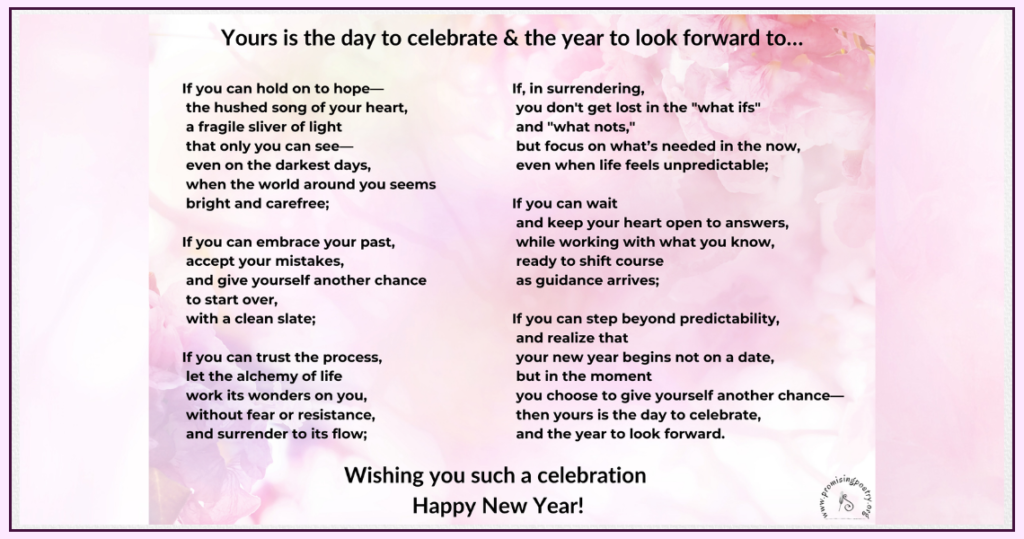
This is my little gift to you—a poem to inspire a hopeful start, wherever you are and whenever you need it.
Written in the timeless style of Rudyard Kipling’s ‘If,’ it encourages you to embrace your past, trust life’s process, and discover light even in the darkest moments. A celebration of fresh starts and self-discovery awaits!
Yours is the day to celebrate & the year to look forward to
If you can hold on to hope—
the hushed song of your heart,
a fragile sliver of light
that only you can see—
even on the darkest days,
when the world around you seems
bright and carefree;

If you can embrace your past,
accept your mistakes,
and give yourself another chance
to start over,
with a clean slate;

If you can trust the process,
let the alchemy of life
work its wonders on you,
without fear or resistance,
and surrender to its flow;

If, in surrendering,
you don't get lost in the "what ifs"
and "what nots,"
but focus on what’s needed in the now,
even when life feels unpredictable;

If you can wait
and keep your heart open to answers,
while working with what you know,
ready to shift course
as guidance arrives;

If you can step beyond predictability,
and realize that
your new year begins not on a date,
but in the moment
you choose to give yourself another chance—

Then yours is the day to celebrate,
and the year to look forward.
Hey there, poetry lovers! In my last post, we dove into the world of concrete poetry—a fascinating form of visual poetry where the words on the page shape themselves into a picture that embodies the poem’s theme. Today, I’m excited to share an example of this with you: my poem titled “Sustainable Love.” This piece is about comparing love’s nurturing process to composting, and I’ve shaped it like a garden tool—a shovel! Let’s dig into the thought process behind this creative choice.
Sustainable Love
Love, like
composting,
 by  nature
takes time
 to nurture
& g r  o w
 in rhythm
&  rhyme.
It starts in
small bits,
 like scraps
of h e a r t
  then layers
 of  c a r e
   slooowly
  built up.
  The scraps
 seemingly useless
  too broken to mend
blend and transcend
with patience and warmth
into something new, rich and full of life,
a foundation for growth, amidst toil & strife.
Like  compost  needing  air ,  water , &  sun,
love  needs  care ,  communication ,  &  fun.
Love's to be tended , to prevent it  from rot,
to  keep  it  dynamic  and  full  of   thought.
Dear, take time, with  your  love, as you do,
 with  composting , daily , a little  more anew.
  create something , that's long-lasting & true,
  a love  that's  sustainable & always anew.
Why a Shovel? The Thought Process Behind the Shape
When I first penned “Sustainable Love,” it followed a standard stanza format. But as I played around with the structure, I found myself inspired to mould it into a shovel—a tool that perfectly symbolizes the nurturing process I wanted to convey. Now, let’s break down the themes and how the visual structure of this poem brings them to life.
Thematic Analysis: How Composting and Love Are Alike
Love Takes Time, Just Like Composting
At the heart of this poem is a comparison between love and composting. Both require patience and care to truly flourish. Just as composting starts with small scraps—tiny bits that might seem insignificant—love often begins with small acts or gestures. These “scraps of the heart” may appear useless at first, but with the right care, they become the building blocks of something much more substantial.
Growth and Renewal
In the same way that composting transforms scraps into rich, fertile soil, love grows and renews through patience and warmth. The repeated emphasis on time—phrases like “takes time,” “slooowly,” and “daily, a little more anew”—highlights the ongoing effort needed to maintain a healthy, sustainable love. Even the most broken parts of ourselves can be mended and turned into something beautiful when nurtured with care.
Care and Communication Are Essential
Just as compost needs air, water, and sunlight to break down and enrich the soil, love requires care, communication, and a bit of fun to stay vibrant. Without these key elements, love can, like neglected compost, become stagnant. It’s all about tending to love regularly, keeping it dynamic and full of thought.
Visual Structure: Why the Shovel Shape Matters
Shovel Shape: A Symbol of Effort and Transformation
The shovel shape is a conscious design choice as I believe it’s a powerful symbol of the effort and transformation that love requires. In composting, the shovel is essential for turning, mixing, and aerating the compost pile, helping it decompose into something rich and life-giving. Similarly, love requires us to dig deep, turn over our emotions, and work through challenges to create something sustaining.
Handle and Blade: The Foundation and Work of Love
The handle of the shovel, formed by the narrow, tightly aligned first few lines, represents the grip or foundation of the poem’s message. As the poem broadens into the blade of the shovel, it symbolizes where the real work of love (and composting) happens—transforming the ordinary into something extraordinary.
Wrapping It All Up: The Power of Visual Poetry
In “Sustainable Love,” the shovel shape isn’t just for show—it’s an integral part of the poem’s meaning. This shape reinforces the central metaphor of love as a process that requires the right tools, patience, and effort to grow into something truly sustainable and renewing. Just like composting, love is a journey of transformation, and this poem visually embodies that journey.
I hope this exploration of “Sustainable Love” gives you a fresh perspective on both love and the art of concrete poetry. As always, I’d love to hear your thoughts—drop a comment below and let’s chat!
Hey there, fellow poetry lovers! Today, I want to dive into a form of poetry that’s as much about what you see as what you read—concrete poetry. If you’ve ever come across a poem where the words are arranged in the shape of a tree, a heart, or even a winding river, then you’ve experienced concrete poetry in action. It’s a fascinating blend of visual art and the written word, and it opens up a whole new way of expressing ideas. So, let’s explore what concrete poetry is, look at an example, and learn how to create one yourself!
What Is Concrete Poetry?
Concrete poetry, also known as shape poetry, is a type of poetry where the visual arrangement of the words on the page forms a picture or shape that represents the poem’s theme. The term “concrete” comes from the idea that the poem’s structure is tangible, something you can see and, in a way, almost touch with your eyes. It’s a visual expression that complements or enhances the meaning of the poem.
In concrete poetry, the shape is just as important as the words. The layout, direction, and even the spacing of the text play a crucial role in conveying the poem’s message. It’s like the words themselves are transformed into a piece of art, where the way they’re arranged on the page adds layers of meaning that go beyond what’s simply written.
An Example of Concrete Poetry
To give you a better idea of what concrete poetry looks like, let’s imagine a simple example. Picture a poem about a raindrop. In a traditional poem, you might describe the raindrop’s shape, its journey from the sky, and how it splashes on the ground. But in a concrete poem, you could take it a step further by arranging the words on the page to form the shape of a raindrop.
In this case, the words “falling,” “through the air,” and so on are arranged to mimic the shape of a raindrop descending from the sky. The word “Splashh” at the bottom completes the image, giving the reader not just a sense of the poem’s meaning but also a visual representation of it. It’s simple, but it’s effective—and it turns a straightforward poem into something more dynamic and engaging.
I used the Canva app to create this piece digitally, but you can also do it freehand—just let your creativity flow!
Writing a concrete poem is a creative and fun process. It’s like drawing with words, and there’s no limit to what you can do. Here’s how you can get started:
Choose Your Subject: Think about the theme or object you want to write about. It could be anything—a tree, a star, a spiral, a heart, or even something abstract like a wave or a whirlwind. The key is to pick something that has a distinctive shape that you can replicate with your words.
Write the Poem: Start by writing a traditional poem about your chosen subject. Focus on the content first—what do you want to say? How do you want to convey the emotions or ideas related to your subject? Don’t worry about the shape just yet; get your thoughts down on paper.
Visualize the Shape: Once you have your poem, think about how you can arrange the words to reflect the shape of your subject. This might mean breaking up lines, staggering words, or even changing the direction in which the text flows. The goal is to make the shape recognizable while keeping the poem readable.
Experiment with Layout: This is where the fun really begins. Start playing with the layout of your poem. Move words around, change the spacing, and see how different arrangements affect the overall look and feel. You might need to tweak the wording or even add or remove lines to get the shape just right.
Fine-Tune Your Creation: Once you’ve got a layout you’re happy with, go back and refine your poem. Make sure the text is still conveying your message clearly and that the shape enhances the meaning rather than distracting from it. It might take a few tries to get it just right, but that’s all part of the creative process.
Getting Creative With Concrete Poetry
For me, concrete poetry is like taking poetry to the next level. Concrete poetry is not just about the words; it’s about how those words interact with the space around them. It’s a way to push the boundaries of traditional poetry and create something that’s both visually and emotionally impactful. Plus, it’s a great way to challenge yourself creatively—trying to find the perfect balance between form and content can be a rewarding experience.
So, next time you’re in the mood to write, why not give concrete poetry a try? Let your words take shape and see what amazing creations you can come up with. Happy writing!
Here’s a poem called “Milk and Mends” that’s all about those tender moments in our relationships where love and forgiveness come into play, especially in the kitchen. You know, those simple gestures and little culinary mishaps that somehow lead to a deeper understanding and bring us closer together. I hope you find it as touching as I do, and that it reminds you of the beautiful ways we mend our hearts with the ones we love. Also let me know what do you think is the relationship of the poet and the other person in this poem?
Milk and Mends
He whispered in my ear,
"There's a gift awaiting in the kitchen."
I rushed to our little haven,
To be welcomed by
The burnt smell of milk cream,
Spills marking a map to a world unknown.

Oh wait, I see a little waterfall
Forming a puddle under the granite slab,
And four tiles away from it,
Two small cups half-filled with milk,
Rose petals on a royal bath,
Pampered with a sprinkle of cocoa powder.

I turn back to look at him—
A sorry face cuts through him,
For the fight last night
Over unfinished homework.
We use cookies on our website to give you the most relevant experience by remembering your preferences and repeat visits. By clicking “Accept All”, you consent to the use of ALL the cookies. However, you may visit "Cookie Settings" to provide a controlled consent.
This website uses cookies to improve your experience while you navigate through the website. Out of these, the cookies that are categorized as necessary are stored on your browser as they are essential for the working of basic functionalities of the website. We also use third-party cookies that help us analyze and understand how you use this website. These cookies will be stored in your browser only with your consent. You also have the option to opt-out of these cookies. But opting out of some of these cookies may affect your browsing experience.
Necessary cookies are absolutely essential for the website to function properly. These cookies ensure basic functionalities and security features of the website, anonymously.
Cookie
Duration
Description
cookielawinfo-checkbox-analytics
11 months
This cookie is set by GDPR Cookie Consent plugin. The cookie is used to store the user consent for the cookies in the category "Analytics".
cookielawinfo-checkbox-functional
11 months
The cookie is set by GDPR cookie consent to record the user consent for the cookies in the category "Functional".
cookielawinfo-checkbox-necessary
11 months
This cookie is set by GDPR Cookie Consent plugin. The cookies is used to store the user consent for the cookies in the category "Necessary".
cookielawinfo-checkbox-others
11 months
This cookie is set by GDPR Cookie Consent plugin. The cookie is used to store the user consent for the cookies in the category "Other.
cookielawinfo-checkbox-performance
11 months
This cookie is set by GDPR Cookie Consent plugin. The cookie is used to store the user consent for the cookies in the category "Performance".
viewed_cookie_policy
11 months
The cookie is set by the GDPR Cookie Consent plugin and is used to store whether or not user has consented to the use of cookies. It does not store any personal data.
Functional cookies help to perform certain functionalities like sharing the content of the website on social media platforms, collect feedbacks, and other third-party features.
Performance cookies are used to understand and analyze the key performance indexes of the website which helps in delivering a better user experience for the visitors.
Analytical cookies are used to understand how visitors interact with the website. These cookies help provide information on metrics the number of visitors, bounce rate, traffic source, etc.
Advertisement cookies are used to provide visitors with relevant ads and marketing campaigns. These cookies track visitors across websites and collect information to provide customized ads.