Hola! This poem is part of my Ars Poetica – BlogchatterA2Z 2025 series, where I explore the art of poetry through 26 stanzas, each beginning with a different letter of the alphabet. Every day, a new stanza unfolds, building upon the previous ones intuitively and organically. If you’re just joining in, feel free to read from the beginning or simply dive into today’s reflection on poetry.
Stanza 5 of the Ars Poetica—Echoes of Ecstasy
Echoes of ecstasy then arrive in evocative expressions Like a divine intervention With a download of disengaged words Splattered across the field of imagination Each word holds its own pulse, Gathering under a shower of light. And as they take root in the hush of thought, A forest rises from buried seeds— Each a quiet promise of life.
Hola! This poem is part of my Ars Poetica – BlogchatterA2Z 2025 series, where I explore the art of poetry through 26 stanzas, each beginning with a different letter of the alphabet. Every day, a new stanza unfolds, building upon the previous ones intuitively and organically. If you’re just joining in, feel free to read from the beginning or simply dive into today’s reflection on poetry.
Stanza 4 of the Ars Poetica—Dance of Discovery
Da-dhan da-dhan da-dhan da-dhan— Now that she has all my attention, There’s a dance of discovery, Like Rumi’s twirls of ecstasy, Spinning into silence, into knowing. The da-dhan’s of my world take no words — Not yet. They pulse in rhythm, syncing with my breath, Or with the beat the poem decides to take. For now, it’s just the da-dhan, da-dhan, da-dhan — Where beats prelude the dance of diction, Where language holds its breath before the plunge.
Hola! This poem is part of my Ars Poetica – BlogchatterA2Z 2025 series, where I explore the art of poetry through 26 stanzas, each beginning with a different letter of the alphabet. Every day, a new stanza unfolds, building upon the previous ones intuitively and organically. If you’re just joining in, feel free to read from the beginning or simply dive into today’s reflection on poetry.
Stanza 3 of the Ars Poetica—Cry of the Unheard
Childish yet persistent, poetry clings, Crying for attention in the middle of chaos— Clutching my legs like a wailing child, While life wheels past, demanding more. Call it trivial, call it untimely, But never call it ignorable— For poetry, like a child unheard, Only screams louder when dismissed.
Hola! This poem is part of my Ars Poetica – BlogchatterA2Z 2025 series, where I explore the art of poetry through 26 stanzas, each beginning with a different letter of the alphabet. Every day, a new stanza unfolds, building upon the previous ones intuitively and organically. If you’re just joining in, feel free to read from the beginning or simply dive into today’s reflection on poetry.
Stanza 2 of the Ars Poetica—Beneath the Pulse of Pause
Breath is either effortless or laborious but never biased. Between the choices I make to Notice or ignore the mundane messengers of life Pushing their way into my senses, Breath bursts into life— Being & belonging In every pause I make Between silence and words.
And in those pauses, Breath turns to poetry, Balancing on the edge of awareness, Bridging the known and unsaid, Believing that the lump down my throat Deserves breath, deserves life— Even when packing dabbas Isn’t a metaphor heavy with prophecy…
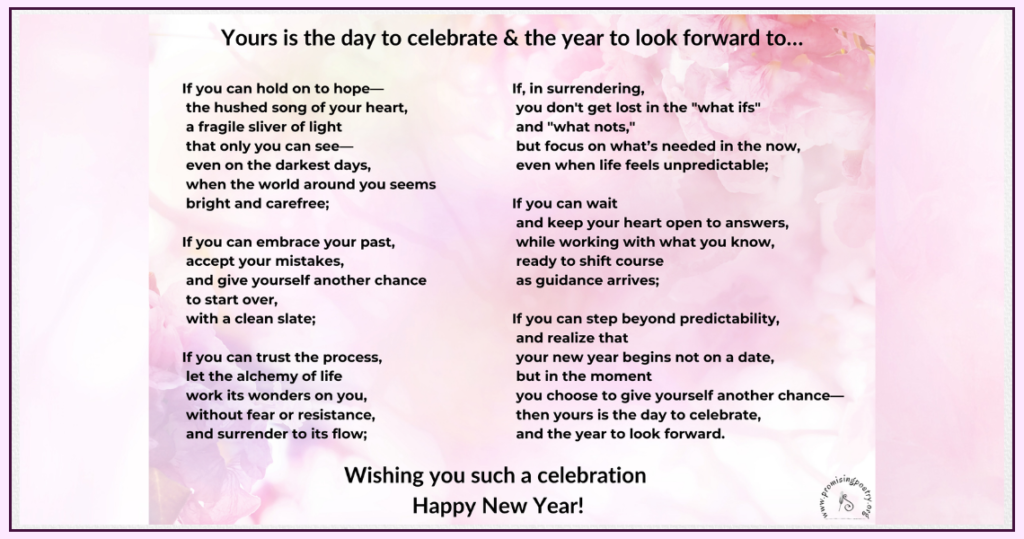
This is my little gift to you—a poem to inspire a hopeful start, wherever you are and whenever you need it.
Written in the timeless style of Rudyard Kipling’s ‘If,’ it encourages you to embrace your past, trust life’s process, and discover light even in the darkest moments. A celebration of fresh starts and self-discovery awaits!
Yours is the day to celebrate & the year to look forward to
If you can hold on to hope—
the hushed song of your heart,
a fragile sliver of light
that only you can see—
even on the darkest days,
when the world around you seems
bright and carefree;

If you can embrace your past,
accept your mistakes,
and give yourself another chance
to start over,
with a clean slate;

If you can trust the process,
let the alchemy of life
work its wonders on you,
without fear or resistance,
and surrender to its flow;

If, in surrendering,
you don't get lost in the "what ifs"
and "what nots,"
but focus on what’s needed in the now,
even when life feels unpredictable;

If you can wait
and keep your heart open to answers,
while working with what you know,
ready to shift course
as guidance arrives;

If you can step beyond predictability,
and realize that
your new year begins not on a date,
but in the moment
you choose to give yourself another chance—

Then yours is the day to celebrate,
and the year to look forward.
Hey there, fellow poetry lovers! Today, I want to dive into a form of poetry that’s as much about what you see as what you read—concrete poetry. If you’ve ever come across a poem where the words are arranged in the shape of a tree, a heart, or even a winding river, then you’ve experienced concrete poetry in action. It’s a fascinating blend of visual art and the written word, and it opens up a whole new way of expressing ideas. So, let’s explore what concrete poetry is, look at an example, and learn how to create one yourself!
What Is Concrete Poetry?
Concrete poetry, also known as shape poetry, is a type of poetry where the visual arrangement of the words on the page forms a picture or shape that represents the poem’s theme. The term “concrete” comes from the idea that the poem’s structure is tangible, something you can see and, in a way, almost touch with your eyes. It’s a visual expression that complements or enhances the meaning of the poem.
In concrete poetry, the shape is just as important as the words. The layout, direction, and even the spacing of the text play a crucial role in conveying the poem’s message. It’s like the words themselves are transformed into a piece of art, where the way they’re arranged on the page adds layers of meaning that go beyond what’s simply written.
An Example of Concrete Poetry
To give you a better idea of what concrete poetry looks like, let’s imagine a simple example. Picture a poem about a raindrop. In a traditional poem, you might describe the raindrop’s shape, its journey from the sky, and how it splashes on the ground. But in a concrete poem, you could take it a step further by arranging the words on the page to form the shape of a raindrop.
In this case, the words “falling,” “through the air,” and so on are arranged to mimic the shape of a raindrop descending from the sky. The word “Splashh” at the bottom completes the image, giving the reader not just a sense of the poem’s meaning but also a visual representation of it. It’s simple, but it’s effective—and it turns a straightforward poem into something more dynamic and engaging.
I used the Canva app to create this piece digitally, but you can also do it freehand—just let your creativity flow!
Writing a concrete poem is a creative and fun process. It’s like drawing with words, and there’s no limit to what you can do. Here’s how you can get started:
Choose Your Subject: Think about the theme or object you want to write about. It could be anything—a tree, a star, a spiral, a heart, or even something abstract like a wave or a whirlwind. The key is to pick something that has a distinctive shape that you can replicate with your words.
Write the Poem: Start by writing a traditional poem about your chosen subject. Focus on the content first—what do you want to say? How do you want to convey the emotions or ideas related to your subject? Don’t worry about the shape just yet; get your thoughts down on paper.
Visualize the Shape: Once you have your poem, think about how you can arrange the words to reflect the shape of your subject. This might mean breaking up lines, staggering words, or even changing the direction in which the text flows. The goal is to make the shape recognizable while keeping the poem readable.
Experiment with Layout: This is where the fun really begins. Start playing with the layout of your poem. Move words around, change the spacing, and see how different arrangements affect the overall look and feel. You might need to tweak the wording or even add or remove lines to get the shape just right.
Fine-Tune Your Creation: Once you’ve got a layout you’re happy with, go back and refine your poem. Make sure the text is still conveying your message clearly and that the shape enhances the meaning rather than distracting from it. It might take a few tries to get it just right, but that’s all part of the creative process.
Getting Creative With Concrete Poetry
For me, concrete poetry is like taking poetry to the next level. Concrete poetry is not just about the words; it’s about how those words interact with the space around them. It’s a way to push the boundaries of traditional poetry and create something that’s both visually and emotionally impactful. Plus, it’s a great way to challenge yourself creatively—trying to find the perfect balance between form and content can be a rewarding experience.
So, next time you’re in the mood to write, why not give concrete poetry a try? Let your words take shape and see what amazing creations you can come up with. Happy writing!
Hey there, poetry enthusiasts! It’s been a while since I last posted, and I’ve missed writing and connecting with you all. But to make up for the lost time, I’m excited to bring you a series on Visual Poetry. We’ll explore, experiment, and enjoy this unique art form together. Let’s dive in!
Now, if you’re thinking, “Wait, isn’t poetry just about words, rhymes, and verses?” you’re in for a delightful surprise. Visual poetry is like a wonderful fusion of literature and art, where the way the text is arranged on the page is just as important as the words themselves. It’s poetry you can see and feel, and it brings a whole new dimension to the poetic experience.
So, what exactly is visual poetry? In simple terms, visual poetry is an art form where the visual arrangement of text, images, and even symbols is used to convey a poem’s meaning. It’s not just about the words themselves; it’s about how those words are presented on the page. The layout, the fonts, the spacing, any artwork in the background—all these elements come together to create a piece that you experience both with your eyes and your mind.
Imagine reading a poem where the words form the shape of a tree, or where different fonts and sizes create a rhythm that mirrors the poem’s theme. Thus, visual poetry takes the traditional idea of a poem and turns it into something you can not only read but also see and sometimes even touch.
Different Types of Visual Poetry
There are different types of visual poetry. Just like traditional poetry comes in various forms—haikus, sonnets, free verse—visual poetry also has its diverse styles. Here are a few that you might find fascinating:
Concrete Poetry: This is probably the most well-known form of visual poetry. In concrete poetry, the words of the poem are arranged on the page to form a picture or shape that reflects the theme of the poem. For instance, a poem about a star might have its text arranged in the shape of a star.
Found and Blackout Poetry: This involves taking existing text (like a page from a book or a newspaper article) and blacking out most of the words, leaving only a few behind to create a poem. The remaining words form both the text and the visual pattern, giving the poem a unique visual appeal.
Calligrams: A calligram is a type of visual poetry where the text forms an image related to the poem’s content. Think of it as a drawing made out of words. The famous poet Guillaume Apollinaire was known for his calligrams, where he’d arrange his text to form images like rain, birds, or even a woman’s face.
Ekphrastic Poetry: This type of poetry takes its inspiration from visual art, where the poet responds to a piece of artwork—whether a painting, sculpture, or photograph—through words. The resulting poem often reflects or interprets the visual piece, creating a dialogue between the two art forms. Ekphrastic poetry bridges the gap between seeing and feeling, offering readers a deeper, multi-sensory experience.
Collage Poetry: Think of collage poetry as a literary version of a visual collage. In this form, poets cut out words and phrases from various sources—magazines, newspapers, books—and then arrange them on a page to create a new poem. The visual aspect comes from the physical placement and style of the cut-out words, which can add layers of meaning and texture to the poem.
Mathviz Poetry (My New Project!): I’m particularly excited to introduce you to a new type of visual poetry I’m working on called Mathviz Poetry. This style combines the precision and patterns of mathematics with the expressive power of poetry. Imagine equations and geometric shapes merging with verses, where the arrangement of numbers, symbols, and words creates a harmonious and visually engaging piece. Mathviz Poetry seeks to bridge the gap between logic and emotion, proving that even math can have a poetic soul.
You might be wondering, what’s the big difference between visual poetry and traditional text poetry? Well, while traditional poetry focuses primarily on the words and their arrangement in lines and stanzas, visual poetry goes beyond that. It uses the physical placement of words, their shape, and even the space around them to enhance or sometimes even change the meaning of the poem.
In visual poetry, how a poem looks on the page can be just as important as what it says. The visual elements work hand in hand with the text to create a richer, more immersive experience. In traditional poetry, you might imagine the scene or the emotion as you read; in visual poetry, you see it directly on the page.
Why Do We Need Visual Poetry?
So, why do we even need visual poetry? Isn’t regular poetry enough? The answer lies in the unique way visual poetry can communicate ideas and emotions. Sometimes, the visual arrangement of words can express something that the words alone cannot. It creates a stronger connection with the reader, evokes more intense emotions, and adds layers of meaning that might be missed in traditional text.
More so, visual poetry also breaks down the barriers between art and literature, showing that the two can coexist beautifully. It invites readers to engage with the poem on multiple levels—intellectually, emotionally, and visually.
What’s Next?
We’ll explore specific styles, see examples, and even try creating some visual poetry ourselves. So whether you’re a seasoned poet or just curious about this art form, there’s so much to discover.
Stay tuned, and let’s explore the beautiful world of visual poetry together!
இத்தோடு ஈரேழு முறை
சொல்லிக் கொடுத்து விட்டாள்—
 சாம்பார் பொடி வீட்டிலேயே செய்யும் முறை
மனம் கேட்கவில்லை
ஒருவேளை சோம்பேறித்தனமோ?
இருக்கலாம்!

பல தடவை பக்கத்து கடைக்கும்
போய் வந்தாகிவிட்டது
சாம்பார் பொடி பாக்கெட்டில் இருந்தும்
 வாங்க மறுத்தது மனம்...

அம்மா தொலைபேசியில் உறுதி அளித்தாள் —
'கவலைப்படாதே நான் சொல்லும்படி செய்தால்
என் கை மணம் அதில் வரும்'
  இருந்தும் ஏற்க மனமில்லை

மனதின் எதோ ஒரு மூலையிலிருந்து வரும்
 அந்த ஏக்கமே அறியும்
ஏறிக்கொண்டிருக்கும் அம்மாவின் வயதை
ஏற்க மனமில்லாமல்
கடத்திக்கொண்டு  பொத்திவைக்க பார்க்கிறேன்
அவள் அரைத்து அனுப்பும் சாம்பார் பொடியையும்
அவள் ஆயுளையும் —
 என் சமையலறை டப்பாவில்...


Written as part of #BlogchatterFoodFest.
Here’s a poem called “Milk and Mends” that’s all about those tender moments in our relationships where love and forgiveness come into play, especially in the kitchen. You know, those simple gestures and little culinary mishaps that somehow lead to a deeper understanding and bring us closer together. I hope you find it as touching as I do, and that it reminds you of the beautiful ways we mend our hearts with the ones we love. Also let me know what do you think is the relationship of the poet and the other person in this poem?
Milk and Mends
He whispered in my ear,
"There's a gift awaiting in the kitchen."
I rushed to our little haven,
To be welcomed by
The burnt smell of milk cream,
Spills marking a map to a world unknown.

Oh wait, I see a little waterfall
Forming a puddle under the granite slab,
And four tiles away from it,
Two small cups half-filled with milk,
Rose petals on a royal bath,
Pampered with a sprinkle of cocoa powder.

I turn back to look at him—
A sorry face cuts through him,
For the fight last night
Over unfinished homework.
Today’s collaboration is with my tween daughter, and I guarantee this poem will make you burst out laughing. If you’re curious about all the excitement or experiencing a bit of FOMO, don’t worry. Check out the post below and join the conversation.
Before you dive into the #CollaborativePoetry for the day, here are a few things I’d like to share:
The first line of the poem is written by the other person, while the second by me, and so on, alternatingly.
What you see here is a raw, first draft that will undergo further editing before finding its place within the pages of a book.
There is no fixed theme or title before embarking on this poetic journey. With each line, our perspectives shifts, and so does the direction of the poem. That’s the uniqueness and beauty of this #CollaborativePoetry.
Every collaborator in this series comes from different backgrounds, ranging from novice to expert in writing/poetry.
To add an extra layer of intrigue, for each poem, I’ll share an analysis generated by ChatGPT. This allows you to see if your understanding or perspective of the poem aligns with it or not. Remember, the beauty of poetry lies in its ability to hold multiple perspectives, all of which can be valid.
So, let’s dive into the poem of the day:
Today, I’ve teamed up with my 12-year-old daughter, Miss.M, once again to craft a comical poem, a stark contrast from the one we created at the start (read it here) of this initiative.
We had a blast and laughed until our stomachs hurt while penning this poem. Honestly, it was all in good fun, with no rhyme or reason behind it.
However, ChatGPT’s analysis takes it to the next level by highlighting an undertone of satire. Check it out at the end of this post. So, without further ado, let’s dive into the poem.
Collaborative Poem - The Great Escape I had once farted, A big-bang that it started Spread till the café in America Ruining everyone's caffé mocha, Making people go mad at me- I then put on my shoes, ready to flee, Sprinting across countries To land in a land Where I have no one to appease And can fart just at ease...
The poem offers a humorous and lighthearted take on a seemingly embarrassing situation—the speaker’s fart causing chaos in a café. The use of comedic exaggeration, such as describing the fart as a “big-bang” and its repercussions spreading across countries, adds to the whimsical tone of the poem.
Despite the initial embarrassment and the anger of others, the speaker decides to flee the scene, putting on their shoes and sprinting across countries to find a place where they can fart without inhibition. This journey symbolizes a quest for freedom from societal norms and expectations, where the speaker seeks refuge in a land where they feel no pressure to conform.
Overall, the poem entertains with its playful language and absurd scenario while also touching on themes of individual autonomy and the desire to break free from societal constraints. It offers a humorous commentary on human behavior and the lengths to which one might go to escape judgment and embrace personal freedom.
That’s a wrap for today! If you’re someone still on the fence, wondering if you can write poetry, or thinking that poetry is a serious affair requiring a lot of effort, then I’m sure this poem will change your perspective. It’s time to let go of your fears and have fun penning poetry.
To see your masterpiece showcased here, click here to get all the details!
We use cookies on our website to give you the most relevant experience by remembering your preferences and repeat visits. By clicking “Accept All”, you consent to the use of ALL the cookies. However, you may visit "Cookie Settings" to provide a controlled consent.
This website uses cookies to improve your experience while you navigate through the website. Out of these, the cookies that are categorized as necessary are stored on your browser as they are essential for the working of basic functionalities of the website. We also use third-party cookies that help us analyze and understand how you use this website. These cookies will be stored in your browser only with your consent. You also have the option to opt-out of these cookies. But opting out of some of these cookies may affect your browsing experience.
Necessary cookies are absolutely essential for the website to function properly. These cookies ensure basic functionalities and security features of the website, anonymously.
Cookie
Duration
Description
cookielawinfo-checkbox-analytics
11 months
This cookie is set by GDPR Cookie Consent plugin. The cookie is used to store the user consent for the cookies in the category "Analytics".
cookielawinfo-checkbox-functional
11 months
The cookie is set by GDPR cookie consent to record the user consent for the cookies in the category "Functional".
cookielawinfo-checkbox-necessary
11 months
This cookie is set by GDPR Cookie Consent plugin. The cookies is used to store the user consent for the cookies in the category "Necessary".
cookielawinfo-checkbox-others
11 months
This cookie is set by GDPR Cookie Consent plugin. The cookie is used to store the user consent for the cookies in the category "Other.
cookielawinfo-checkbox-performance
11 months
This cookie is set by GDPR Cookie Consent plugin. The cookie is used to store the user consent for the cookies in the category "Performance".
viewed_cookie_policy
11 months
The cookie is set by the GDPR Cookie Consent plugin and is used to store whether or not user has consented to the use of cookies. It does not store any personal data.
Functional cookies help to perform certain functionalities like sharing the content of the website on social media platforms, collect feedbacks, and other third-party features.
Performance cookies are used to understand and analyze the key performance indexes of the website which helps in delivering a better user experience for the visitors.
Analytical cookies are used to understand how visitors interact with the website. These cookies help provide information on metrics the number of visitors, bounce rate, traffic source, etc.
Advertisement cookies are used to provide visitors with relevant ads and marketing campaigns. These cookies track visitors across websites and collect information to provide customized ads.