While going through the Annual Report of MSME 2020-21, a particular statistic got me thinking. Let me put down the statistics here:
Taken from MSME’s Annual Report 2020-21
We can clearly see a huge gender gap there.
Also, I would like to bring to your attention an interesting point made in the report that mentions there was no significant deviation in this pattern (of the dominance of males in ownership in proprietary MSMEs) in urban and rural areas, although the dominance of male-owned enterprises was slightly more pronounced in urban areas compared to rural areas (81.58% as compared to 77.76%). If just education and access to technology were factors in women entrepreneurship, shouldn’t it be more pronounced in rural than urban? So what are we missing here? Think!
Sneak-peek into the lives of Indian urban women
Now let the statistics be on one side. Let me draw your attention to the picture of a few educated women’s lives living in urban areas who dream of being an entrepreneur.
Satya*– Age 37, married with two kids. A brilliant girl who had cleared her UPSC prelim in her 20’s, got married and is now a homemaker made to believe making 3 different breakfast types each day catering to the taste of her family members (and not hers) is all about being a woman.
Joy*– Age 28, an MBA grad from a prestigious institute. A self-made woman who had the ambition and a foolproof plan for her business idea fall in love with a wrong person who ends up stalking and blackmailing her for nothing wrong on her part. Confidence shattered and cynical of cyber security, she now prefers taking a 9-5 job.
Veda*– Age 35, mother of 2 kids, a free and independent woman prior marriage lives a life of a “parrot in a golden cage”, pampered but not set free. Even her dressing and choice(?) of not being on social media is a decision(!) made by her husband.
Shashi*– Age 40, a software engineer, an ex-data analyst, a mother to 2 teens, decides to upgrade her professional skills and make her entrepreneurial dream come true. The family accepts on one condition that she makes sure the prestige and peace of the household be intact by making sure she gives her due time and attention to take care of the elders at home and follows the customs of the family to a T. Most importantly, to make sure that the onus of household chores doesn’t fall as a burden on anyone else. She still chases her dream, registers her company, multitasks, toils day & night only to end up falling chronically ill just in the next 2 years.
The above women are not any fictional characters and you can easily find one in your family too. I hope this could have thrown light on the picture that we overlook.
Even in a recent episode of a Tamil talk show, social activist Smt.Oviya mentions how still women are trapped in the patriarchal mindset that there is a need for women to develop a business mindset. She goes on to mention that even when women come to register for MSME, there are many cases where women don’t even have a single utility bill in their name to proceed with the paper works.
The need for change
Social stigma, patriarchal mindset, women being bound to unpaid care work, cyber crimes against women- no matter how much ever she is educated or has access to technology- are all few factors that act as roadblocks in a woman’s entrepreneurial journey that we overlook.
Here, a man’s business is considered legit and even seen as a family business while a woman’s business is not; it’s mostly seen as her hobby. A successful woman is portrayed as one who could multitask striking the right balance between work and family while a man is not expected to strike such balance.
Gender biases should be eradicated. Unpaid care work should be shared and not seen just as a woman’s duty. Only then, a woman can scale in her entrepreneurial journey at an exponential rate.
The government may come with multiple schemes and banks may provide non-collateral loans but are we as a society ready to unlearn our cultural conditioning and biases that hold back our women at home?
“The best thermometer to the progress of a nation is its treatment of its women.”
– Swami Vivekananda
*Names changed for privacy concerns.
Growth Matters Forum is a community for business owners to explore ideas, streamline growth and create an impact. Join the community here.
If you are a beginner to the blogging world, wanting to earn but shy away from networking or actively using social media, then this is for you.
As bloggers, we start with the hope to be seen. We jump into blogging with the idea that our articles be read and shared instantly. But the ground reality hits hard when we see no visibility for the post for which we laboured in hours. That’s when networking comes to play.
Given the popularity of social media platforms for instant connections, shares and likes, we might think networking is not a big deal. But let me tell you that intentional and healthy networking for bloggers should mean looking beyond those Instagram connections and story shares.
One of the best and dynamic Indian platforms that connect bloggers under one roof is Blogchatter. It helps in better networking and engaging with fellow bloggers with a variety of options. There is something for everyone and you can very easily find and grow your community for better learning and for better reach, of course.
As someone who prefers listening over talking and being alone over partying, networking wasn’t my cup of tea. Also, being an ITP warrior, I’m generally not left with much energy for social media presence too. So right when I was wondering how to get into intentional networking, I chanced upon Blogchatter.
What makes Blogchatter the best bet and a personal favourite is its versatility. Not all bloggers come with the same purpose and same skill sets. While some may blog for a hobby, some do it for business or as a part of learning. While some may be good at long posts, some may steal the show with short video captures. While some bet on SEO, some swear by social media presence. Blogchatter makes every blogger feel seen and heard.
Blogchatter with its carefully crafted features always comes up with campaigns, challenges and contests that are well-curated keeping in mind the dynamism of the blogger world. This gives each blogger the freedom to have their own approach and also find their tribe.
Even if you are an introvert like me, their campaigns like Blogchatter half marathon, book review programs, reading challenge and the easiest of all blogroll submissions can help you get started with networking.
One of my favourite features of Blogchatter is #CauseAChatter. Here’s a quick guideline on how you can write for a cause.
Even while being very less active, being part of the campaigns has helped with the visibility of my website. But the best part is being able to discover like-minded people and their amazing writings. Discovering different styles of writing and also posts from niches outside of ours is an added advantage exclusive of being part of the Blogchatter community.
If you are someone full time into blogging and are an extrovert with social media presence being your strength, Blogchatter’s time to time contest, Twitter threads and their most –favoured #MyFriendAlexa are something that you certainly don’t want to miss.
Well, while visibility alone can give us the boost, Blogchatter gives its community the high of earning money too. You can either choose to just read a book or read and review it; write a single guest post or pen multiple posts for a marathon; write for a cause or for the sheer joy of writing or just do it all to earn money.
The Blogchatter team knows how to bring the best to the blogger world and individual bloggers too. Being a part of the Blogchatter community has been one of my best decisions and this post would just mean my gratitude to them. (This is not a sponsored post!)
So if you are reading this and are yet to join the Blogchatter community, I must say, you are missing out on the best of the blogging world.
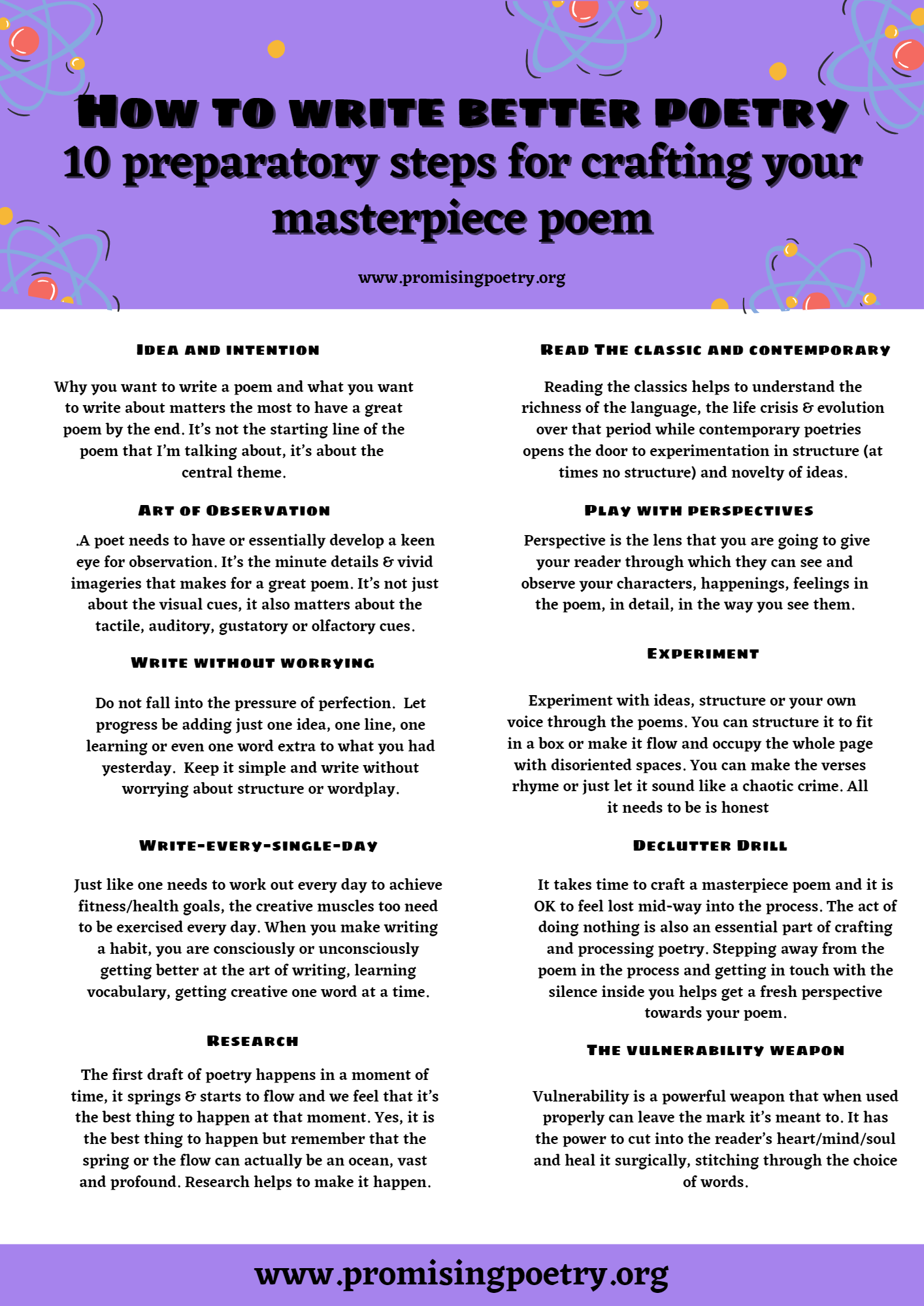
10 preparatory steps for crafting your masterpiece poem
Designed by Author on Canva
It’s every poet’s dream to write better poetry and craft that masterpiece poem every time they sit to pen one. But what’s stopping them from doing so? Is it the pressure that comes with it or is there a need to find and fix the basics right?
In this article, we shall see how can a poet get better at creating a masterpiece poem without coming under pressure and what are the basic essentials for it.
Poets, especially the ones whose works are unpublished and who are just beginning to get a grip on the art form, don’t easily call themselves a poet.
There is always a feeling of being less or being incompetent to call themselves a poet, call it impostor syndrome or whatever you may fancy, but it is true.
They might be calling themselves a writer or even a freelancer, but never a poet. They will be creating masterpieces but may call poetry writing a side hustle. Mainly because poetry is not that rewarding monetarily in spite of poetry making it to the mainstream these days.
But does that make one any less of a poet?
If you are one who is still not convinced to call yourself a poet or if you do call yourself one and make sure you get better at being a poet, then this is for you.
Let me get you through some background before sharing some experiential knowledge through this year’s poetry month experiment.
My experience with NaPoWriMo gave me the conviction of calling myself a poet
The first time that I came to know about National Poetry Writing Month (NaPoWriMo) was in the year 2017 when I came across two of Pune’s best poetry circles, Pune Poetry Slam and Bullockcart Poetry. I had been following their pages on Facebook for months and used to try their prompts regularly even though I had not posted it much, thanks to the impostor syndrome.
Then came national poetry month and out of some adrenaline rush, I just took up the challenge to try and write 30 poems in 30 days.
The first few days were a poetic high. I had my friends and relatives cheering up. My mind was fresh and I had enough words to play around with. It felt as though I was back to my college days with that competitive spirit.
It was certainly my first big step towards taking poetry on a serious note. I was experimenting and enjoying it all along. And then after 13 days into writing or so, it started getting difficult. The prompts got tougher and I was also going out of ideas.
But if there was something that kept me through then it was the accountability factor of taking an open challenge in an online space.
After over a week’s time, my Facebook audience had actually started developing an interest in reading my posts and more than myself, they were looking forward to the poems. That, in fact, kept me going and helped me push through the dry days.
But least did I know then that there wasn’t actually any necessity to create a masterpiece every day. The point was to be consistent, explore, experiment, learn and get your idea out. Something that I didn’t know as a first-time entrant into the challenge. But that year, that challenge laid a strong foundation for what was to come in the years after.
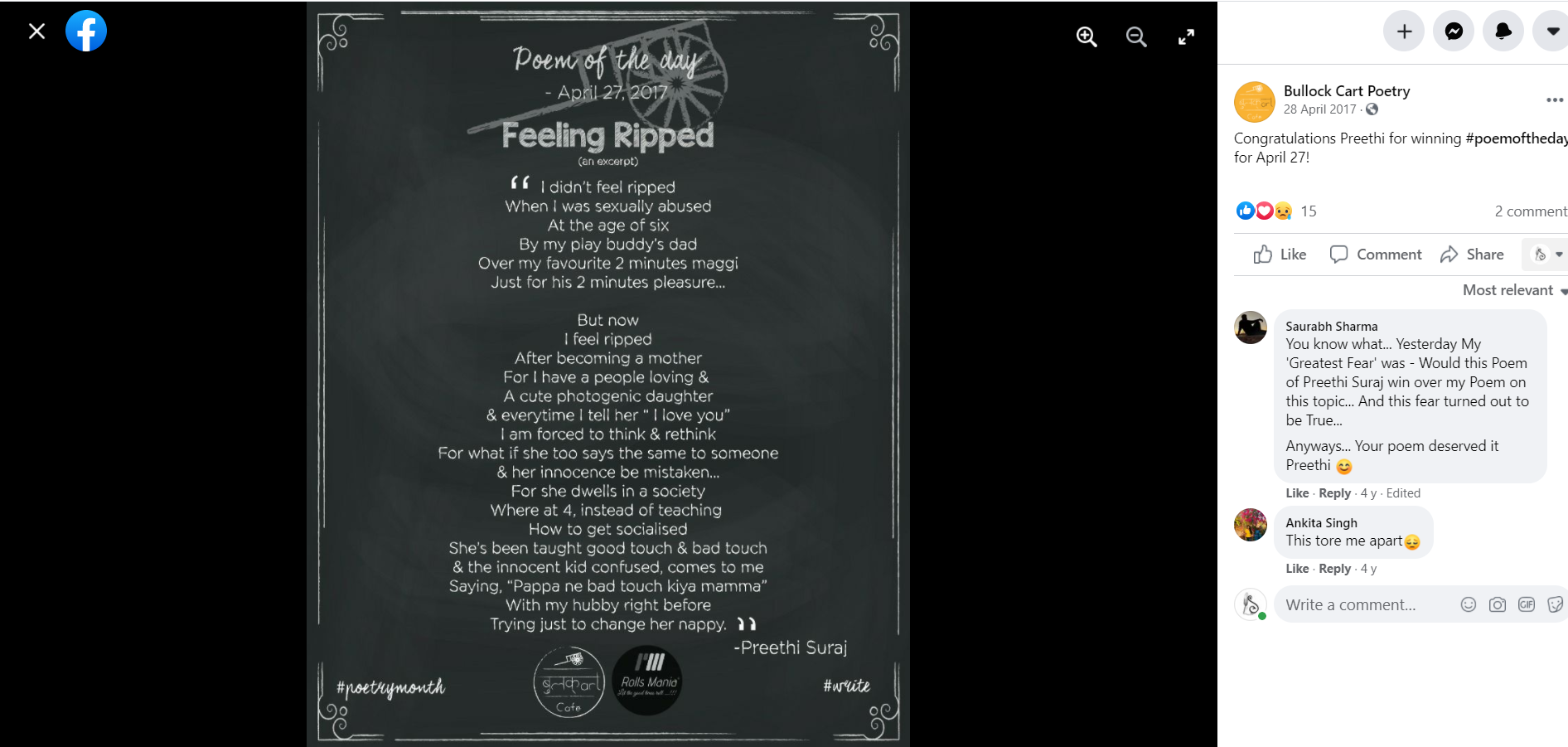
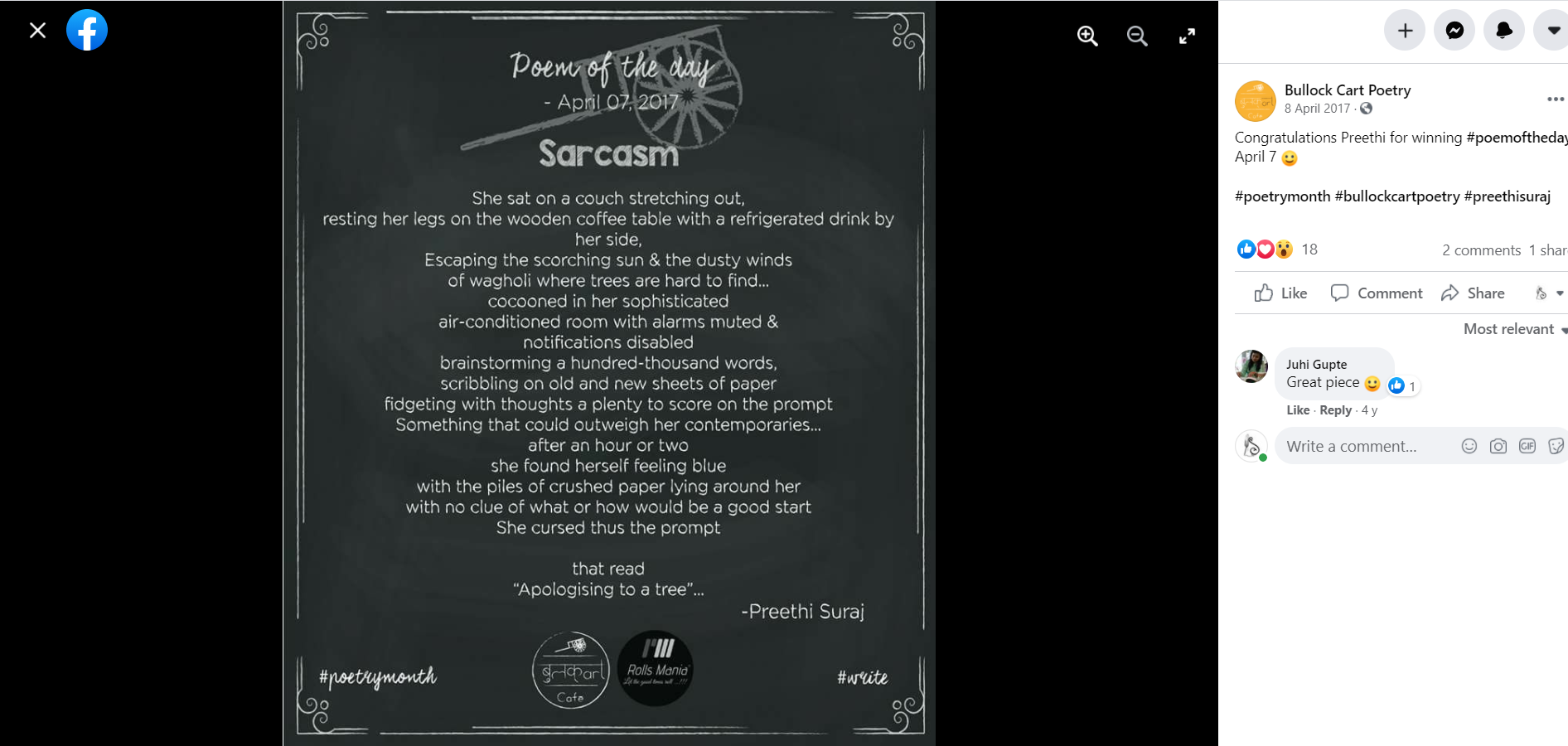
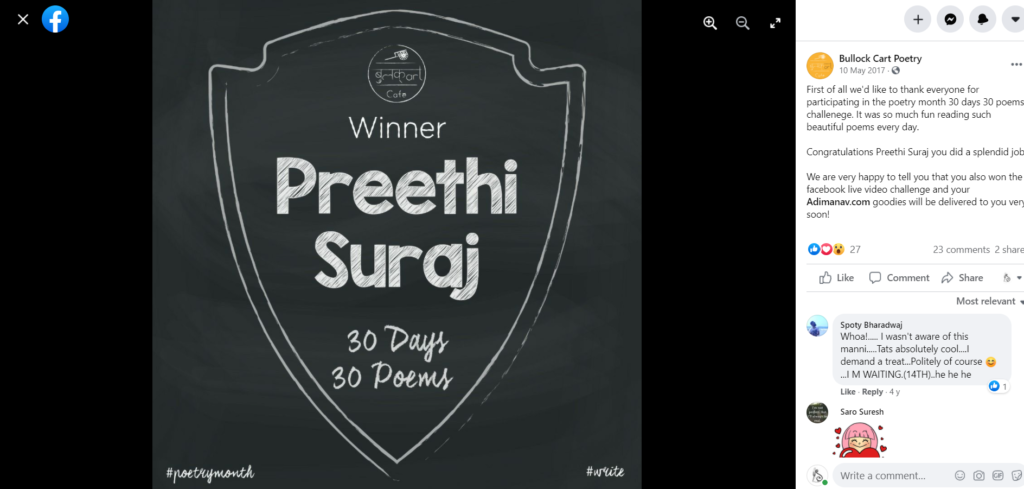
Surprisingly, I also got to win the month’s challenge of writing 30 poems in 30 days for the prompts shared by Bullock Cart Poetry with a few of my poems making it to the “poem of the day”.
From NaPoWriMo, 2017, by Bullockcart Poetry
I couldn’t continue to write for PPS simultaneously and I just attempted for the first 6 days and one of my very short poems (written just in 2 mins right before getting off to sleep) got selected for the “poem of the day”.
With the high and experience that the challenge gave, I continued taking NaPoWriMo challenges since then, only that I kept the poems to myself and was not pushing to do 30 poems in a month’s time. Rather, I took the prompts, created over days.
At times, I went for creating multiple pieces for a single prompt. I started playing with the prompts and enjoyed and learned a lot over years. More than writing, I enjoyed reading and exploring new poetry pages and finding amazing talents.
NaPoWriMo led Poetpreneurship
Fast forward to 2020, the foundation that was laid years back had now helped me dive into the space of what I call, Poetpreneurship. As a poetpreneur, I now help others find solace in reading, writing and gifting poetry. Isn’t that cool?
While poetry and making money have always been thought to be poles apart, I could jump into my solopreneur journey with poetry as the only capital because of the experience of years of writing and NaPoWriMo has had a prominent place in it.
More on my entrepreneurial journey, Promising Poetry, in the future but here is something that I did this year that I wanted to share with you.
NaPoWriMo-2021- An Experiment
April 2021, as with every year, was a month of poetic high with writings for NaPoWriMo (National Poetry Writing Month) prompts doing their rounds online. This year, I thought why not do NaPoWriMo with a difference.
So I went ahead to experimenting and sharing the process of writing one poem from scratch on my Instagram handle. As part of it, the first 10 days were about the preparatory steps for crafting a better poem.
10 preparatory steps for crafting your masterpiece poem
Idea and intention
So what comes first is the idea and intent. Why you want to write a poem and what you want to write about matters the most to have a great poem by the end. It’s not the starting line of the poem that I’m talking about, it’s about the central theme.
Personally, I write poems for multiple purposes, like for learning, experimenting with a particular technique or style, writing for my customised products or for prompts. But my favourite pieces of poetry are those that flow freely out of overwhelming emotion or an experience.
To help you get started, here are a few questions to ponder and reflect on:
What does poetry mean to you?
Why do you want to write a poem?
What are some lived experiences that you can talk about in-depth?
🤩Ask yourself these questions and if you don’t get an answer still, sit in silence. Try focusing on the emotions you go through at the moment. Be a witness, don’t judge. Let the silence in you do the talking and reflecting.
😊Remember, poetry has to flow. For that to happen, allow yourself to be vulnerable and just BE!
Read The classic and contemporary
To be a poet/writer, reading matters. To be a writer, you need to be a reader too.
For me, in poetry, reading the classics has helped to understand the richness of the language, the life crisis & evolution over that period while contemporary poetries have opened the door to experimentation in structure (at times no structure) and novelty of ideas.
For me, reading in between the process of writing helps me come out of the boundaries of my own voice/perspective and helps me look at the piece that I’m working on with newer perspectives & possibilities.
💫 Here are a few reasons why you should read for better writing:
It helps widen/break your boundaries giving wings to your imagination.
Helps improve your vocabulary.
Helps identify multiple approaches to the same idea.
Gives exposure to various genres and styles of writing.
It’s fun, relaxing and enriching.
😊 And yes, reading is also counted as progress in terms of crafting a poem.
Art of Observation
Poetry is essentially an art that helps us view the world from a different angle.
It helps broaden our views and to make the views clearer and specific with observation playing an important role.
. 😊A poet/writer essentially needs to have or essentially develop a keen eye for observation. It’s the minute details & vivid imagery that makes for a great poem.
🖋One of the classic examples for observation is William Wordsworth’s poem “I wandered lonely as a Cloud” where he just didn’t pass by a stretch of daffodils, rather he took time to observe and capture it in his words.
💫By observation, it’s not just about the visual cues, it also matters about the tactile, auditory, gustatory or olfactory cues.
🌟Here are a few questions that can help you in getting better at the art of observation:
Where/what was the first moment did you eye on the subject/object of your poem? Do you remember the context? What picture does it paint in your mind?
How do you make the subject/object in your poem come alive through visual/emotional/auditory/tactile cues?
Does the subject/object of your poem symbolize anything beyond the obvious?
😊 Remember, there is always more to the subject than the obvious.
Play with perspectives
Perspective in a poem is a tool wherein you get to decide how you want your readers to look at a particular object/subject that you are talking about in your poem.
Perspective is the lens that you are going to give your reader through which they can see and observe your characters, happenings, and feelings in the poem, in detail, in the way you see them.
Say, for example, if you decide to capture the love between a couple as your theme, you can play with multiple perspectives like being either of the people in love or take an observer’s stance and pen a poem as a witness to their love or maybe you can talk from the perspective of the couch that watches the couple love, fight, unite & spend time together.
🤩Perspectives can be aplenty, at times irrational too but what’s poetry without a bit of craziness?
So try to find a unique perspective to get your poem started. Dare to be different😊
🌟Here are a few questions that can help you get started:
Who/what is the subject/object in your poem that’s going to talk to the reader?
What is the emotion that the subject/object wants to instil in the reader?
Does the subject/object want to talk in first person/second person/third person?
Write without worrying
There is a tendency to have the impostor syndrome and be critical of our idea to an extent that we kill the idea even before letting it breathe.
We judge ourselves quickly and see progress from the lens of criticism.
🤩Let us keep progress to be very simple here. Let it be just one idea, one line, one learning or even one word in addition to what you had yesterday. Simple.
Now why I say that is poetry happens when we let it happen. And worrying about the structure, elements or finish since the start doesn’t help in any way. For the first few days let the idea sit.
Let an idea come in waves of wonders.
😌What matters is that you start, where & how don’t matter much. This can apply to that one piece of poem that you are thinking to pen or the journey itself as a poet.
💫Interestingly, if I remember properly, I started writing poetry (for me then, poetry meant ending with rhyming lines!) around the age of 13 or so and I remember writing this: Nature, nature, nature/You are God’s creature (now don’t ask me if that even makes sense!)
I laugh and criticize myself whenever I get reminded of my first poem but then I realize, that day, knowingly or unknowingly, I made a start and I’ve progressed to where I’m now today and I’m happy about it.
And I’m sure your poem is going to be far better than the one I started with. So, pen & progress.
🌟Here are a few questions that can help you add another word/verse/idea to your poem:
What are the words that come to your mind when you think about the theme of your poem? Jot it down.
Make a mind map of the theme or the flow of the poem with only words that come to your mind at once you think of the poem.
What inspired you to come up with this theme/idea of the poem? Reflect & make a note.
Experiment
For any art form to survive through the ages, experimentation is a constant criterion.
When it comes to poetry, the very first impression that comes to us is that of rhyme, rhythm and a sense of aesthetics it gives us. But poetry has evolved from being a lyrical ballad or classic sonnet to being a more fluid version—be it in structure or aesthetics— with experimentation.
The best thing about poetry is it is not bound by grammar or any other rules, which makes it more interesting and a great canvas for experimentation.
Well, you can experiment with ideas, structure or your own voice through the poems. You can structure it to fit in a box or make it flow and occupy the whole page with disoriented spaces. You can make the verses rhyme or just let it sound like a chaotic crime. All it needs to be is honest and just be.
🌟Here are a few questions to help you get started with experimenting with your poetry.
What does the structure of your poem convey? Can you break a few lines, add a few spaces and restructure to have added symbolic meaning?
Does your poem necessarily need to read from left to right or flow from top to bottom?
Is it necessary for the whole poem to convey one single idea? Can it have multiple/contradicting ideas?
Write—every—single—day
If you are an aspiring Poet sitting out there and finding it difficult to string words and blame it on writer’s block, then I’m sorry. Let me tell you that writer’s block is nothing but a myth.
😊Just like one needs to work out every day to achieve fitness/health goals, the creative muscles need to be exercised every day.
To do so, you need to understand that you need to just write every day and not necessarily create a masterpiece every day.
When you make it a habit, you are consciously or unconsciously getting better at the art of writing, learning vocabulary, and getting creative one word at a time.
🌟Here are a few things that can help you get into the habit of writing every day:
Accept that writer’s block is a myth.
Do not fall under the pressure of creating a masterpiece every day. Just write.
Have a fixed time to put words into paper. Make it part of your routine, make it religious.
If you feel you are stuck, just write about it—how you feel being stuck. As simple as that.
It doesn’t necessarily have to be poetry. It can be prose too.
Journaling or writing for prompts helps too.
If nothing works, just try this. Take a favourite piece of writing from a book and put pen to paper, just copying the content. And trust me, the mere act of putting pen to the paper itself helps relax the creative muscles and gives a fresh flow of thoughts.
Hope you don’t forget to exercise your writing muscle every day.
Declutter Drill
Let us understand that crafting a masterpiece is not a single-day thing. It takes time and it is OK to feel lost mid-way into the process.
Let me tell you, in spite of not thinking, reading or writing poetry, the act of doing nothing is also an essential part of crafting and processing poetry.
Stepping away from the poem in the process, calming the chaos in your mind and getting in touch with the silence inside you helps get a fresh perspective towards your poem.
In fact, it helps in a much better way during the process of editing. A day/week/month away from the poem and then getting back to it helps us have an objective look at the poem and helps ease the editing process.
Editing is better and easy when you are detached from your poem (essential learning for me, from the recent poetry workshop by @boundindia facilitated by the amazing poet @bhagatpragya ).
So remember, in this case, no progress is also progress.
🌟Here are a few tips for a declutter drill during the process of crafting poetry:
Don’t write just because you are feeling pressured to write one. Just stop wherever you are.
Do not look into your poem. Forget it for a day/week.
Sing, dance, doodle, play guitar or pull out some weeds. But just don’t look at your poetry.
Try something different. Like, if you were writing in English, take a break, and write anything in your mother tongue instead. Or if you were penning a poem on heartbreak, why not read or write a humorous poetry/fiction.
Take a stroll or play badminton. Get some fresh air. Just don’t worry about the poetry. Not yet. Not until you may find the kind of rush (not pressure), the day you started with the idea of your poem and felt that poetic high.
Research
The first draft of poetry happens in a moment of time, it springs & starts to flow and we feel that it’s the best thing to happen at that moment. Yes, it is the best thing to happen but remember that the spring or the flow can actually be an ocean, vast and profound. Research helps to make it happen.
By research, I don’t mean going about researching and looking out for poetic techniques or literary elements. I’m asking you to research the subject/object or idea of the poem.
For example, when I started with the idea of the experimental poetry in this series, “Words of Wisdom From the Wandering Jew”, I was in the mindset of writing something unique and from an observer’s stance of a gardener. It was instinctive that I use or talk about this plant wandering jew as I see it grow like a weed in all the pots in my garden and I just love it.
Then out of curiosity, I googled to learn more about the wandering jew and ended up reading an article on why the plant is called so. In fact, there were writings that say many stand against calling the plant so and prefer to call it a wandering dude. It’s after that that the poem took a specific direction and “calling names” became a part of the poem’s theme.
So research helps you think beyond the confines of your acquired/ experienced knowledge. It helps you picture better and craft with depth.
🌟Here are a few tips on how you can utilize research for crafting better poetry:
Zero down on the subject/object of your poem and research on it to get more specifications on the character/behaviour.
If your poetry is set to evoke a particular emotion research/look out if there are objects/colours that symbolize it and try incorporating them into your poem.
If your poetry is set in a particular place, research the place to get fine images of the place. It helps bring the place alive even if you have never been to the place.
If you are writing an English poem about a Tamilian as a subject of your poem, research the language (more specifically, the regional dialects) and try incorporating the poem to give the magical touch of the vernacular element.
These are just a few tips but you can just go about researching anything and get your work better. Just remember not to get into the rabbit hole of simply reading one article after another. Have your intention set before getting into researching, take notes and get back at your poetry.
The vulnerability weapon
Do you remember that one piece of poetry that made you feel intense and made you feel as if it was talking to/about you? I’m sure that one poem would have made you fall in love with poetry. Maybe if you revisit that poetry today, you may notice the magic element in the poem would be the poet’s vulnerability.
Poetries that make a difference, that touch a chord with us, that are bound to stay are the ones that are intense and honest and it’s a poet’s vulnerability that makes the poem intimate and promising poetry.
Vulnerability is a powerful weapon that when used properly can leave the mark it’s meant to. It has the power to cut into the reader’s heart/mind/soul and heal it surgically, stitching through the choice of words.
🌟Here are a few tips on how you can utilize vulnerability in your poem:
If you are going through a particular emotion, observe it and try putting down the emotion in words. Keep it raw.
Go with your gut feeling to know what exactly you want to write.
Putting a piece of your vulnerable self out in a poem can be scary, especially when you think it’s going to be read by a wider audience. Rather, think this way while you pen. Think that it’s an intimate letter or piece of writing to be shared with just only one person. The perspective of writing/reading to one person helps lower the fear of being vulnerable.
To feel more empowered even while being vulnerable, think this way that you have the power to give voice to someone else (a voiceless soul) who may also be experiencing the same thing as you are and for them, your vulnerability might mean support, a journey of togetherness. Think that way and I’m sure you will be more ready and authentic in exposing a part of yourself in your writing.
Remember that being vulnerable can be more of learning for yourself and for others too. It can be healing and helpful.
A printable on key takeaways
To make it easy for you to remember and try it out, here is a printable on the 10 points discussed above. Feel free to download and save it. Even better, take a print and put it on a wall to make it easier to access every time you sit to pen poetry. It helps.
So there you go with 10 tips that you can implement right away. Hope you find this useful.
One needs a stronger sense of purpose to pursue a passion and live life on one’s own terms. And when I first had the idea of becoming a Poetpreneur, I found myself wondering about the purpose of poetry.
Poetry, as I see it, is the art of stringing words together in the best possible order—to tell a story, evoke an emotion, or make someone feel something deeply and intensely.
But how far can poetry go to change the world?
Can poetry calm chaos, bring a battle to a halt, comfort a desperate soul, offer hope to someone struggling to hold on to life, help us find love, make us feel loved or, more practically, pay the bills?
The questions could be endless. But finding answers to at least a few of them was vital for me if I was going to pursue poetry not merely as a passion, but as a career.
Finding Poetry in Rhymes & Chants
As someone drawn to words, their sounds, and the unseen rhythm and harmony they bring along, poetry has always been a part of my life.
It was there in the nursery rhymes sung by Preeti Sagar, in the rhythm of stressed and unstressed syllables while chanting shlokas, and even in the wordless song of silence that I feel within me.
Poetry has always enraptured me.
There was always an urge to put my feelings into words and find ways to encapsulate even everyday incidents in something extraordinary. And I did it through verse.
Believe it or not, when I started writing, I was mad enough to capture even mosquitoes and cockroaches in creative imagination, just for fun!
And, of course, nature was my first love, thanks to my alma mater, Madras Christian College, known for its beautiful scrub jungle.
What started as a passion and a way of expression soon turned into the compass of my life. Consciously or unconsciously, I began seeking poetry to understand the complexities of life.
And trust me, poetry has led me to better places.
Gitanjali — Biggest Influence on My Poetry & Life Journey
Rabindranath Tagore’s Gitanjali is one of the biggest influences on both my poetry and my life journey.
Honestly, I don’t remember how I happened to land up with this book. But one thing I clearly remember is that the very first poem brought me to tears.
Thou hast made me endless, such is thy pleasure,
This is my prayer to thee, my Lord-strike,
strike at the root of penury in my heart,
Clouds heap upon clouds and it darkens

Thou hast made me endless, such is thy pleasure
Thou hast made me endless, such is thy pleasure.
This frail vessel thou emptiest again and again,
and fillest it ever with fresh life.

This little flute of a reed thou hast carried over hills and dales,
and hast breathed through it melodies eternally new.
At the immortal touch of thy hands
my little heart loses its limits in joy
and gives birth to utterance ineffable.

Thy infinite gifts come to me
only on these very small hands of mine.
Ages pass, and still thou pourest,
and still there is room to fill.
— Tagore
Here are the opening lines:
“Thou hast made me endless, such is thy pleasure.”
I couldn’t move on to the rest of the poems and I didn’t force myself to.
I simply sat with that poem.
Some poems come to us to prepare us for an intense experience, while some arrive as an assurance that our path is headed in the right direction.
That cannot-be-worded, cannot-be-explained, cannot-be-seen kind of intense and intimate feeling that poetry brings along is what makes me want to read, write and gift poetry.
There is a certain magic in the mysticism that every poem holds. Poetry can shed light on different perspectives, and an honest poem can even make you a different person in a single verse.
Take, for instance, these famous lines from Alfred Lord Tennyson’s The Brook:
“For men may come and men may go, But I go on for ever.”
These lines have grown with me, revealing different meanings at different stages of my life.
During my school years, when I first read the poem, I took the lines literally. Human beings may visit the brook and move on, but the brook will continue to flow.
At that age, I was lured by the music of the poem—the rhyme, rhythm and flow—and I didn’t look much beyond that perspective.
When I was in college, the repetition of the line began to mean something else.
I had reached a point in life where broken relationships had left their bruises, and the words became a quiet assurance:
Men may come and go, but I can still go on with life.
The line comforted me. It helped me take things a little more lightly and move forward.
In my early twenties, the profoundness of the line left me awestruck. I began to understand its metaphorical meaning, the eternal existence of nature contrasted with the impermanence of human life.
And now, as I write this, another perspective occurs to me.
What if the “I” in the line is also a symbol of the soul?
Our bodies may perish, but the soul—the vital force of our existence—continues.
Perhaps that wasn’t what Tennyson intended. But isn’t that the beauty of poetry?
The poem remains the same. We change. And because we change, the poem changes with us.
Wow!
Poetry never fails to amaze me.
But wait. Can amazement alone bring about change?
I believe it can.
A single poem, or even a single powerful verse, is like a viable seed. It can grow within us over the years, taking root in our minds and hearts and eventually bearing the fruits of change.
That is poetry for me.
Key Takeaways
Poetry can change the world, one person at a time or, in the case of spoken-word poetry, one gathering at a time.
It can help us shed inhibitions, gain clarity and think laterally.
Poetry can bring peace or start a protest. Anything with that kind of power deserves to be handled with care.
Poetry holds different perspectives and becomes richer with time. A poem that means one thing to us today may reveal something entirely different years later.
Poetry helps us appreciate the world around us and the world within us with greater intimacy.
And if you ask me whether poetry can help pay the bills, the answer is yes. With technology at hand, poetry can certainly become a source of meaningful income. My own endeavour, Promising Poetry, is an example of that. [Explore my poetry services, here.]
Well, What Does Promising Poetry Have to Say?
If you want to know what Promising Poetry has to say, then read this:
Because perhaps the best way to understand what poetry can do is not to talk about it endlessly, but to read a poem and see what happens within you.
May poetry find its way to the doors—or at least the windows—of your heart.
This post is a part of Blogchatter Half Marathon. The prompt “What if the world didn’t have art (poetry, here)”, made me take this perspective.
We use cookies on our website to give you the most relevant experience by remembering your preferences and repeat visits. By clicking “Accept All”, you consent to the use of ALL the cookies. However, you may visit "Cookie Settings" to provide a controlled consent.
This website uses cookies to improve your experience while you navigate through the website. Out of these, the cookies that are categorized as necessary are stored on your browser as they are essential for the working of basic functionalities of the website. We also use third-party cookies that help us analyze and understand how you use this website. These cookies will be stored in your browser only with your consent. You also have the option to opt-out of these cookies. But opting out of some of these cookies may affect your browsing experience.
Necessary cookies are absolutely essential for the website to function properly. These cookies ensure basic functionalities and security features of the website, anonymously.
Cookie
Duration
Description
cookielawinfo-checkbox-analytics
11 months
This cookie is set by GDPR Cookie Consent plugin. The cookie is used to store the user consent for the cookies in the category "Analytics".
cookielawinfo-checkbox-functional
11 months
The cookie is set by GDPR cookie consent to record the user consent for the cookies in the category "Functional".
cookielawinfo-checkbox-necessary
11 months
This cookie is set by GDPR Cookie Consent plugin. The cookies is used to store the user consent for the cookies in the category "Necessary".
cookielawinfo-checkbox-others
11 months
This cookie is set by GDPR Cookie Consent plugin. The cookie is used to store the user consent for the cookies in the category "Other.
cookielawinfo-checkbox-performance
11 months
This cookie is set by GDPR Cookie Consent plugin. The cookie is used to store the user consent for the cookies in the category "Performance".
viewed_cookie_policy
11 months
The cookie is set by the GDPR Cookie Consent plugin and is used to store whether or not user has consented to the use of cookies. It does not store any personal data.
Functional cookies help to perform certain functionalities like sharing the content of the website on social media platforms, collect feedbacks, and other third-party features.
Performance cookies are used to understand and analyze the key performance indexes of the website which helps in delivering a better user experience for the visitors.
Analytical cookies are used to understand how visitors interact with the website. These cookies help provide information on metrics the number of visitors, bounce rate, traffic source, etc.
Advertisement cookies are used to provide visitors with relevant ads and marketing campaigns. These cookies track visitors across websites and collect information to provide customized ads.