The greatest threat to our planet is the belief that someone else will save it.
~Robert Swann
Perfect for kids of 5 years and above, the Zayn & Zoey- Environment Series is a perfect conversation starter for topics on Environment and Sustainability.
We got this book recommendation from fellow parents through the Fb community, Kids Book Cafe, which is an active community in raising readers. Check their website here, for age-appropriate recommendations.
This series has three books: Reduce-Reuse-Recycle, Rainwater Harvesting and Learn About Solar Power and I would suggest that you start introducing the books to kids in the same order as I have put out here for better comprehension.
The books are written in simple language and colourfully illustrated on gloss finish pages which is sure to hook young readers.
Zayn & Zoey-Environment Series Books
Zayn & Zoey-Reduce-Reuse-Recycle
As the title suggests this explains the 3Rs; reduce, reuse and recycle; in a way that could easily get a kid thinking and come up with their own idea.
It explains how waste can affect the environment and how one can practise the 3 rs in daily life, like utilising the backside of old worksheets for rough work, having toy donation drive at schools, wrapping gifts with newspaper, etc.
This particular book is my daughter’s favourite as she was able to practically try the ideas out instantly.
The Zayn & Zoey: Environment Series comes highly recommended for school libraries as this makes up for a great conversation starter and relevant read around Environmental issues and can help kids take action as a group or community.
Rainwater Harvesting with Zayn & Zoey
With beautifully illustrated pictures this book shows kids how rainwater harvesting is done by taking the kids on a tour of Zayn & Zoey’s Grandma Grey’s farm.
I loved the questions of Zayn and Zoey that were part of the narrative. They were typical of kids that exhibited curiosity and wonder elements.
Teeny Weeny Tip: Next time when it rains, get your kid involved in placing a bucket closed with a thin cotton cloth as a filter, in an open area where you can harvest the rainwater. I am sure they will be amused at how this little act could save a considerable amount of water.
Zayn & Zoey- Learn About Solar Power
Addressing the curiosity of kids about how the sun can give us electricity, this book is written engagingly informative. Language is lucid and helps in better comprehension of a complex process in simpler words.
This book talks about solar panels and the various benefits and applications of solar power.
There are interesting fun facts throughout the book that feeds hungry minds.
Pro Tip: For some practical ways to utilise solar energy at a small scale that can involve kids, try these:
Ask them to sun dry their hair after a head bath instead of opting for a hairdryer.
Explain to them the benefits of sun-drying washed clothes instead of running an additional cycle of hot spin.
Involve your kids in sun-drying mangoes or tomatoes and help them how solar power can be used to our benefit in easier ways.
Wrap up words
I highly recommend this book as conversations on environmental issues, energy, conservation and sustainability are the need of the hour, especially for the younger generation to make conscious choices.
Here are some of our little wins:
Some of the little ways that my 10-year-old understands and makes efforts independently for sustainable solutions. (Proud momma here!)
Labels made from one side papers
Damaged plastic containers used as pots & pet bottles used as sprinklers
Greeting card made out of scrap
Doll makeover 1
Makeover 2
Makeover 3
Makeover 4
Makeover 5
Sustainable solutions by my 10-year-old
When it comes to sustainability, inclusivity is mandatory, which means involving kids too in having talks on sustainability and helping them take independent steps, how much ever small they may be.
Every small step towards sustainability matters and let’s help young minds make conscious choices.
For now, I leave you with this quote to ruminate upon:
“Trees are poems the earth writes upon the sky, We fell them down and turn them into paper, That we may record our emptiness.”
Ishan Salman Panicker’s father is a Malayali Hindu and his mother, a Catholic tribal woman from Shillong. His maternal grandfather is a Muslim from Bangladesh. Father Joseph Kunnel prophesies a dark future for Ishan. Ishan escapes from the priest and his prophecies and arrives in Delhi with his wife Jenny. Delhi turns out to be a twirling black hole that drives Ishan to write his own gospel.
This novel is, short as it is, a complex work that probes the inevitable mystique and horror of life. The plot spans a whole century. Saints and sinners, Gandhi and Godse, Jesus and Krishna, and a whole range of ordinary people come together to continue the evolution of a 14-billion-year-old black hole.
Book Review
This book is a brilliantly written fiction woven through the threads of non-fictional, historical & contemporary events and characters.
“Don’t be satisfied with stories, how things have gone with others. Unfold your own myth.”
― Rumi, The Essential Rumi
At some point or the other in the journey of life, we all go through what is called an existential crisis. We get this nagging urge to find out the purpose and the meaning of our life.
Questioning all of our experiences and beliefs, we seek solutions. We seek the truth. But how many of us get to be guided on the right path and how many of us are misguided by bad influences in the name of guidance, religion or spirituality?
Do we really get to unfold our own myth? Is it as simple as it sounds? Well, the book Black Hole by Tomichan Matheikal gives us the idea of how complicated and/or corrupted can things get in the journey that starts as one man’s search for his meaning of life.
The story revolving around multiple characters over a period of three generations brings out the dark side of all religions through the careful capture and layering of real-life historical events that wear the myriad shades of religious politics.
The story is rich with philosophies and perspectives touching upon a wide range of topics. It has references from Bhagwad Gita and Bible and also talks about Judaism in the same breath.
One of the parallel stories set around the Khasi tribe in Shillong that talks about khadduh throw light on lesser-known things showing the amount of research that has gone into writing this book.
While political topics run from Gandhi to Godse and Indra Gandhi to Narendra Modi, the author’s love for Literature can be seen from his references ranging from Herman Hesse’s Siddhartha to Gustave Flaubert’s Madame Bovary to Bhasa’s Dutavakya.
Writing Style
In what may be considered a well-researched and intellectual piece of writing, the author has carefully dealt with controversial topics with an unbiased approach. With a no-nonsense style of writing, this book obviously makes for a quick-moving and short read in spite of its complex settings.
Straightforwardness and satire are in proportion throughout the book.
Spirituality is the best agglutinating force.
-Black Hole by Tomichan Matheikal
When he taught them to heal themselves, they demanded miracles.
-Black Hole by Tomichan Matheikal
The author’s brilliance in literature shines through his lavish use of metaphorical language that at most places blurs the line between prose and poetry. One may want to reread the book just for appreciating the author’s choice of words. Few of my favourites here:
The girl was staggered by the tenderness as much as by the alienness of its source.
The clouds that kissed the hills strummed on the romantic chords stretched tight beneath her suave exterior.
…their dreams fluttered with butterflies and snapdragons.
…he introduced himself with a smile that looked sadder than the mist in a lonely sea.
If you are a logophile, you will love this book as almost every page of the book is rich with vocabulary that’s sure to amuse you.
“What is peace?” she wondered. “The absence of conflicts,” he said.
-Black Hole by Tomichan Matheikal
Having said that, if there is something that may seem a little off about the book, it would be the complexity in remembering and relatively understanding the multiple characters and stories that run parallel.
It gets a little tricky actually as it’s the same multi-character, multi-story, multi-plot thing that adds weight to the story is what feels little challenging to comprehend too.
On the other hand, the cover design by Nishanth Thakur is unassuming and I wonder if it was a deliberate choice to keep the cover design simple as opposed to the complex story inside.
Not convinced much with the cover design and the fact that I was so invested in this book, I went ahead to design a book cover using Canva. Here it is:
Creative imagination of the book cover of Black Hole. Designed by self, using Canva
Content Warning
There are vivid descriptions of assaults, riots, violent acts and the aftermaths of it which may evoke intense emotions. While it adds to the authenticity of the book, you may want to make sure that you are in the right mental space to read it and be ok.
Final words
This is not the kind of book that makes for a breezy read or is unputdownable. Rather, this is the kind of book that one may read in intervals having the urge to take time in between to process and reflect on what is being said and then get back to reading ahead.
If you love challenging reads with philosophical perspectives trying to understand the purpose of life, people, their emotions, roots of religion or the search for truth, then this book is for you.
Black Hole can get you questioning your own beliefs and make you want to revisit the nation’s history. It may seem to contradict but when you read it, you will find it to be a disturbing and yet satisfying read.
Not every book makes one inquisitive about the author. But the fact that a sense of personal experience in his writing and the honesty that shines even through this fictional work made me want to know more about the author and read his other works too.
Here is Ishaan Panicker’s gospel, a glimpse into the book. To know how he arrived at that, the experiences that led him to write his gospel, read the book.
In the beginning, was a black hole. The black hole was with God, and the black hole was God. All things existed in the black hole. Nothing could escape the tenacity with which the black hole held everything within it. The bonds of that tenacity grew strong and stronger until the black hole could not bear the bondage anymore. And it exploded. Boom. Big Bang. And the black hole became flesh.
Buy here
Hope you liked the review. I wish to leave you with this quote of Rumi for you to ruminate!
When someone critises or disagrees with you, a small ant of hatred and antagonism is born in your heart. If you do not squash that ant at once, it might grow into a snake or even a dragon.
Title: Wish By Spirit- A journey of recovery & healing from an autoimmune disease
Author: Joan Young
Genre: Autobiography/Memoir
Type: E-book
Page Count: 231
Price: Kindle edition- ₹449
Paperback- ₹1124
Blurb (as on Kindle)
After mysterious bruises appeared on her arms and each day brought a struggle to maintain the life she knew, Joan finally learned she had immune thrombocytopenia purpura, ITP. ITP is an autoimmune bleeding disorder, subjecting its victims to a lifetime struggle with low platelet counts and constant fear of bleeding to death, or so Joan was led to believe. After seven failed treatments, the additional health problem they created, and a platelet count that hovered near zero, she began her own search for a cure.
She experimented with vitamins, herbs, energy medicine, and took a deep look into her soul to discover ways to heal her sense of self. Joan’s journey from diagnosis to remission lasted 18 months. The insights into her life, the healing practices she learned, and her spiritual shift changed her life forever. Reading this book could change yours.
Book Review
Wish by Spirit by Joan Young, is more than just being an account of her journey of recovery from an autoimmune disorder. This book brings a total shift in the mindset moving from self-pity to self-introspection to self-healing to self-empowering.
As much as this book has dealt with treating external symptoms, it has also equally dealt with doing the inner work. Thus this book can appeal to anyone who is going through chronic health issues and go for a holistic approach towards health and healing.
If there is one quote that can sum up the gist of this book, then it would be this:
“The wound is the place where the Light enters you.”
-Rumi
If you or anyone you know of is going through chronic illness or an autoimmune disease, then this book makes for a must-read. While the autoimmune disease is believed to have “no cure”, this book comes in like a breath of fresh air giving hope and a roadmap to all the possibilities of healing and living a quality life.
It also makes a must-read for the patient’s support system to gain an insight and understanding of what it takes and how much time and energy it takes in their battle against the illness.
Apart from the mention of allopathy medications and treatments, Joan has written down comprehensively about alternative medicine, energy healers, etc. This gives us a clear insight on having a holistic approach towards health and focusing on aspects like lifestyle changes, diets, working on our inner self, etc.
Author’s writing style
It could have been easy for anyone undergoing a health crisis to fall into victim mode and write from the perspective of self-pity. But what makes Joan’s writing style distinct and outstanding is that she writes from an objective view, with a tone of empathy and lots of hope.
Her writing is lucid, honest and has the potential to get you out of your comfort zone, ask yourself the tough but necessary questions, for the onset of your journey towards healing.
Wrap up words
This book makes for a must-read for those going through critical illness and their support system. Even otherwise too this makes for a great read, as this book changes our perspective towards health for the better and helps us implement necessary changes for better health, physical, mental and spiritual.
Also, a must-read book for those fighting ITP and also for their support system
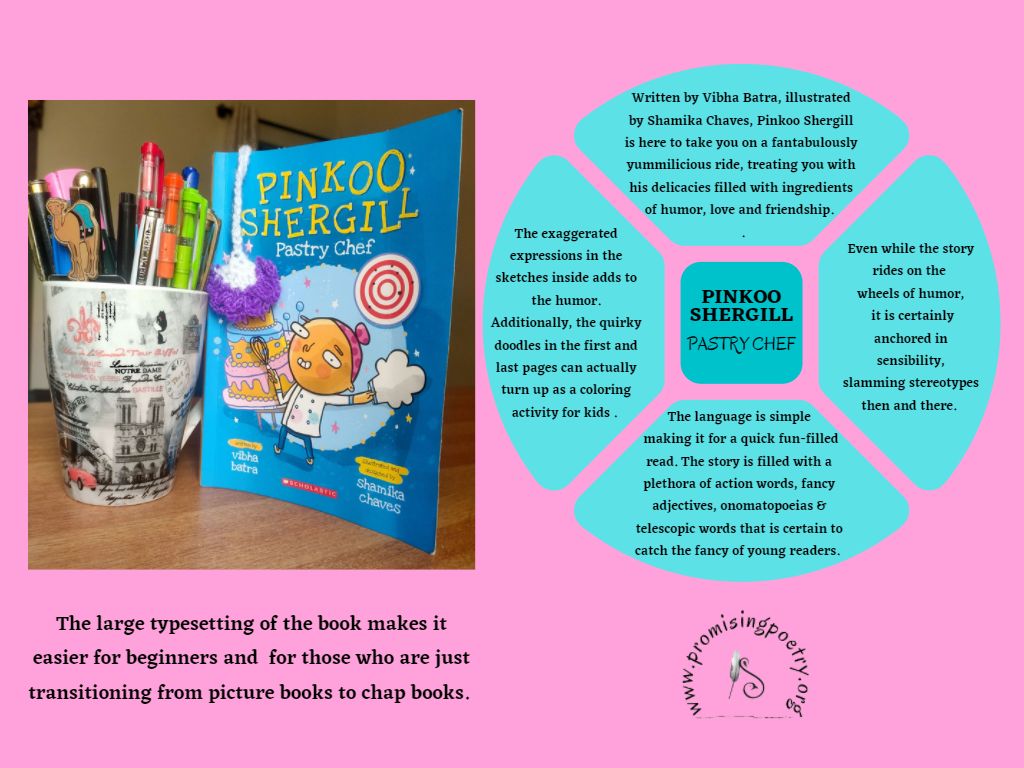
Pinkoo Shergill, a quick look. Image Source: Designed by self on Canva
Pinkoo Shergill is here to take you on a fantabulously yummilicious ride, treating you with his delicacies filled with ingredients of humour, love and friendship.
Pinkoo, the 10-year-old boy breathes, dreams and lives for baking while his Papaji is conditioned to believe the kitchen is not for boys to step in. How Pinkoo overcomes all the hurdles to enter the Great Junior Bake-a-Thon with an unexpected surprise waiting at the end is what the story is about.
Even while the story rides on the wheels of humour, it is certainly anchored in sensibility slamming stereotypes then and there. To do so without sounding preachy, to be able to talk in the language of children is the biggest plus of the book.
The characters are well defined and much relatable. The blabbermouth cousin Tutu, the supportive friend Manu, the annoying-girl-turned-friendly Nimrat are all very much liked by my daughter as she could relate to one of each from her own friends’ circle.
My daughter, Miss M was fascinated about the joint family set-up and the Punjabi way of addressing the relatives. Also, the generous use of onomatopoeias (like buuuzzz, pinggg, whooosh) and telescopic words (like giganterous, coolsome, irritatinnoying) caught her fancy at once and now she has her own list of such words.
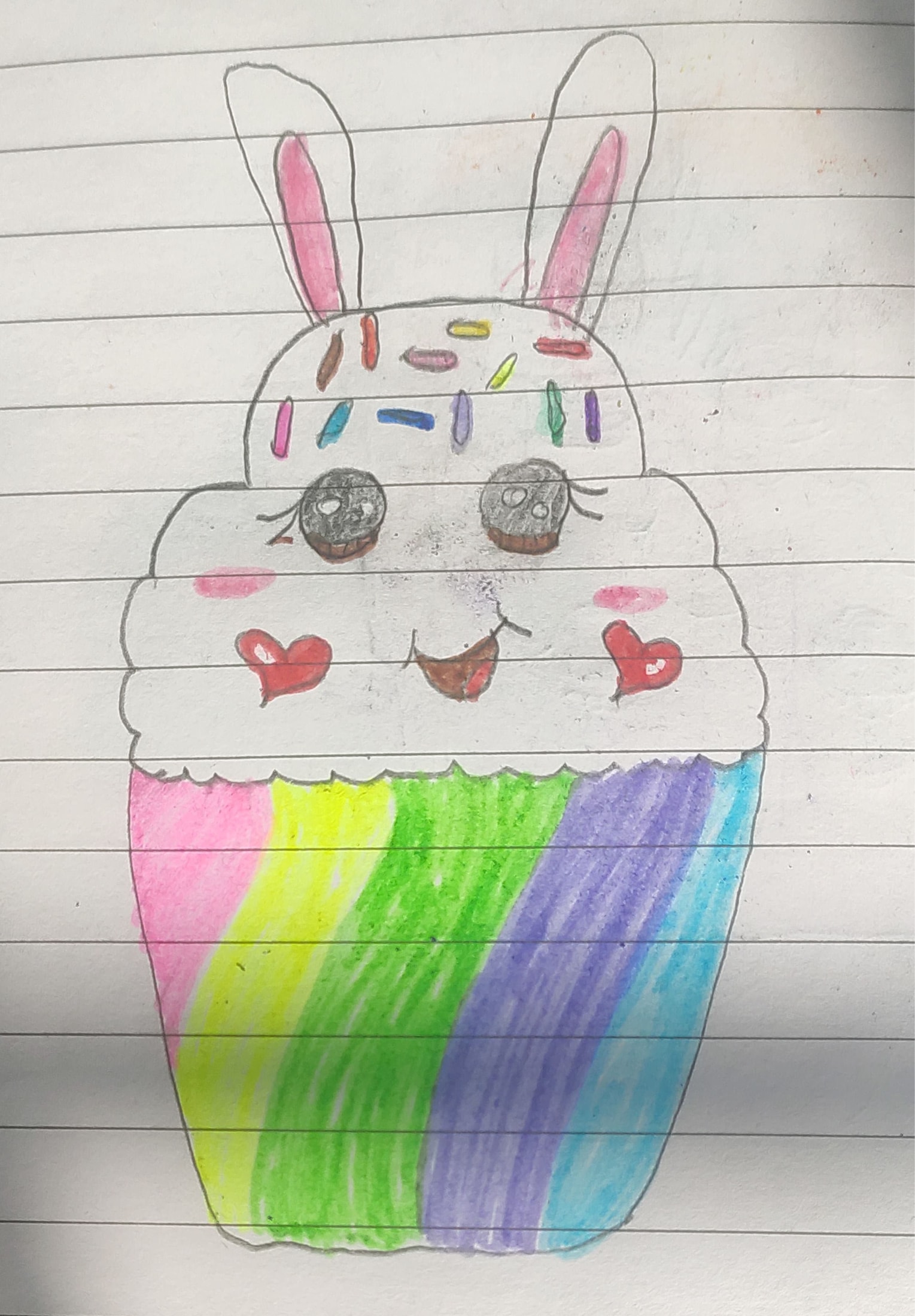
What you see above is some Pinkoo Shergill inspired cakes and cupcakes drawn by my daughter. Also yes, she is a big-time unicorn fan!
My personal favourite happens to be the conversations between Pinkoo’s and Tutu’s eyes.
Yeah right, conversation between eyes! They have a dialogue going. I told you, this book is hilarious.
A word of caution: The book takes you through a ride of yummilicious cake preparations, all so drool-worthy and is best enjoyed with at least a cupcake or gulabjamun by your side.
The author, Vibha Batra, has kept the language simple making it for a quick fun-filled read. She has also filled in the story with a plethora of action words and fancy adjectives that is certain to catch the fancy of young readers. It can also come in handy for teachers too to introduce the same in a fun way through the story.
The only minus I see in the book is the overuse of capitalizations which felt sore to my adult eyes though I’m not sure if I can call it a minus as my daughter found it just fine.
The cover page by the illustrator Shamika Chaves is vibrant and beautiful. The exaggerated expressions in the sketches inside adds to the humour.
Additionally, the quirky doodles in the first and last pages can actually turn up as a colouring activity for kids (idea courtesy, Miss.M).
Altogether, Pinkoo Shergill makes for a quick fun read with ingredients of humour, love and friendship added in the right proportions making the story a relishing experience. The large typesetting makes it easier for beginners or for those who are just transitioning from picture books to chapbooks.
P.S. Don’t miss out on the creativity of the author come out even in the acknowledgements at the end.
You may think that you consume poetry consciously but there may come along a book, like Gitanjali, where poetry will consume you, wholly, making you feel both lost and found, leaving you with a gratified feeling.
It’s with a feeling of reverence and fondness that I attempt at writing about this book. This book is one that I don’t want to view from a reviewer’s lens. Though this post may be tagged under the category of a book review, let me be clear that this is not a book review.
This is more like a childlike joy of sharing a found treasure with friends. This is exactly that.
Rabindranath Tagore’s Gitanjali is a treasure to be shared and enjoyed, consumed and let be consumed, discussed in platforms and yet relished in silence.
Written by the Bengali poet Rabindranath Tagore, Gitanjali (which translates to “Song Offerings”) is a collection of translated poems of Tagore’s collection of Bengali poems titled Gitanjali. Well, the Bengali collection had 157 poems while the English translated collection has only 103 poems.
The collection of poems captures the conversations of the poet with God in its profoundness even while keeping the language simple. It’s the simplicity in which Tagore brings out hope and the possibility to have conversations with God that makes it extraordinarily beautiful.
The poet Rabindranath Tagore won the Nobel Prize for Literature for Gitanjali in the year 1913 which put Indian Literature in high regard across the world.
Where the mind is without fear
I was introduced to Tagore’s work in my school through this poem “Where the mind is without fear” from Gitanjali–
Where the mind is without fear and the head is held high;
Where knowledge is free;
Where the world has not been broken up into fragments by narrow domestic walls;
Where words come out from the depth of truth;
Where tireless striving stretches its arms towards perfection;
Where the clear stream of reason has not lost its way into the dreary desert sand of dead habit;
Where the mind is led forward by thee into ever-widening thought and action
Into that heaven of freedom, my Father, let my country awake.
This poem, written by the visionary during the period when the British ruled India, at first looked like written as a yearning for freedom from slavery. But what made me feel relevant even now, making it a timeless classic is that it yearns for freedom from our very own limitations of the mind.
This poem and all of the other poems in Gitanjali too helps work on an individual level of freedom.
As a nation, we might be free from the shackles of slavery seeing progress in the fields of science, technology, medicine, sports, etc. But are we free from discrimination at the grassroots levels?
Do we even realize what freedom of mind may actually mean?
Gitanjali gently nudges us to question ourselves leading us to the heaven of freedom where the heaven is found just within us, where God sits right inside of us making conversations with Him possible, right now.
Gitanjali-Biggest influence on my poetry (and life) journey
As mentioned in one of my previous posts, Rabindranath Tagore’s Gitanjali is one of the biggest influences on my poetry (and life) journey and honestly, I don’t remember how I landed up with this book. But one thing that I clearly remember is that the very first poem in it had me in tears. Here is that piece:
Thou hast made me endless, such is thy pleasure,
This is my prayer to thee, my Lord-strike,
strike at the root of penury in my heart,
Clouds heap upon clouds and it darkensThou hast made me endless, such is thy pleasure
Thou hast made me endless, such is thy pleasure.
This frail vessel thou emptiest again and again,
and fillest it ever with fresh life.This little flute of a reed thou hast carried over hills and dales,
and hast breathed through it melodies eternally new.
At the immortal touch of thy hands
my little heart loses its limits in joy
and gives birth to utterance ineffable.Thy infinite gifts come to me
only on these very small hands of mine.
Ages pass, and still thou pourest,
and still there is room to fill.
— Tagore
More interestingly, I couldn’t move on to the rest of the poems and I didn’t force myself to do so too. I sat with the poem.
Some poems come to you to prepare you for an intense experience
while some others come in as an assurance that your path is headed the right way.
Gitanjali has poems that make me feel both ways.
A relationship with God
More often or so, our relationship with God stems from fear or an obligation or a traditional practice but this anthology will make one seek God from a space of love.
There are times when the complexities of life may drain us, making life a dreadful solo journey. But one read of even one poem from Gitanjali can make you feel comfortable assuring that it needn’t be a solo journey while He is by your side.
Tagore brings in the beauty and joy of having an honest relationship with God through his lines effortlessly and efficiently.
I ask for a moment's indulgence to sit by thy side. The works that I have in hand I will finish afterwards.Away from the sight of thy face my heart knows no rest nor respite, and my work becomes an endless toil in a shoreless sea of toil.To-day the summer has come at my window with its sighs and murmurs; and the bees are plying their minstrelsy at the court of the flowering grove.Now it is time to sit quiet, face to face with thee,and to sing dedication of life in this silent and overflowing leisure.
- Tagore in Gitanjali
Ain’t it just amazing? I sometimes feel that kids have such conversations easily while we as adults lose the connection with God because of our learned ignorance. Kids keep it simple like this conversation in the poem above. They say their fears openly, approach and own God which we as adults fear to do, afraid of being judged.
Gitanjali makes those real-time conversations with God possible and helps experience the childlike joy that comes with believing in magic and being open to it.
On another note, I would also love for you to listen to the song below penned by Tagore (not from Gitanjali though) which gives one the hope and courage to make the right choices and walk alone if the right thing is to stay away from a wrongful crowd.
What makes Gitanjali a must read
This book has an introduction to Gitanjali by the Irish poet W B Yeats is more than enough of a reason to make Gitanjali a must-read. Yeats’ introduction clearly shows his fascination for the mysticism in Tagore’s poems and calls it the work of a supreme culture.
Where most of the divisions and discriminations creep into society out of a religious divide, this anthology has the power of changing perspectives working on an individual level to free us from such limitations.
Even for an atheist, this book has an appeal as there’s no definite portrayal of God here and it’s more of an abstraction and personification. And the poems can make one easily personify God the way they want or simply relate it to an idea they believe in.
It’s more of an experience than a depiction. It’s more of a personal belief than a traditional practice.
Gitanjali helps you shift from a religious trip to a spiritual voyage with hope and love as comfort.
Concluding Notes
Our prayers end in a hurry, we take time to do rituals but not the time to sit alone to contemplate or have a conversation with God. We don’t even think about the possibility of having a conversation with God.
We distance ourselves from God not knowing of His residence just right in our hearts. Gitanjali helps you find Him, fall in love and make Him your forever friend.
We do things out of fear but not with an open-mindedness to seek, to be called wrong and to learn right from the wrong. We forget to learn to unlearn. And it can be hard from a lot of conditioning since birth but that is where Tagore’s Gitanjali comes in as a gentle nudge and a comforting blanket.
Some poems come to you to prepare you for an intense experience
while some others come in as an assurance that your path is headed the right way.
Gitanjali has poems that can make you feel both ways.
–
P.S. Not every poem in Gitanjali has to be read in one go. Nor every poem of Gitanjali may appeal to you all at once. It is a growing experience.
Sit alone with one poem at a time and experience the magic it brings along. I bet, it will grow upon you and the poems will start talking to you (not necessarily in the same order of writing) right at the time when you least expect it.
A book review is an unbiased, critical analysis of a book focusing on the style, theme, strengths and weaknesses of the book, criticizing the content and not the author and also not giving away the whole story (or content) of the book.
Book reviews are meant to help you find the right book that can find answers to your seeking (be it joy, knowledge, curiosity or truth). It also helps as a bridge between authors and readers without compromising on each other’s purposes.
The need for a book review
What’s the need for a book review you may ask when there is the choice of reading the blurb or few pages into the book if you are buying offline or checking out author’s or publisher’s talks as part of a promotion? To answer in short, blurbs and promotional talks are carefully curated to impress you.
Now take a look at these two situations:
Situation 1: Have you ever grabbed a book just by one look at its enticing cover and one read of its cleverly written blurb only to regret the buy? I have done that and all I wished was then was to have had/read an honest book review of the poetry book earlier.
Nevertheless, the poetry book actually served the purpose of inspiring me in an unexpected way because it’s only upon reading few pages into that book that my husband said I write much better and that I consider writing poetry seriously.
Situation 2: If you are a parent buying book for your kid and you read the blurb, carefully scan the contents on the index page and also glance through few pages of the book only to end up with your kid pointing out inappropriate content with awkward questions after the buy, won’t you feel upset? Well, I have been there.
The blurbs and promotions won’t tell you much about the settings, the sentiments that run through the book, the feelings that the book may evoke or if there is any content that may be right as per the context but seem inappropriate for a kid to see it out of the context.
It’s to avoid such regrets and embarrassments that one needs honest book reviews.
Also with over a million books published every year and the number just growing exponentially, it becomes difficult for a reader to find the right book just like it’s difficult for an author to reach the right audience. This is where book reviewers come to play.
Book reviewers bridge the gap between an author and a reader.
What’s in a book review for a reader
As a reader, a book review can help to understand the theme, settings and style of writing to know if it’s something of your interest.
It helps you understand the age appropriateness of the content, especially in children’s literature it’s a key deciding factor.
A good review can help you explore new genres which otherwise you might not have picked up.
When it comes to books of debut author’s a book review can be the key deciding factor.
An honest book review can save you from buying a wrong one.
What’s in a book review for an author
It helps in reaching your book to the right audience.
A good book review helps in bringing greater visibility to the book.
Reviews help open up discussions around the book, thereby helping authors to identify the pulse of the audience.
It also helps authors get an idea to what write next.
An honest review even helps the author identify the weakness in the plot/writing and come up better next time.
What’s in a book review for a reviewer
To be able to analyze a book critically and share a review gives the pleasure of revisiting the content/story again.
For a reviewer, it helps as an aid to hold on to key aspects of the book for a longer period of time.
It helps a reviewer explore new genres and also be open to new ideas.
Over time, with reviewing, it helps the reviewer to view their own work with critical lens.
If the reviewer has a good track record for honest and critical reviews, he/she/they get books for free (for reviewing) and also get the chances to be paid too in exchange of a genuine review.
Concluding Notes
With an ocean of books available online and offline, book reviews have the potential to make or break a deal. As much as it’s important to have book reviews, it’s also important on a reviewer’s part to keep it honest.
Let me know your experience with book reviews or book reviewing!
We use cookies on our website to give you the most relevant experience by remembering your preferences and repeat visits. By clicking “Accept All”, you consent to the use of ALL the cookies. However, you may visit "Cookie Settings" to provide a controlled consent.
This website uses cookies to improve your experience while you navigate through the website. Out of these, the cookies that are categorized as necessary are stored on your browser as they are essential for the working of basic functionalities of the website. We also use third-party cookies that help us analyze and understand how you use this website. These cookies will be stored in your browser only with your consent. You also have the option to opt-out of these cookies. But opting out of some of these cookies may affect your browsing experience.
Necessary cookies are absolutely essential for the website to function properly. These cookies ensure basic functionalities and security features of the website, anonymously.
Cookie
Duration
Description
cookielawinfo-checkbox-analytics
11 months
This cookie is set by GDPR Cookie Consent plugin. The cookie is used to store the user consent for the cookies in the category "Analytics".
cookielawinfo-checkbox-functional
11 months
The cookie is set by GDPR cookie consent to record the user consent for the cookies in the category "Functional".
cookielawinfo-checkbox-necessary
11 months
This cookie is set by GDPR Cookie Consent plugin. The cookies is used to store the user consent for the cookies in the category "Necessary".
cookielawinfo-checkbox-others
11 months
This cookie is set by GDPR Cookie Consent plugin. The cookie is used to store the user consent for the cookies in the category "Other.
cookielawinfo-checkbox-performance
11 months
This cookie is set by GDPR Cookie Consent plugin. The cookie is used to store the user consent for the cookies in the category "Performance".
viewed_cookie_policy
11 months
The cookie is set by the GDPR Cookie Consent plugin and is used to store whether or not user has consented to the use of cookies. It does not store any personal data.
Functional cookies help to perform certain functionalities like sharing the content of the website on social media platforms, collect feedbacks, and other third-party features.
Performance cookies are used to understand and analyze the key performance indexes of the website which helps in delivering a better user experience for the visitors.
Analytical cookies are used to understand how visitors interact with the website. These cookies help provide information on metrics the number of visitors, bounce rate, traffic source, etc.
Advertisement cookies are used to provide visitors with relevant ads and marketing campaigns. These cookies track visitors across websites and collect information to provide customized ads.