Hola! This poem is part of my Ars Poetica – BlogchatterA2Z 2025 series, where I explore the art of poetry through 26 stanzas, each beginning with a different letter of the alphabet. Every day, a new stanza unfolds, building upon the previous ones intuitively and organically. If you’re just joining in, feel free to read from the beginning or simply dive into today’s reflection on poetry.
Stanza 7 of the Ars Poetica—Gestation of Grace
Giving her the time she needs to open up, I carry her in the fabric of my being. She lingers in every cell, every nerve— a quiet pulse I cannot unfeel. It’s like the gestation of something sacred, where anxiety and awe weave themselves into breath. An unknown life grows within, grows around, grows through— consuming me, wholly— my care, my energy, my very sense of self. And I don’t mind vanishing into her— for this is no ordinary surrender. This creation has chosen me, a gift seeded by the universe, waiting to be born in word.
Hola! This poem is part of my Ars Poetica – BlogchatterA2Z 2025 series, where I explore the art of poetry through 26 stanzas, each beginning with a different letter of the alphabet. Every day, a new stanza unfolds, building upon the previous ones intuitively and organically. If you’re just joining in, feel free to read from the beginning or simply dive into today’s reflection on poetry.
Stanza 6 of the Ars Poetica—Fathoming the Unfathomable
From the hush of intuition, a question stirs: What holds the poem—form or freedom? Is it the spine of a sonnet or the spill of free verse That makes it belong to this moment’s breath? How do we fathom what resists being known? Do we chase it down, begging for clarity, Or wait—still, receptive— As it arrives bearing its secret confession? A bloom in the dark, Not of confusion, But creation.
Hola! This poem is part of my Ars Poetica – BlogchatterA2Z 2025 series, where I explore the art of poetry through 26 stanzas, each beginning with a different letter of the alphabet. Every day, a new stanza unfolds, building upon the previous ones intuitively and organically. If you’re just joining in, feel free to read from the beginning or simply dive into today’s reflection on poetry.
Stanza 5 of the Ars Poetica—Echoes of Ecstasy
Echoes of ecstasy then arrive in evocative expressions Like a divine intervention With a download of disengaged words Splattered across the field of imagination Each word holds its own pulse, Gathering under a shower of light. And as they take root in the hush of thought, A forest rises from buried seeds— Each a quiet promise of life.
Hola! This poem is part of my Ars Poetica – BlogchatterA2Z 2025 series, where I explore the art of poetry through 26 stanzas, each beginning with a different letter of the alphabet. Every day, a new stanza unfolds, building upon the previous ones intuitively and organically. If you’re just joining in, feel free to read from the beginning or simply dive into today’s reflection on poetry.
Stanza 4 of the Ars Poetica—Dance of Discovery
Da-dhan da-dhan da-dhan da-dhan— Now that she has all my attention, There’s a dance of discovery, Like Rumi’s twirls of ecstasy, Spinning into silence, into knowing. The da-dhan’s of my world take no words — Not yet. They pulse in rhythm, syncing with my breath, Or with the beat the poem decides to take. For now, it’s just the da-dhan, da-dhan, da-dhan — Where beats prelude the dance of diction, Where language holds its breath before the plunge.
Hola! This poem is part of my Ars Poetica – BlogchatterA2Z 2025 series, where I explore the art of poetry through 26 stanzas, each beginning with a different letter of the alphabet. Every day, a new stanza unfolds, building upon the previous ones intuitively and organically. If you’re just joining in, feel free to read from the beginning or simply dive into today’s reflection on poetry.
Stanza 3 of the Ars Poetica—Cry of the Unheard
Childish yet persistent, poetry clings, Crying for attention in the middle of chaos— Clutching my legs like a wailing child, While life wheels past, demanding more. Call it trivial, call it untimely, But never call it ignorable— For poetry, like a child unheard, Only screams louder when dismissed.
Hola! This poem is part of my Ars Poetica – BlogchatterA2Z 2025 series, where I explore the art of poetry through 26 stanzas, each beginning with a different letter of the alphabet. Every day, a new stanza unfolds, building upon the previous ones intuitively and organically. If you’re just joining in, feel free to read from the beginning or simply dive into today’s reflection on poetry.
Stanza 2 of the Ars Poetica—Beneath the Pulse of Pause
Breath is either effortless or laborious but never biased. Between the choices I make to Notice or ignore the mundane messengers of life Pushing their way into my senses, Breath bursts into life— Being & belonging In every pause I make Between silence and words.
And in those pauses, Breath turns to poetry, Balancing on the edge of awareness, Bridging the known and unsaid, Believing that the lump down my throat Deserves breath, deserves life— Even when packing dabbas Isn’t a metaphor heavy with prophecy…
April is an exciting month in the blogging and poetry world, packed with creative challenges. Over the years, I have participated in both NaPoWriMo and BlogchatterA2Z, and this year, I’m once again diving into my favorite—BlogchatterA2Z! The challenge is simple yet demanding: to publish 26 posts throughout April, each corresponding to a letter of the English alphabet, with Sundays as rest days.
Last year, I explored The Poet’s Alphabet, a series covering everything one should know about the craft of poetry. This year, I’m taking a different approach. Instead of writing multiple poems, I’ll be writing just one, over 26 days! Specifically, I’ll be crafting an Ars Poetica—a poem about poetry itself.
The concept of Ars Poetica originates from Horace, whose poem of the same name became so influential that the title eventually evolved into a genre in itself—much like how “Xerox” became synonymous with photocopying. Inspired by this tradition, I will be writing my own Ars Poetica, with each stanza beginning with a different letter of the alphabet.
As of now, that’s all I know. This will be an intuitive, organic process, where each day’s writing will surprise me as much as it surprises you! What you’ll be reading are draft versions—raw, unpolished, and evolving. Toward the end, I will refine and weave them together into a cohesive piece.
I hope you’ll join me on this journey, sharing your thoughts, feedback, and constructive criticism along the way. For now, grab a front-row seat and watch a poem take shape from its very first lines! By the way, I just realized I had written an Ars Poetica even before I knew what it was! You can read it here.
Let’s start with the Ars Poetica for the BlogchatterA2Z challenge.
Stanza 1 of the Ars Poetica – Alchemy of Words
Around eight in the morning When it’s time to pack dabbas With rice, salad, and a curry, Even as a whiff of coffee with chicory Refuses to linger a little longer— As if in a hurry to leave before The stink of wet waste lounging In the corner of my house for over a week takes over— An alchemy of strangeness and familiarity Runs down my throat, knotting The mundane with metaphors, Bringing life to fleeting ephemera. Words form a lump in my throat— To be gulped down, then later chewed over, To see if they are worth a life, As my mind still churns with the question: What good can poetry cook up Around eight in the morning When it’s time to pack dabbas?
Participating in the Write A Page A Day (WAPAD) campaign by Blogchatter, where you write every day in February to reach a target of 10,000 words, has been an incredible growth journey for me. This year marks my third participation, and with the benefit of hindsight, I can see just how much I’ve evolved over these three campaigns.
Year One: Chasing Word Counts
In my first year, I was enthusiastic about the challenge of writing daily, but the 10,000-word target gave me jitters. My primary reason for participating was to cultivate a daily writing habit.
Most days, I journaled my reflections, keeping them private. Yet, on days when I didn’t feel like writing, the thought of logging a zero-word count pushed me to write at least 50 words. Throughout the month, I was obsessed with tracking my word count and calculating my progress, focusing more on reaching the target than enjoying the writing process itself.
Year Two: Seeking Validation
By the second year, I was more confident about meeting the word count. I planned ahead and decided to write love-themed poems, sharing one each day on my blog. I genuinely enjoyed interacting with readers and fellow bloggers, but the pressure to post 28 poems in 28 days started feeling overwhelming by the third week.
Though I persisted—editing and posting older poems on low-energy days—I realized that writing for validation wasn’t fulfilling. Trying to force creativity into a time frame didn’t always bring out my best work.
Year Three: Writing for the Joy of It
This year, I approached WAPAD without a rigid plan. Writing has become second nature to me, and past experiences with Blogchatter campaigns have established me as a writer within my circle. I no longer feared word counts, and having various writing projects, from poetry editing and translation to website copywriting and book formatting, I felt liberated to write purely for the joy of it.
I embraced days with zero word counts without guilt or panic. I also experimented with long-form content, including writing for a book and journaling for self-reflection, without feeling the urge to post online instantly. This year, I learned to sit with my words, ruminate, and reflect before editing, fully enjoying the writing process.
The Evolution
Reflecting on these three years, I realize how much I’ve grown. From anxiously tracking word counts to seeking validation, and finally, to writing for the love of writing itself, my journey with WAPAD has been transformative. I’ve learned to embrace the process, let go of self-imposed pressures, and find joy in simply putting words on paper. And that, to me, is a win worth celebrating.
This is my little gift to you—a poem to inspire a hopeful start, wherever you are and whenever you need it.
Written in the timeless style of Rudyard Kipling’s ‘If,’ it encourages you to embrace your past, trust life’s process, and discover light even in the darkest moments. A celebration of fresh starts and self-discovery awaits!
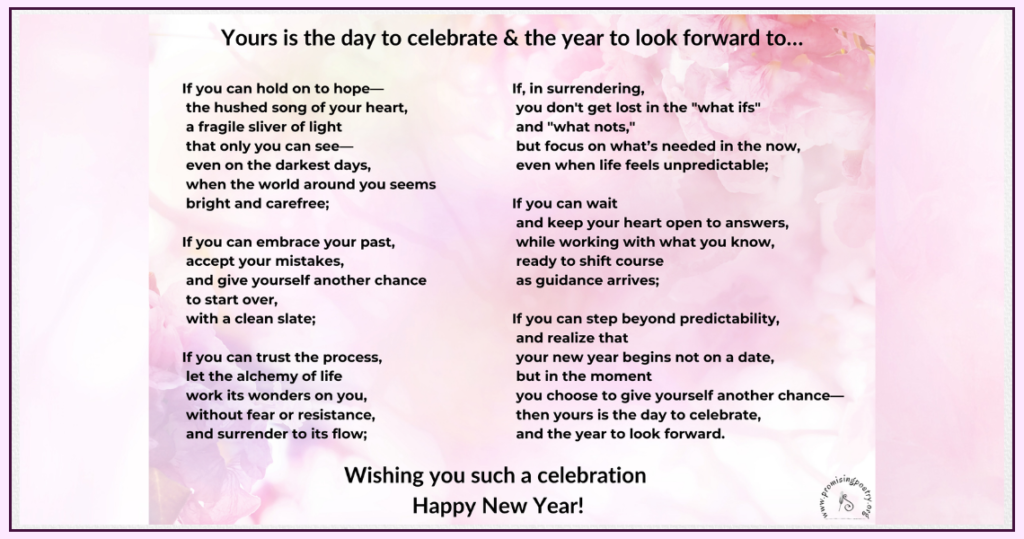
Yours is the day to celebrate & the year to look forward to
If you can hold on to hope—
the hushed song of your heart,
a fragile sliver of light
that only you can see—
even on the darkest days,
when the world around you seems
bright and carefree;

If you can embrace your past,
accept your mistakes,
and give yourself another chance
to start over,
with a clean slate;

If you can trust the process,
let the alchemy of life
work its wonders on you,
without fear or resistance,
and surrender to its flow;

If, in surrendering,
you don't get lost in the "what ifs"
and "what nots,"
but focus on what’s needed in the now,
even when life feels unpredictable;

If you can wait
and keep your heart open to answers,
while working with what you know,
ready to shift course
as guidance arrives;

If you can step beyond predictability,
and realize that
your new year begins not on a date,
but in the moment
you choose to give yourself another chance—

Then yours is the day to celebrate,
and the year to look forward.
Wishing you such a celebration. Happy New Year!
~ Seetha (aka) Preethi
312300cookie-checkYours is the day to celebrate & the year to look forward to — A PoemyesServices, Testimonials
At Promising Poetry, we believe in creating heartfelt, bespoke poetic experiences that resonate deeply with our clients. From commemorating cherished relationships to crafting unique gifts that speak volumes, our work is driven by a passion for words and a dedication to personal connection.
Every testimonial here reflects the joy, emotion, and satisfaction our clients have experienced through our customized poetry services. These words inspire us to continue weaving magic with words and creating meaningful moments for everyone who trusts us with their stories.
Here’s what our valued clients have to say about their journey with Promising Poetry:
Ms Nanditha Shaji
Service Integration Manager, Novartis
It was a delightful experience to get my Dad’s picture customised with Promising Poetry. Words, if used rightly, can create magic, and that is why I was looking for a customised frame for my Dad’s picture, and Seetha very clearly understood my feelings and my bond with my Dad.
She penned down beautiful poetry explaining my relationship so well that reading it for the first time just brought tears to my eyes.
Thank you, Promising Poetry, for the amazing work. Stay blessed, Seetha!
Ms Deepa Karthikeyan
A proud Mother
I have known Preethi (aka Seetha) from her childhood and her customised poems always amaze me. It gives me goosebumps and I always wonder how can a person write a customised poem even for strangers, that too with such accuracy. Only a few will have such a calibre and Preethi is that rare one.
I love her Tamil poetry and request to write more in Tamil too. Also, I’m impressed by her blogs on “Living with an autoimmune disorder” which brings out awareness on autoimmune disorders.
Proud of you Preethi, God Bless!
Mr Krishnan Nalaiah
Vice President, GVL Inc.
The customised poetry gift that I received is a beautiful piece and an excellent poetic rendition. Wish you the best in your every endeavour. Certain that you will attain success and stardom.
Thank you very much, as I will cherish your “Promising poetry just for you” for very long.
Ms Harini
Company secretary in practice
Big thanks to Promising Poetry & Preethi. I have taken assistance for more than 4 works & received 1 from my friends. Awesome, all of them were. What I like the best about her is she delivers in a very short span. I almost told them every time at the last moment and she managed to carry out the same immediately without a slight frown. Thank you so much.
She also gets your thoughts immediately, and the work matches your expectations perfectly. How at all she gets an acronym with the perfect description is best known to her. Personalised gifting, you get the best here.
Ms Gayathri
IT Employee, CTS
Thank you Promising Poetry for the customized poetry gift which I ordered for my parents. I would say, it just created magic and the most memorable moments. My mom and dad loved it so much and magic came to light. Thank you so much.
It was a great experience working with you. Theme, wordings, the look…everything was in alignment with my expectations. Thanks for putting all these together into a great gift. I would highly recommend Promising Poetry for a customised gift with a touch of poetry.
Mrs. Lalitha Panchapakesan
Writer, Poet
I recently had the pleasure of working with Seethalakshmi, and I must say, the experience was exceptional. Her profound understanding of both languages involved and her deep appreciation for poetry truly shone through in her work.
Seetha skillfully captured the essence and intricacies of the original poems and translated them while preserving the poetic rhythm and maintaining the emotional resonance of the poems.
Beyond technical proficiency, Seetha displayed a genuine passion for her craft. Her love for poetry was evident in how she carefully considered the cultural nuances and historical contexts of the original works, allowing readers to fully immerse themselves in the poems’ richness.
I highly recommend Seetha’s services.
Mrs. Raji Balachander
Independent Writer, Co-Editor of the Governor’s Monthly Newsletter for Rotary District 3233
A testimonial is long overdue for Preethi. Although I have never penned it in actual words (I have told her, though), I have always marvelled at the way she is able to gauge the requirement of the person (almost mind-read) requesting the gift of poetry from her. The first time she wrote for me was 10 years back (now u know how long this testimonial is due), for the 50th birthday of our eldest brother-in-law. It was in Tamil. I remember telling her why he was special to the family… just 3-4 lines.. but the poem was close to 20 lines, an awesome summary encompassing all that I told her and a bit more. That’s what makes her special… her going that extra mile to make that extra smile on the receiver’s face. Needless to say, he loved it, and it was just the beginning… Then came her verses in English: for a wedding, for the birthday of two married high-school sweetheart friends of mine and an acrostic poetry for their child’s first bday, for my beloved Professor in college, and a whopping 100 acrostic poetry bday verses for 100 members of the rotary club we were part of: each unique, reflecting the character of the person who celebrated his bday.
Two of my most favourite ones of hers are a Tamil ode written as a blessing from his demised parents for a family friend’s 50th birthday and an acrostic farewell poem in English from my furry son to my nephew who was leaving the country for his higher studies, cherishing the bond they shared. Both the poems evoked tears from the receiver as they were voices from souls they were close to, but couldn’t either hear or understand. Of course, their tears were contagious, and it was a very emotional moment in both cases. The Tamil one was in perfect regional slang, and our friend said he could actually hear his parents’ voices saying them… That’s the power of Preethi’s words… the power to transform words to moments of nostalgia. Coming to think of it, I might actually have left out some of the works I commissioned her to write… She has written so much for me, and I keep coming to her for more coz her words convey what we truly want to say and what’s left unsaid, even. That’s poetry in its own right!
Get in touch!
At Promising Poetry, we aim to inspire, educate, and celebrate the art of poetry. We invite you to explore, create, and share in this vibrant community. Welcome to your poetic journey!
For placing an order for customized poetry or other queries or collaborations, drop us an email at promisingpoetry5@gmail.com.
"Whether you seek to woo, celebrate or express,
We can weave words that truly impress.
Don't wait, reach out and share your story,
Let's craft a bespoke verse that's brimming with glory."
299400cookie-checkTestimonialsyes
We use cookies on our website to give you the most relevant experience by remembering your preferences and repeat visits. By clicking “Accept All”, you consent to the use of ALL the cookies. However, you may visit "Cookie Settings" to provide a controlled consent.
This website uses cookies to improve your experience while you navigate through the website. Out of these, the cookies that are categorized as necessary are stored on your browser as they are essential for the working of basic functionalities of the website. We also use third-party cookies that help us analyze and understand how you use this website. These cookies will be stored in your browser only with your consent. You also have the option to opt-out of these cookies. But opting out of some of these cookies may affect your browsing experience.
Necessary cookies are absolutely essential for the website to function properly. These cookies ensure basic functionalities and security features of the website, anonymously.
Cookie
Duration
Description
cookielawinfo-checkbox-analytics
11 months
This cookie is set by GDPR Cookie Consent plugin. The cookie is used to store the user consent for the cookies in the category "Analytics".
cookielawinfo-checkbox-functional
11 months
The cookie is set by GDPR cookie consent to record the user consent for the cookies in the category "Functional".
cookielawinfo-checkbox-necessary
11 months
This cookie is set by GDPR Cookie Consent plugin. The cookies is used to store the user consent for the cookies in the category "Necessary".
cookielawinfo-checkbox-others
11 months
This cookie is set by GDPR Cookie Consent plugin. The cookie is used to store the user consent for the cookies in the category "Other.
cookielawinfo-checkbox-performance
11 months
This cookie is set by GDPR Cookie Consent plugin. The cookie is used to store the user consent for the cookies in the category "Performance".
viewed_cookie_policy
11 months
The cookie is set by the GDPR Cookie Consent plugin and is used to store whether or not user has consented to the use of cookies. It does not store any personal data.
Functional cookies help to perform certain functionalities like sharing the content of the website on social media platforms, collect feedbacks, and other third-party features.
Performance cookies are used to understand and analyze the key performance indexes of the website which helps in delivering a better user experience for the visitors.
Analytical cookies are used to understand how visitors interact with the website. These cookies help provide information on metrics the number of visitors, bounce rate, traffic source, etc.
Advertisement cookies are used to provide visitors with relevant ads and marketing campaigns. These cookies track visitors across websites and collect information to provide customized ads.