Hello, hello! Kicking off the #CollaborativePoetry initiative on a high note as the previous blog post about it has clinched the top blog award from the Blogchatter community. Check here.
Before you dive into the first collaborative poetry, here are a few things I’d like to share:
The first line of the poem is written by the other person, while the second by me, and so on, alternatingly.
What you see here is a raw, first draft that will undergo further editing before finding its place within the pages of a book.
There is no fixed theme or title before embarking on this poetic journey. With each line, our perspectives shifts, and so does the direction of the poem. That’s the uniqueness and beauty of this #CollaborativePoetry.
Every collaborator in this series comes from different backgrounds, ranging from novice to expert in writing/poetry.
To add an extra layer of intrigue, for each poem, I’ll share an analysis generated by ChatGPT. This allows you to see if your understanding or perspective of the poem aligns with it or not. Remember, the beauty of poetry lies in its ability to hold multiple perspectives, all of which can be valid.
So, let’s dive into the poem of the day.
This poem is in collaboration with, Shubhangi Shukla. She’s an Indian woman on her journey to redefine what it means to be a woman. She helps other women overcome mental, emotional and energetic blocks, rediscover who they are beyond family and work obligations, and become their most confident and empowered version. Check out her business profile, here.
Collaborative Poetry: Becoming
Sitting cross-legged between yellow walls The canvas of my mind breathes Blue skies and beautiful white clouds... Nascent wings of my feminine, flutters Is this ALL to life or is there more? Do canvases turn concrete or expand too? Am I moulded or can I become HER? The boundless beauty that I dream of- Ambitious. Persevering. Sincere. Whole. Love. Breathe into life, breaking the yellow wall!
The poem explores themes of self-discovery, ambition, and the quest for personal transformation. The speaker begins by setting the scene, describing themselves sitting amidst yellow walls, which can symbolize confinement or limitation. However, amidst this confinement, the canvas of the speaker’s mind is depicted as expansive, filled with imagery of blue skies and white clouds, suggesting a desire for freedom and transcendence.
The speaker then reflects on the potential of life, questioning whether there is more beyond the confines of their current existence. This introspection leads to a consideration of personal growth and empowerment. The mention of “Nascent wings of my feminine” suggests a burgeoning sense of identity and agency, particularly in the context of femininity.
The poem’s central question—whether the speaker is merely moulded by their circumstances or capable of transformation—underscores a desire for self-realization and fulfilment. The speaker aspires to embody qualities such as ambition, perseverance, sincerity, and love, envisioning a boundless beauty that transcends limitations.
The concluding lines evoke a sense of empowerment and liberation as the speaker’s aspirations breathe life into existence, breaking through the metaphorical yellow walls of constraint. This suggests a transformative journey towards self-actualization and the realization of one’s full potential.
How did you find this collaborative poetry? If you want to see your masterpiece featured here, click on the post below to get all the details! Let’s create magic through collaborative poetry!
Did you know that there are poetries with just one word? Or that famous poems can be as simple as a post-it note on a refrigerator? And here’s the kicker – there’s a heap of nonsense poems out there, taken seriously and all!
Did you know that my debut in poetry was an epic saga about a mosquito, then a cockroach, and shockingly, it made its grand debut in my school magazine? And hey, guess what? You, yes you, can write poetry too! Mind-blowing, right?
Hey there! I’m Seethalakshmi, also known as Preethi. I’ve got a background in Mathematics, but took a wild turn into the world of poetry a few years back, even though I never studied literature. And guess what? You can dive into poetry too!
In my journey with poetry over the past few years, I’ve noticed that many folks feel poetry is reserved for the elite, sophisticated, or artsy types. But that’s just not true!
Poetry is for everyone—for you and me to every person out there. We’ve been surrounded by poetry since birth—through lullabies, sing-songs, rhymes, prayers, classical tunes, movie songs.
So, how do you get started?
To make poetry a more integral part of our everyday lives and bask in its beauty, I’m planning a little something called #CollaborativePoetry. Yep, you heard it right!
You and I can team up and create poetry together. How cool is that? Let’s bring some poetic magic into the world, one collaboration at a time!
#CollaborativePoetry Guidelines
So, without further ado, let’s dive into the guidelines:
There are no rules when it comes to poetry. Come on… poetry is all about breaking rules and having fun, right? So, there’s absolutely no restrictions on theme, topic, or structure of poetry.
As for the number of lines, let’s stick to a maximum of 10 lines. The idea is simple: you start with a line, followed by a line from my side, and so on, alternatingly.
Wondering where to write? Well, if you know me personally, you can connect with me over WhatsApp. If not, just drop me an email at promisingpoetry5@gmail.com saying Hi with the subject line as #CollaborativePoetry. We can then connect over Google Chat and create a poem at our convenience.
Who can write? YOU!! Yes, YOU!! There’s no age limit and no need for any prior knowledge of poetry.
Which language? English or Tamil, or both. Take your pick!
If you are a privy person and still want to try this, well, there’s an option of staying anonymous even while having your poem in the public eye.
What’s in it for you?
You get the exciting opportunity to collaborate with me. Need I say more? But hey, I’ll throw in some extra incentives just in case.
If you’ve ever felt the urge to try poetry but hesitated, here’s your golden opportunity and a supportive space to do so.
Your masterpiece will be proudly featured on this website, accompanied by a catchy one-liner about you.
Enjoy the perks of backlinks to your website, blog, or any of your social media pages.
And who knows? If this endeavour evolves into a book, your name will grace its pages too!
Sample
Still undecided? Allow me to tantalize you with a taste—a piece in English and another in Tamil, born from collaborations with my tween daughter and my mother (my willing partners in crime)!
The first lines were their creation, while I followed up with the next, and so on alternatingly, in a delightful dance of creativity. We didn’t have any themes or titles in mind, and yet, within 10-20 minutes, these gems emerged!
In this world of beauty,
You're my poetry.
Between both of us
An untold story
Is woven back to life
Like the dawn that never dies...
The memories of us
Stitching those distances
Makes me feel safer-
The sky, your comforting hug!

~A collaboration with my daughter
அன்பு என்பது
பாலைவனச் சோலை
பரந்த விண்வெளி
காணும்-கையளவு காதல்-
யாசிப்பதால் கிடைக்காதது
காத்திருந்தால் சுவையாகிறது,
தன்னைத்தானே நேசிக்கிறது...
நேசித்த நிலையில் விரிவடைந்து
ஆன்மீகத்தை அடைகிறது...
ஒரு பாலைவனச் சோலை
பரந்த  விண்வெளியாகிறது!

~A collaboration with my amma
If you still have any doubts, ask away in the comments section or email me at promisingpoetry5@gmail.com
Ready to dive in? Let’s conjure up some poetic magic together!
Edit: Happy to share that this blogpost is rewarded as the top blog by the Blogchatter community:)
Authors: Rehana Sultana, Anuradha Shetty, Roma Gupta Sinha, Kajal Kapur, Deepti Menon, Chinmayee Sahu, Huma Masood, Nirmiti Narain, Tarang Sinha, Anushree Saha, Dr Alpana Das Sharma, Rahul Vishnoi, Harshita Nanda, Roshan Radhakrishnan, Suchita Agarwal
Publisher: Readomania
Type: Paperback
Page Count: 111
Blurb
What goes on in the minds of people on the threshold of doing something drastic? A woman convinced there’s a presence at her window that only she can see; a collector who has an unusual interest in fingerprints of her victims; an unsettled man blaming everything on his wife; a low-caste child trying to make sense of India’s freedom; a haunted guest house room and the ghost that goes away; a reclusive and aggressive teenager who loves lizards—the stories explore times long ago, realms we never knew existed, the deep recesses of the human mind, and fears that become aggressions.
The Blogchatter Book of Thrillers features 15 thrilling stories from Blogchatter’s community writers—these tales will chill, scare and stay in your head and heart. Featured Authors: Rehana Sultana, Anuradha Shetty, Roma Gupta Sinha, Kajal Kapur, Deepti Menon, Chinmayee Sahu, Huma Masood, Nirmiti Narain, Tarang Sinha, Anushree Saha, Dr Alpna Das Sharma, Rahul Vishnoi, Harshita Nanda, Roshan Radhakrishnan, Suchita Agarwal.
Book Review
I’ve had limited exposure to thrillers, mostly centring on either ghostly tales or crime mysteries. Therefore, when I began this book, I anticipated a similar theme. However, I was astounded by the diverse range it presented. Each story was distinctly unique, revealing that thrillers are capable of eliciting a myriad of nuanced emotions: fear, disgust, longing, guilt, anxiety, dread, paranoia, revenge, tension, and more. It’s this rich blend of emotions that contributes to the success of this anthology, complemented by the array of writing styles found within its pages.
Although the stories vary significantly in their settings, a recurrent thread of social injustices and biases emerges in most of them. This common theme elevates the thrillers, leaving readers with thought-provoking elements to contemplate.
The writing style is concise and fast-paced, rendering it an excellent choice for a quick read. However, due to the story’s brevity, some narratives could benefit from additional background stories or more detailed character sketches. Nevertheless, this limitation can also be viewed as a positive, sparking curiosity and encouraging readers to immerse themselves in their own imaginings, pondering the potential backstories of the characters.
Well, that said, here are brief reflections on each story and the emotions they stirred within me:
“Against My Windowpane” by Rehana Sultana delves into the profound impact on a doctor who grapples with psychological distress after losing a patient due to placental abruption. This narrative prompted contemplation about the often-overlooked mental trauma that physicians might endure while handling various patient diagnoses regularly.
“The Last Rasam” by Anuradha Shetty, set in pre-independent India, starkly exposes the horrors of the caste system and patriarchal oppression. The narrative reveals a mother’s harrowing decision to poison her daughter’s food to liberate her from societal evils. However, the chilling lines at the end, “You are all crazy. The truth is that there is no freedom, Raghu. There is No Freedom,” leaves an indelible, haunting impression, raising profound questions about true liberation.
Enshrouded in mystery,Roma Gupta Sinha’s “The Secrets Of Nandini Rutuja” delves into the life of a once bubbly teenage girl who turned recluse and hasn’t ventured beyond her room for the past two and a half years. This captivating tale explores the intricate bond between the girl and her caretaker, culminating in an unforeseen twist that will leave you shocked.
In Kajal Kapur’s “Memory’s Missing Piece,” we discover the harrowing ordeal of a young reporter who faces an attack while covering the clashes outside Jamia Milia Islamia in Delhi. What intensifies the horror is the enigmatic circumstances surrounding her pregnancy during her hospital treatment. What struck me most about this story was its conclusion—a subtle infusion of love and hope emerging amidst life’s relentless cruelty.
“What Tomorrow Holds” by Deepti Menon narrates the story of a foster child seeking revenge, finding solace in the love offered by an outsider, all while enduring mistreatment from her own family. What struck me about the story was its writing, particularly the concluding line that lingers hauntingly in one’s mind.
Chinmayee Sahu’s “The Encounter” cleverly disguises itself as a typical encounter episode, only to surprise and shock readers with its unpredictable twists. It compels you to eagerly turn back the pages for a re-read, showcasing the depth of its crafty storytelling.
“Fragments Of Yesterday” by Huma Masood follows the journey of a young woman who survives a fatal accident and endeavors to reclaim her lost memories. While the uncertainty about her past pains her, the eventual moment of realization goes beyond mere discomfort—it horrifies her.
“The Fields” by Nirmiti Narain stands out as one of my personal favorites, primarily due to its exceptional writing style. The vivid portrayal of the setting deeply immersed me in the narrative. The unexpected love story between an unconventional pair both surprised and horrified me simultaneously. The unique blend of poetic descriptions within a suspenseful horror story makes it a compelling read, compelling me to revisit this tale multiple times.
“One Night” by Tarang Sinha tugs at your heartstrings, evoking a sense of helplessness as you realize the narrator is a young, distressed girl on the brink of suicide. An unexpected intervention by a paranormal entity leaves you on edge, instilling hope. Just as a sense of positivity starts to emerge, the story concludes with a haunting revelation. This is the kind of narrative that lingers, sure to haunt your thoughts.
“The Dactyist” by Anushree Saha is undeniably the most disturbing and haunting story within this Anthology. The revelation of a psychopath among us, collecting people’s fingerprints as a macabre hobby to such extreme lengths is both unimaginable and chilling. I believe this story would have been best placed as the final entry in the Anthology. The concluding lines are so utterly terrifying that they are bound to send shivers down your spine and haunt your dreams. What better way to conclude a thriller than with such an unnerving narrative?
Dr. Alpana Das Sharma’s “Black”, true to its title, exposes the darkness of the evils faced by women in our society. However, the thrilling aspect of this story lies in how the protagonist discovers a glimmer of light within this darkness and harnesses it to liberate herself.
“A Husband’s Guide To Set A Wife Right” by Rahul Vishnoi depicts the story of an abusive husband who consistently manipulates and controls his wife. However, in a twist of karma, his actions lead to his own reckoning. This narrative is certain to evoke feelings of anger and disgust, as it uncomfortably reflects the unfortunate reality of the society in which we live.
Harshita Nanda’s “The Silver Anklet” transports readers to a world where mystery and mystical elements entwine along the banks of the Ganges. The story delves into the depth of a mother’s determination to protect her daughter. Beginning in a haunted guest room, the chilling narrative unravels a tale of revenge and betrayal as a ghost’s presence sets the stage for an intense thriller.
“What Runs In Our Blood” by Roshan Radhakrishnan is situated in the pre-Independence era, vividly portraying the horrors of the caste system. While this system’s evils persist even today, the story’s theme of seeking revenge to avenge the victims resonates deeply. It elicited a genuine emotional response, evoking a desire for justice, albeit within a hauntingly gory narrative.
Suchita Agarwal’s “Hartoli’s Duty” is situated in a supernatural and spiritual realm, depicting the story of a guardian whose sole responsibility is to transport dead people from one shore to the next. Beyond the captivating nature of this duty, the guardian’s interactions with the departed are poised to prompt introspection into his own actions. What could be more unsettling than a tale that holds a mirror to one’s deeds, compelling to examine one’s behaviours and choices?
From the haunting horrors of the supernatural to the stark realities of societal injustices, these tales grip the reader, eliciting a spectrum of emotions – from fear and disgust to hope and introspection. The adept storytelling and varied writing styles showcase the depth and versatility of the contributing authors. As the anthology concludes, it leaves an indelible mark, inviting readers to reflect not only on the intricacies of each story but also on the broader human experiences they encapsulate.
But, above all, what renders it particularly special for me is that I possess a book that is the collective result of a community of bloggers. The Blogchatter community has engaged in the mutual exploration of each other’s works, offering both critique and applause, fostering a space where growth is nurtured. It represents a triumph for the community, and I am delighted to be a part of it.
Blogchatter, you consistently astound me with your words and actions, and this specific line from the introduction overwhelmed me this time: “This book isn’t just about the 15 authors who have contributed their stories but also the rest of the community who are the wind beneath their wings.” So, yes, onwards and upwards for more such anthologies!
I am an Indian homemaker, mother, and writer armed with a pen, a flair for poetry, and a passion for peace. My works have been published on platforms such as Inkspire, Women’s Web, BeStorified, Gentleness Ambassadors and the Great Indian Anthology.
265000cookie-checkTHE BLOGCHATTER BOOK OF THRILLERS – BOOK REVIEWyesBookish Posts
Title: Whispered Melodies: A Journey Through Verses
Author & Illustrator: Neerja Bhatnagar
Publisher: Self-published
Genre: Poetry
Type: Kindle
Price: ₹99
Blurb
“Whispers Melodies – A Journey through Verses” is a collection of English poems written by Neerja Bhatnagar. With profound insight and heartfelt expressions, Neerja takes readers on a poetic journey that explores the interconnectedness of nature, emotions, and the human soul.
The book immerses readers in the enchanting beauty of the natural world, where Neerja skillfully weaves words to paint vivid imagery. Neerja’s poems beautifully evoke the vast array of emotions nature can evoke within us. Beyond the realm of nature, the poet delves deep into the intricacies of human emotions, exploring the tapestry of joy, sorrow, love, and longing. With exquisite sensitivity, Neerja’s verses evoke empathy and resonance, offering solace and understanding to readers who have experienced similar emotional landscapes. Her poems serve as a bridge between hearts, reminding us that we are not alone in our experiences and that our emotions connect us to one another in profound ways.
As the collection unfolds, she delves into the depths of the human soul, delving into questions of identity, purpose, and spirituality. Through introspective verses, she invites readers to contemplate the mysteries of life and the profound connection between the outer world and our inner selves. Her poems inspire readers to embark on a journey of self-discovery, urging them to listen to the whispers of their own souls and find solace and meaning in the harmony of existence.
“Whispered Melodies – A Journey through Verses” is a poetic tapestry that celebrates the beauty and complexity of the natural world, unravels the intricacies of human emotions, and encourages readers to embark on a soul-stirring exploration. Neerja Bhatnagar’s eloquent verses serve as an invitation to pause, reflect, and reconnect with the enchanting essence of nature, emotions, and the eternal soul. This is Neerja’s first book of verses.
Book Review
“Whispered Melodies: A Journey Through Verses” by Neerja Bhatnagar is a collection of poems that draw inspiration from everyday life. These poems explore universal emotions and perspectives we encounter in our daily lives, and the poet skillfully captures these moments with beautiful rhyme and rhythm. In a literary era dominated by contemporary free verse, Bhatnagar’s work stands out as a refreshing departure with its emphasis on rhyme and rhythm.
Beginning with a poetic dedication to all lovers of verse, this collection embarks on a captivating journey through the world of poetry. Comprising over 50 introspective poems, these verses delve into the realms of nature, our deepest emotions, and the enigmatic bond we share with the cosmos. Each poem invites readers to pause, savour life’s moments, and contemplate the intricacies of our existence, fostering a deeper appreciation for both the ordinary and extraordinary facets of our journey.
I particularly liked the poems titled “Starry Nights” with one from a child’s perspective and the other from that of an adolescent. It’s intriguing to witness how our perspectives evolve from childhood to adulthood. While childhood is filled with wonder, adulthood often brings a sense of longing, and Bhatnagar skillfully portrays this contrast within the same starry nights.
In some of the poems like the one titled “Emotional Breakdown” with the following verses in between, the author packs in surprise elements.
The pain is all-consuming,
It's like a raging fire,
Burning deep within me,
And I can't help but admire.

~An excerpt from the poem "Emotional Breakdown"
Amidst descriptions of overwhelming pain akin to a raging fire, the last line of the stanza comes as a surprise element that hints at an appreciation for the resilience found within vulnerability, adding depth to the emotional narrative. There are many such places that would make one pause and reflect and more so, relate to what the poet says.
However, there are a few areas that could benefit from improvement. The formatting of the poems, while not detrimental to the essence of the work, could have been more reader-friendly, especially for screen readers. Another aspect that could be addressed is the repetition of certain phrases throughout the collection. Some of these repetitions may have been reworked to avoid redundancy and enhance the overall impact of the poems. A more thorough editing process would have resolved this issue.
Additionally, the last stanzas of the poems felt a bit forced and heavy-handed in delivering a moral message, more like prose. While it’s important to convey meaning in poetry, not every poem needs a clear moral. Leaving some poems open-ended can engage the reader’s imagination and sense of wonder.
But that said there are definitely pages and verses that are to stay with me forever. Here are a few from the collection:
The stars twinkle and shine so bright,
A galaxy of diamonds in flight.
Each one a world so far away,
Yet close enough for us to play

~An excerpt from the poem "Starry Night(as seen by a kid)
The night sky, a place to dream,
A space that's not quite what it seems.
It brings a sense of awe and grace,
And sets the mind and heart to race.

~An excerpt from the poem "Starry Night(as seen by an adolescent)
Self-love is a precious gew,
A treasure that we must all find within.
It's a journey of discovery,
To embrace our flaws and feel free.

~An excerpt from the poem "Self Love"


Reflection is a mirror that we hold,
A chance to see ourselves so bold,
And in the light of our own gaze,
We find the strength to change our ways.

~An excerpt from the poem "Reflection"
Wrap up words
In conclusion, “Whispered Melodies: A Journey Through Verses” offers a fresh perspective on elements of nature, human emotions and the mystic bond between us and the cosmos through its verses of rhyme and rhythm. As such, I recommend this collection to younger readers, such as middle graders and college students (thanks to the clean language in the poems) and also those who are just starting to explore poetry and appreciate true rhyme. As for seasoned poetry readers, accustomed to contemporary poetry that delves into free verse, this rhyming style might come as a refreshing change. If you are someone who is into reflective poetry and appreciates the beauty of rhyme, then this book is for you.
மத்திய உணவுக்கான நேரம்
எதிர்பாராத அளவில் கூட்டம்
வாசலில்- ஒரு சவம்
அதை தூக்கிச் சுமந்தபடி
பல கைகள்

பட்டு வண்ண பட்டாம்பூச்சியை
சுமந்தபடி
பல கட்டெறும்புகள்!

உன் இறுதி ஊர்வலத்தில்
உன்னைச் சுமக்கப் போவது யார்?
In this digital era, providing a safe internet environment for tweens can be a stressful job for parents. Here’s a familiar scene unfolding in households across the world. Picture this: It’s an evening filled with back-to-back meetings and deadlines, and you engage in a passionate conversation with your tween about their internet usage at home. You’re concerned about their online safety, while they argue for more freedom and independence. It’s a classic clash of generations, where parents yearn to shield their children from the dangers lurking on the web, while tweens strive for autonomy and access to the vast online world.
In this blog post, I will take you through the intricacies of navigating this delicate balance, exploring essential tips and tools for ensuring a safe internet environment for your tweens. Welcome to the “Safe Internet for Kids” world, where the journey begins with understanding and communication.
Keeping the communication open
As the parent of an 11-year-old daughter, one of the fundamental and unwavering principles in my parenting journey has always been maintaining open lines of communication. The stark reality of today’s world, whether it’s in the online or offline realm, is that our children will inevitably encounter ever-evolving threats, and we can’t be by their side at all times. They, like we did growing up, are susceptible to making mistakes. However, as parents, well-wishers, and educators, our role is to remain accessible and offer guidance. We must keep those communication channels wide open so that our children feel comfortable turning to us whenever they encounter any challenges.
I vividly recall a recent incident. My daughter was engrossed in playing an online game that was not only age-appropriate but also approved by us. However, to our surprise, an adult-content advertisement suddenly appeared in the midst of her gameplay. Without hesitation, my daughter promptly brought it to our attention, sparking a flurry of curious questions from her. This unexpected event led to an impromptu, age-appropriate sex education session from our side. It was on that day that we truly grasped the importance of maintaining open lines of communication and engaging in candid discussions about typically taboo topics. We realized that by doing so, we create an environment where she feels at ease turning to us whenever she encounters uncertainty or potential threats.
Screen-time for tweens
Believe it or not, television isn’t a prominent feature in our household. Although we do possess a TV, its primary function revolves around serving as a second screen for our work-related tasks, devoid of any cable connection. It’s been almost six years since our family consciously opted to forgo regular TV consumption. This choice was motivated by our desire to limit our child’s exposure to screen time and nurture a genuine passion for reading. What makes this approach effective to this day is that it wasn’t merely imposed as a rule; it was a collective decision made as a family. We firmly believe that instilling good habits starts with us, as parents, setting the example.
Our Treasure Trove
Now, I understand if all of this might sound too idealistic to be true. To be completely honest, while we earnestly strive to uphold these habits, we too occasionally falter.
The Surge in Screen Time During the Covid Pandemic
Just as we were patting ourselves on the back for successfully nurturing our child into a young book enthusiast, the Covid pandemic blindsided us. Shifting to online learning became a necessity, leading to a surge in mobile usage for communication with friends, studying, and discreetly exploring online games. It was an unforeseen baggage that accompanied these challenging times.
It was during this time that we found the need to strike a balance between online and offline activities. Here are several steps we took to create a secure internet environment for our child:
1. Embrace Offline Activities
Our foremost objective was to reduce screen time significantly. To achieve this, we encouraged reading books, engaging in arts and crafts (which helps clear mental clutter), playing board games, and gardening. As parents, we actively participated in these activities.
2. Stay Informed
It’s crucial for parents and educators to stay informed about the latest online trends and popular apps among kids. This knowledge helps us stay ahead and understand potential risks.
3. Choose Big Screens
We acknowledged that completely isolating our child from the online world was impractical. Instead, we encouraged her to use a laptop placed in the living room under our supervision, rather than a mobile device in isolation.
4. Co-Browsing
When our daughter began exploring the internet for both studies and play, we adopted co-browsing. We sat with her, guided her through websites and content, and helped her identify age-appropriate material.
However, as she entered her tween years, co-browsing became less appealing. We had to explore other options.
5. Teach Online Internet Safety to tweens
Open communication remained our ally. We educated her about the importance of not sharing personal information, avoiding contact with strangers, and recognizing online threats. We also made sure she felt comfortable sharing any encounters with adult content.
6. Set Clear Rules
We established specific time limits and website access rules, with strict restrictions on social media usage. Again, consistently reinforcing these limits to a tween was challenging, but we found a solution.
7. Discover Happinetz
As a recent addition to our digital safety toolkit, we introduced Happinetz, a Wi-Fi router that monitors digital usage and content on connected devices. It’s linked to our regular modem, and we’ve connected our mobiles and laptops to it.
The standout feature of Happinetz is its ability to create age-appropriate content zones, including kids mode, teen mode, and adult mode. It also allows us to set time limits for internet usage and get insights into the browsing history. With Happinetz taking care of most monitoring and guidance based on our pre-defined limits, we’ve eliminated the constant need to remind our tween, making parenting a lot smoother.
After nearly two weeks of using Happinetz, we’re pleased with its effectiveness in providing a safe internet environment for our child. I’ll share a detailed review of Happinetz after a month of usage. If you’re interested in learning more about this product, you can find additional information here.
If you’re considering purchasing Happinetz to ensure a safe internet environment for your tween, feel free to use this link or the coupon code – ‘SEETS01’ for a discount. I assure you, it’s a worthwhile investment in your child’s online safety.
Wrap up words
In the ever-evolving digital landscape, the journey to create a safe internet environment for tweens is an ongoing process. It requires adaptability, vigilance, and, most importantly, a commitment to open communication. As parents, we must continue to explore and utilize tools like Happinetz to strike that delicate balance between freedom and safety in our children’s online world. While challenges may arise, it’s our shared responsibility to empower the next generation with the knowledge and skills needed to navigate the digital realm securely.
Remember, as technology advances, so too must our parenting strategies. With dedication and the right resources, we can pave the way for our children to thrive in the digital age while ensuring their online experiences remain safe, educational, and enriching. Here’s to fostering a generation of digital citizens who are well-equipped to embrace the opportunities and challenges of the modern world.
In the last post, we saw about Acrostic poetry, its crafting and variations. In this post, we shall see the Creative Uses of Acrostic Poetry. It can be a powerful tool for various purposes, including describing a person, crafting invitations, celebrating occasions or branding a company.
I have personally employed Acrostic poetry on numerous occasions, and I must emphasize that one of the most highly sought-after forms of poetry among my clients, especially for gifting, is Acrostic Poetry. Here are some creative uses of Acrostic Poetry:
Describing a Person
Acrostic poems can be a heartfelt and personalized way to describe someone you admire or appreciate, such as a friend, family member, or significant other. Each letter of the person’s name can serve as a starting point for positive qualities, memories, or characteristics that define them.
For example, if you’re describing a friend named “SARA”:
Sincere and caring, always there to lend a hand,
A radiant smile that brightens up the land,
Reliable and loyal, a rock on which to stand,
A heart of gold, as vast as the ocean's sand.
These acrostic poems can be wonderful gifts or heartfelt gestures of appreciation.
A customised Acrostic Poetry video for “The Venkats” on their Birthday!
Invitations
Acrostic poems can add a creative and memorable touch to invitations for special occasions, such as weddings, birthdays, or other celebrations. You can use the acrostic form to spell out the purpose or theme of the event and set the tone for what guests can expect.
For example this invitation for the First Birthday of a little master, “SUHANDHAN” :
Mr. & Mrs. Nagarajan request the pleasure of your company as they clebrate the mark of 365 days of
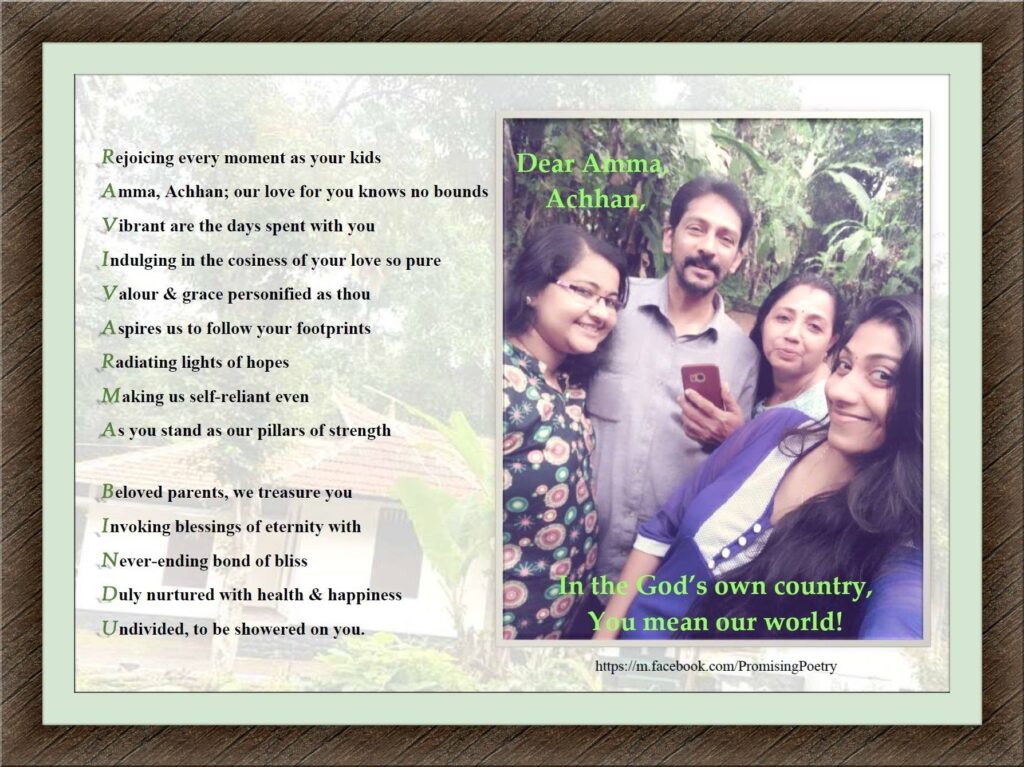
Acrostic poems can be employed to commemorate significant events and milestones, such as anniversaries, graduations, or retirements. They allow you to capture the essence of the occasion and express your sentiments creatively. Here’s a sample of my customised poetry gift for my client celebrating their parents’ Wedding Anniversary.
Acrostic poems can be a unique and memorable way to create a brand identity or slogan for a company. Businesses can use the acrostic form to highlight their core values, mission, or the essence of their products or services.
For instance, if a company specializes in eco-friendly products, they might use “GREEN” as their acrostic:
Growing a sustainable future,
Respecting nature in all we do,
Eco-friendly solutions, tried and true,
Environmentally conscious, through and through,
Nurturing a planet that's clean and new.
Such acrostic branding not only conveys a message but also creates a memorable and distinctive brand identity that customers can relate to.
In conclusion, acrostic poetry is a versatile and creative tool that can be applied in numerous ways beyond traditional verse. Whether you want to express appreciation for someone, add a unique touch to invitations, or create a memorable brand identity for a company, acrostic poems offer a dynamic and engaging means of communication that can leave a lasting impression on those who encounter them.
Below is the link to more such poetries that I have customised for my clients over the years. Have a look & if you are looking for customised poetry for gifting, feel free to reach me at promisingpoetry5@gmail.com.
Acrostic poetry, though sounds complex, is an easy, delightful and creative way to play with words. In this blog post, let us explore the enchanting world of acrostic poetry, its crafting and variations.
What is an Acrostic Poem?
An acrostic poem is a form of poetry in which the initial letters of each line or stanza spell out a word, name, or message when read vertically. Essentially, it’s a hidden message or theme encoded within the poem itself. Acrostic poems can be short and sweet or lengthy and complex, depending on the message you wish to convey.
Crafting an Acrostic Poem
Now that you have been introduced to the enchanting world of acrostic poetry, let’s take a closer look at how to craft your own acrostic poem:
Choose Your Subject
Start by selecting the word or message you want to convey in your acrostic poem. This word will determine the structure and theme of your poem.
Brainstorm
Jot down words, phrases, and ideas related to your chosen subject. These will serve as the content for your poem.
Structure Your Poem
Decide on the structure of your acrostic poem. Will it be a single word spelt vertically, or will it be a longer message hidden within the lines of the poem? Choose a format that suits your creative vision.
Write Your Poem
Begin composing your poem, ensuring that the first letter of each line or stanza corresponds to the letters of your chosen word or message. Be creative with your language and imagery to convey your theme effectively.
Revise and Refine
Like any form of poetry, acrostic poems benefit from revision. Read your poem aloud, check for clarity and coherence, and make any necessary revisions to improve the flow and impact of your message.
Share Your Creation
Once you are satisfied with your acrostic poem, share it with friends, family, or the world. You can publish it in print or online, or gift it or simply keep it as a personal reflection of your creativity.
In its simplest form, an acrostic poem consists of a single word or a name. Each letter of the chosen word begins a new line or stanza, and the lines may or may not relate to the word itself. This type of acrostic is concise and can be a fun way to create a puzzle or express a sentiment using the letters of a word. For example, if you choose the word “LOVE,” your acrostic poem may go like this:
Luminous
Overwhelming
Vibrant
Eternal
Sentence Acrostic
A slightly more complex variation involves creating a sentence for each letter in the chosen word or message. Each sentence can describe or expand upon the word itself. Here’s an example of a recent acrostic poem I crafted to convey my happiness and pride as an Indian citizen on the successful soft landing of India’s Chandrayaan mission.
Acrostic Poem celebrating the success of India’s Chandrayaan Mission
Carrying the hopes of a billion hearts,
Heralding light years of success,
Aim set high, a nation's dream comes true
Nurturing aspirations, stories untold
Daring to touch the lunar skies
Reaching beyond, where eagles rise.
Another milestone in Indian history
Yearning for glory, a celestial quest-
A testament to India's very best,
A noble endeavour, every Indian's pride-
Now seeds its success in the lunar soil!
Theme-Based Acrostic
You can use acrostic poetry to explore a specific theme or concept. In this variation, each line or stanza represents a different aspect of the theme, with the initial letters forming the theme word. For instance, if you’re writing about “NATURE,” each line could delve into various elements of the natural world:
Nurturing forests, where tall trees sway,
A symphony of birds welcomes the day,
The river's gentle flow, finding its way,
Under the vast sky, in meadows we play,
Reveling in the beauty, come what may,
Every moment with nature, a gift to convey.
Message or Storytelling Acrostic
Acrostic poems can also be used to tell a story or convey a message. In this variation, the initial letters of the lines or stanzas combine to form a hidden narrative or a clear message. This approach allows for a more extended exploration of a topic or story. Here's an example using the word "DREAM":

Dancing through the moonlit night,
Reaching for stars with all my might,
Every wish taking its flight,
A journey into the boundless height,
My hopes and visions ignite.
These various approaches to acrostic poetry offer creative flexibility and allow you to adapt the form to suit your artistic vision and the message you want to convey. Whether you opt for a single word, sentences, theme-based exploration, or storytelling, acrostic poems offer an engaging and unique way to play with language and capture your thoughts and emotions. Hope you now have a better idea of crafting acrostic poems and their variations. So, don’t hesitate to experiment and let your creativity flow as you explore the fascinating world of acrostic poetry.
The exciting Kolam Kondattam Kontest is right around the corner. And Bharathi can’t wait to participate and show off, er, showcase his creative skills. Encouraged by his friends, Tabassum and Alagu, he registers for the contest (with a ‘k’).
Alas, the Residents’ Welfare Association, led by the fearsome Mrs Subramaniam, won’t hear of it. The contest is open only to the residents of Pravin’s Paradiso Apartments. And while Bharathi hangs out at the apartments all the time, he’s not exactly-technically-actually a resident.
Now it’s up to Bharathi to hatch an ingenious plan. Will he be able to get around the rules, get past the building bullies and get a shot at his dream?
Book Review
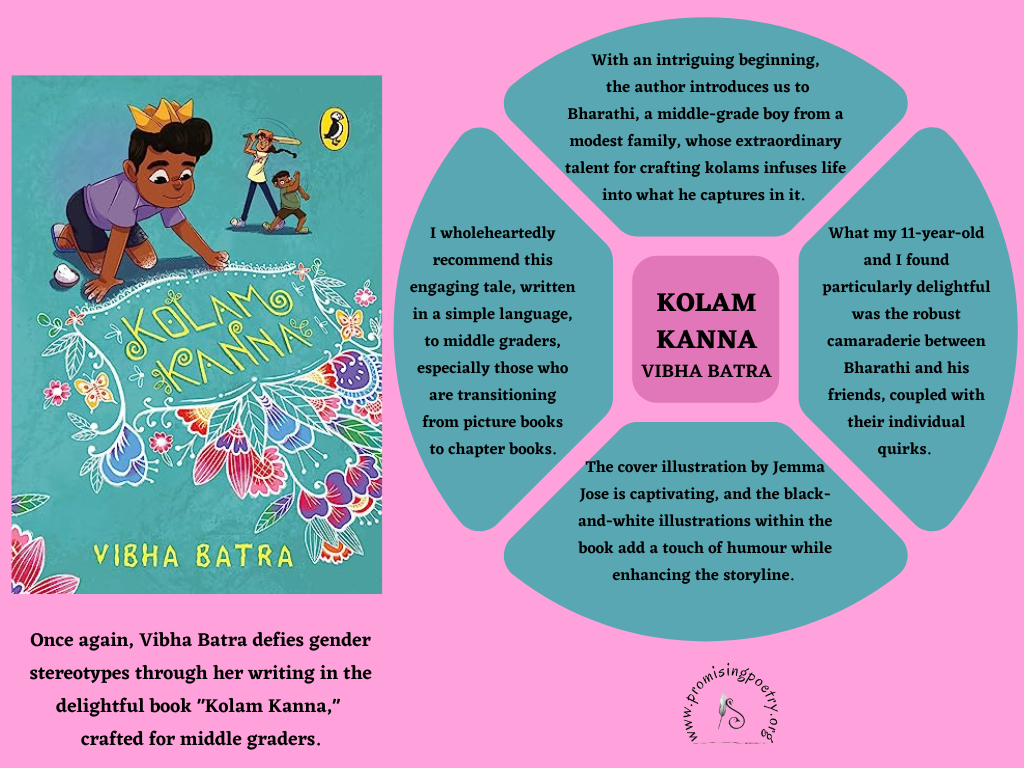
Once again, Vibha Batra defies gender stereotypes through her writing in the delightful book “Kolam Kanna,” crafted for middle graders. With her signature style, she presents a fun-filled and effortlessly readable narrative that challenges conventions.
The story begins by immediately seizing your attention with a thought-provoking question: “How do you catch a tiger?” What ensues is an even more captivating and mysterious response. With this intriguing beginning, the author introduces us to Bharathi, a middle-grade boy from a modest family, whose extraordinary talent for crafting kolams infuses life into what he captures in it. While Tabassum and Alagu, his close friends, readily recognize and support his exceptional talent for creating kolams, much like his mother does, many others in his vicinity find it peculiar and cling to their stereotypical biases.
Furthermore, as excitement builds for the Kolam Contest announced within Pravin’s Paradiso Apartments, where Bharathi’s mother is employed and his friends Tabassum and Alagu reside, Bharathi is brimming with hope and dreams. However, his enthusiasm is short-lived as he discovers that the competition is exclusively for the apartment’s residents. The rest of the story unfolds to answer whether Bharathi can overcome this obstacle and fulfil his dream by participating in the contest.
What my 11-year-old and I found particularly delightful was the robust camaraderie between Bharathi and his friends, coupled with their individual quirks. Their humorous pranks added an extra layer of amusement, enhanced by the author’s engaging writing style.
My daughter thoroughly enjoyed the tiny kolams adorning each chapter title and eagerly engaged in trying to replicate them. Additionally, she found great delight in the incorporation of Tamil words and phrases within the story.
Wrap up words
The cover illustration by Jemma Jose is captivating, and the black-and-white illustrations within the book add a touch of humour while enhancing the storyline. I wholeheartedly recommend this engaging tale, written in simple language, to middle graders, especially those who are transitioning from picture books to chapter books.
Buy here
Recommended Read (Another book written by the same author)
Let’s dive into some of my most personal bookish confessions. These revelations will give you a sneak peek into my one-of-a-kind connection with the world of books. So, grab a comfy seat, and let’s explore the quirks and peculiarities that make my reading journey a bit different. While I may not have followed the crowd when it came to classic novels or popular series, my unique experiences and idiosyncrasies in the world of literature have shaped my own delightful adventure.
Skipping the Classics
I must admit that I have never read the famous fiction books that many of my peers grew up with, such as The Famous Five, Nancy Drew, or The Secret Seven. My literary journey took a different path, and I’ve never quite stepped into their well-trodden pages.
Not a Potterhead (yet!)
I am not a Potterhead either. While the world was enchanted by the magical adventures of Harry Potter, I found myself drawn to different stories and worlds. Sometimes, being outside the mainstream can feel like a world of its own.
The Picture Book Predicament
On occasions, I’ve found myself purchasing picture books not for my daughter or as gifts for children but for my own personal enjoyment. There’s something enchanting about the illustrations and simplicity of these books that speaks to my inner child.
The Wordy Poetry Hack
When I encounter writer’s block while crafting personalized poetry gifts for clients, I turn to a peculiar trick. I select a book from my shelf, open it randomly, and choose a word from the first line. This word becomes the catalyst for my creative process. Sometimes it leads to poetry; sometimes it doesn’t. Regardless, it helps me overcome the block.
The Mix-and-Match Reader
Unlike many readers who prefer to immerse themselves in one book at a time, I find myself constantly switching between different genres and stories. It’s as if I can’t resist the allure of multiple literary worlds simultaneously.
A part of our collection!
The Eclectic Taste
While my daughter’s book collection is often in high demand among her friends, mine doesn’t enjoy the same popularity. It appears my taste in literature, which encompasses non-fiction, poetry, spirituality, and even mathematics (an unusual combination, I admit), is somewhat unique.
Emotional Resonance Over Names
More often than not, I find myself forgetting the names of characters or places in the plot. However, what I remember with remarkable clarity is how the book evoked specific emotions during my reading journey and the circumstances surrounding my immersion in its pages.
The Mysterious Connection
To add a final layer of intrigue, my bookshelf harbours books I haven’t completed and others I haven’t even started. Yet, books have a way of communicating with readers in mysterious ways. Some books remain dormant on my shelf for years, only to be rediscovered when the timing is just right, making them feel entirely new and inviting me to finish what I once started.
So, there it is- my bookish confessions. In sharing these personal revelations, I hope to show that there is no one-size-fits-all approach to reading. We all have our idiosyncrasies when it comes to books, and that’s what makes the world of literature so rich and diverse. Embrace your unique reading style, and you may find that books have their own way of speaking to you, too.
261800cookie-check8 Confessions Revealing My Bookish Secretsyes
We use cookies on our website to give you the most relevant experience by remembering your preferences and repeat visits. By clicking “Accept All”, you consent to the use of ALL the cookies. However, you may visit "Cookie Settings" to provide a controlled consent.
This website uses cookies to improve your experience while you navigate through the website. Out of these, the cookies that are categorized as necessary are stored on your browser as they are essential for the working of basic functionalities of the website. We also use third-party cookies that help us analyze and understand how you use this website. These cookies will be stored in your browser only with your consent. You also have the option to opt-out of these cookies. But opting out of some of these cookies may affect your browsing experience.
Necessary cookies are absolutely essential for the website to function properly. These cookies ensure basic functionalities and security features of the website, anonymously.
Cookie
Duration
Description
cookielawinfo-checkbox-analytics
11 months
This cookie is set by GDPR Cookie Consent plugin. The cookie is used to store the user consent for the cookies in the category "Analytics".
cookielawinfo-checkbox-functional
11 months
The cookie is set by GDPR cookie consent to record the user consent for the cookies in the category "Functional".
cookielawinfo-checkbox-necessary
11 months
This cookie is set by GDPR Cookie Consent plugin. The cookies is used to store the user consent for the cookies in the category "Necessary".
cookielawinfo-checkbox-others
11 months
This cookie is set by GDPR Cookie Consent plugin. The cookie is used to store the user consent for the cookies in the category "Other.
cookielawinfo-checkbox-performance
11 months
This cookie is set by GDPR Cookie Consent plugin. The cookie is used to store the user consent for the cookies in the category "Performance".
viewed_cookie_policy
11 months
The cookie is set by the GDPR Cookie Consent plugin and is used to store whether or not user has consented to the use of cookies. It does not store any personal data.
Functional cookies help to perform certain functionalities like sharing the content of the website on social media platforms, collect feedbacks, and other third-party features.
Performance cookies are used to understand and analyze the key performance indexes of the website which helps in delivering a better user experience for the visitors.
Analytical cookies are used to understand how visitors interact with the website. These cookies help provide information on metrics the number of visitors, bounce rate, traffic source, etc.
Advertisement cookies are used to provide visitors with relevant ads and marketing campaigns. These cookies track visitors across websites and collect information to provide customized ads.