A poem on Overcoming Failure with the Comfort of Affection
PC: Designed by the Author using Canva
Love’s Embrace
On a day so ordinary
When the heart bore no story
She hopped towards me
With her usual contagious glee

Our chit-chats about her day at school
Suddenly took a turn, uncool
Her bold expression turns hushed
To whispers, whilst her agony gushed

A 10-year-old shares her failure
In a tone tainted with despair
Like her skin’s acquired the colour of shame
And every eye’s pointing her out to blame

My heart sinks as her eyes bore into mine
Hoping for hope through my words of shine
I stand there as an adult holding of a promise
In her expectant eyes, to make her feel at ease

There are faces familiar
Surrounding us, all so near
Yet in a voice quite clear
I go on to tell my stories of failure

There are stares of shock & surprise
At an adult’s success losing its disguise
Yet, I know for sure this is what she needs to hear
Of seeing failure equally as success, so dear


Tomorrow when she sees me smile
With my head held high in a confident style
Her failures will no longer fail her
As whispers would turn to hopeful chatter
UPDATE: Happy to share with you that this post was selected as a top blog by Blogchatter. Thank you for supporting my work 🙂
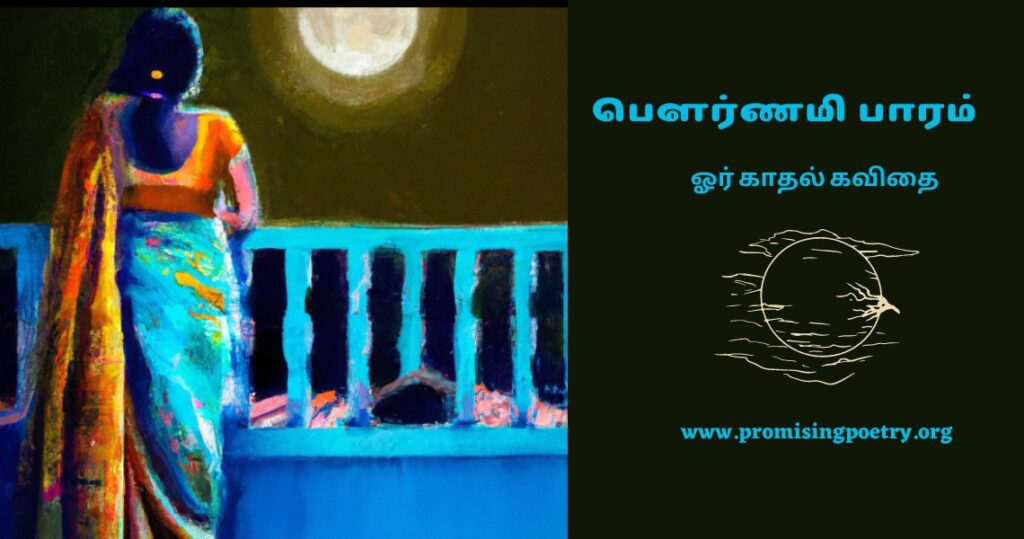
பறந்தவெளியிலிருந்து  அவனும்
இருண்ட தாழ்வாரத்திலிருந்து இவளும்
ஒருத்தரை ஒருத்தர் நோக்கியவாறு
தனிமையை தொலைக்கிறார்கள்

தொலைவிலிருந்து கண்டவாறு
காத்திருக்கிறேன் நான்
துணையாக ஒருநாள் என்னை
தேர்ந்தெடுப்பாள்  என்றெண்ணி
I’m sure if you are reading this, at least for once you would have written poetry or attempted to write one. Whether a student, teacher, parent, someone from a literary background, homemaker or an uneducated person, everyone makes an effort to write a poem at some point in their lifetime. The simple reason behind this is that poetry is a means of self-expression, to capture emotions, thoughts, and experiences in a creative and imaginative way. Here’s a beginner’s guide to writing poetry from scratch.
Poetry can be used to tell a story, convey a message, evoke a feeling, or simply play with language. Writing poetry can also be a form of therapy, allowing people to work through difficult emotions and explore their inner selves. Additionally, poetry has been a significant part of human culture for thousands of years, passing down stories, beliefs, and traditions from one generation to the next.
Where did I start?
So whatever your reason for writing poetry be, know that you are not alone and every expression matters. You don’t need a degree in literature or great writing skills to pen poetry. If you don’t believe me, let me tell you how I started writing one. It is a little embarrassing for me to put it here but then if it could help you see a possibility for your own poetry-writing journey, then why not, right?
When I was around 11 years old (that’s 23 years back) I started writing and my very first fascination was nature and it still remains to be so. My ‘idea’ of poetry at that time was just about lines ending with rhymes. This is how my very first poem, started (don’t laugh at it; it was a kid’s expression then!):
Nature, nature, nature
It's God's creature
If we destroy nature
Who will save the future?
A path of creative self-expression
Do you see that? At this age, after years of writing experience, I can see so many things flawed in the above stanza. For one, it has to be God’s ‘creation’ & not ‘creature’ and the whole thing looks like a ‘forced rhyming’ just to call it poetry. Don’t even ask me about the rest of the stanzas. But wait, does it matter that it was flawed? Absolutely no; because I see it as a ‘start’.
Yes, that day, a small kid started her journey towards self-expression and all that mattered to her were words that helped her make sense of what was happening around her and also inside her mind. And my dear friend, that’s all that should matter to you too when you are starting to pen poetry.
Writing poetry is a path of creative self-expression.
Choose a theme that talks to you
Now that you know what really matters, let’s get to the act of writing. All you need is an intention to write one. Firstly, choose a theme that talks to you or tap into an emotion that you are currently experiencing. That way you can easily get into the flow of writing instead of getting about it mechanically. Start somewhere, anywhere but just start. It really doesn’t matter if you write a great starting line or not, trust me!
Hack
If you are still stuck wondering where to start, then simply borrow a line/phrase from any book you read or a poem you liked. You can later replace the first line with something of your own; it really works. And yeah, it is not copying, it’s simply taking inspiration.
Forget editing & go with the flow
If you ask any of the writers or poets, they will tell you how most times their first drafts end up nothing but crap. So fret not about perfection and simply add one word after the other. Remember, just one word after the other. Easy, right? For beginners, free verse is the best bet but if you are in the mood for experimentation with different forms like haiku, lyrical poems, etc, then go for it. Just don’t let the structure restrict the flow of your ideas.
Poetry is enriched with vivid imagery (descriptions). Showing and not telling is a writing technique used to create vivid and engaging descriptions by allowing readers to experience and interpret events and emotions, rather than just being told about them. All you need to do is to tap a little deeper into your sense of touch, vision, hearing, smell or taste. Here are some examples of showing and not telling:
Telling: The food was delicious. Showing: The flavors exploded in his mouth as he savored each bite of the perfectly cooked biriyani.
Telling: She was sad. Showing: Tears streamed down her cheeks as she sat alone, staring blankly out the window.
Telling: The view was breathtaking. Showing: The sun set over the mountains, painting the sky in shades of pink and orange and taking his breath away.
Write for one person
Every individual has different perspectives and it’s the ability to put our perspectives out loud and clear that matters. So, loosen up, leave your hesitations and write for one person-yourself. Even if you plan to publish, it’s just you and the other person who is reading that is involved in this equation. So write for either yourself or just one reader. That way, the connection between you and the reader is easily established.
Make it relatable
Have you noticed that a song lyrics appeals to you so much that it feels it was written just for you? Well, that’s where relatability comes into the picture. Even while you are writing your personal experiences, try and make it relatable to the reader.
To make a poem written from personal experience relatable to the reader, you can focus on universal themes and emotions that are common to many people. This can include topics such as love, loss, joy, fear, hope, etc. Additionally, you can use concrete and specific details that paint a vivid picture of your experiences and help the reader connect with them on an emotional level.
Avoid using jargon or uncommon terminology that may confuse or alienate the reader. Finally, you can use literary devices such as imagery, metaphor, and simile to enhance the emotional impact of the poem.
Read it aloud
Reading your poem aloud can help you to identify and correct any issues in your writing, and to gain a better understanding of how the poem will be received by an audience. This is when you will get an idea of how the usage of words complement each other or not, whether is there a rhythmic flow to the poem, is the tone and theme of the poem are conveyed or not, etc.
So, own your poem and read it aloud to help you understand the nuances intuitively. It may sound difficult but try and see. You will get better at it with every poem.
Edit and evolve
Now that you know how your poetry has turned out and how it sounds while reading, it’s time that you make the edits and polish your poem. Though editing may take time to learn, it’s still your poem to experiment and evolve. Take charge of it and check the tone and mood of the poem. Make sure they match the content and the emotional impact you want to convey.
Read the poem several times, paying attention to each line and stanza. Look for areas that could be improved, such as awkward phrasing or unclear meaning. Consider using synonyms, metaphors, and similes to add depth and impact. Check the structure of the poem. Make sure each stanza and line break serves a purpose, and that the poem has a clear beginning, middle, and end. Finally, have someone else read the poem and provide feedback. This can give you a fresh perspective and help you to identify areas that could be improved.
Trust the process
Poetry is a creative form of self-expression. So, trust the process and evolve with each piece of writing. Also, poetry gives you the liberty to break the rules and simply have fun. So what stops you from writing a poetry, today? Get creative. Get bold. Get writing!
P.S. At the start of this post you read the childish poetry that I started with. To know how my writing has evolved over years, you can check these two poems (click on the below images) that are inspired by my all-time fascination with nature. You will see that with years, the experiences and perspectives have evolved. And, that is all that I wish for you to know, so you honour your expressions and emotions in verses without any hesitation.
Hope this post helps. If you are just beginning to pen poetry, feel free to post it in the comments or share it on Twitter and tag me @PoetryPromising.
If you are an established poet, do share your very first piece of poetry. Let others be inspired.
While I strongly believe that a blog with well and consistently written posts can help you ace the blogging game, it’s also true that a good SEO (Search Engine Optimisation) can be the catalyst for the google ranking. Though there are plenty of resources on how to go about on-page or off-page SEO, I have always found them to work best for long-format content and not poetry.
SEO gets trickier when it comes to poetry mainly because of its brevity and also of the difficulty to stuff keywords into it. So I thought why not share a few easy and actionable tweaks that I had applied in this poetry blog of mine and found them work well. So here you go.
“Succesful SEO is not about tricking Google. It’s about partnering with Google to provide the best search results for Google’s users.”
Phil Frost
My top ranking pages
If someone had told me a few months back that you can rank your poetry blog well with just SEO, I would have laughed at them. Like, who are they kidding, huh?
As poets, while we know how difficult it is to even get our work to be seen, it is even more difficult to believe in someone talking about getting our poetry blog on the first page of google, just by SEO. So I can understand if you are reading this article through the lens of suspicion.
To ascertain that these tips work, let me start with sharing the proof first. Here are three screenshots where you can find,
My website ranking first for the keyword “promising poetry”.
One of my poems ranked on the first page of google images, for the keyword “lipogram poem”.
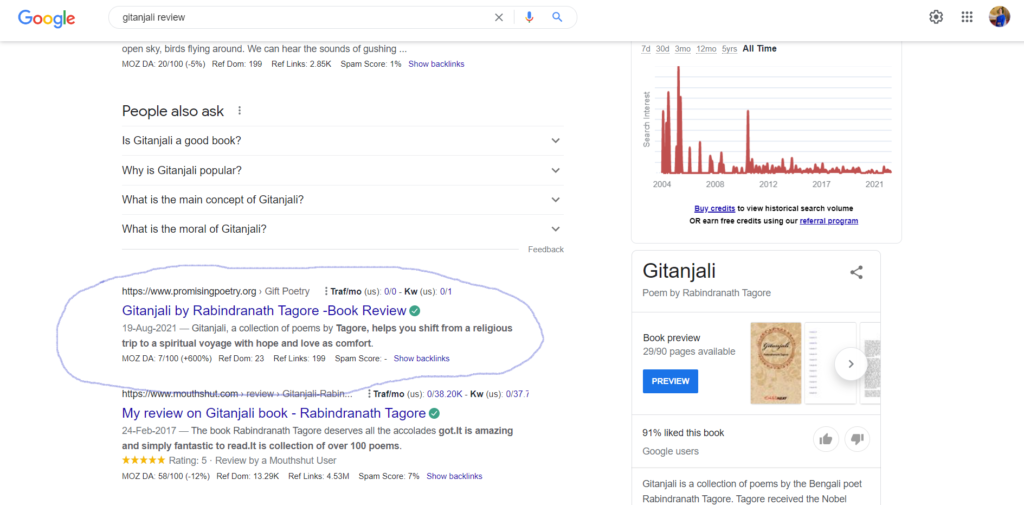
My review of the poetry book, Gitanjali is ranked on Google’s first page.
A screenshot of my website ranked first for the keyword “promising poetry”.
A screenshot of one of my poems ranked on the first page of google images, for the keyword “lipogram poem”.
Screenshot of my review of the poetry book, Gitanjali which is ranked on Google’s first page.
Now that you are convinced, let me just dive into the tips part.
5 Easy and Actionable SEO Tips for Poetry Blogs
Include intro/conclusion
Brevity is the biggest enemy of poetry which makes it not feasible to rank on the first page. A minimum of 300 words count gets traction for google ranking and the lengthier it gets (quality matters too!), the better the traction is. So, here is the tweak. Try to include an introduction and/or conclusion, before/after your poetry which can help you get the desired word count.
Choose your title wise
As poets, it can be very tempting to give unusual or abstract or mystic titles to our poetry pieces but let me warn you that it can be of no help when it comes to ranking. Say, for example, one of my poems, “Rasa” wouldn’t have ranked on google images’ first page, had I titled it just as “Rasa”. Come on, who on earth would search as “A poem on Rasa”?
So, the trick here was to title it, “Rasa- A Lipogram Poem”. Now, the keyword “lipogram poem” did the magic here and brought visibility to the piece. The key takeaway here is to have a lengthy title while describing what the poem is about or the poetry format. If you wish you can add your actual creative title of the poem as a subtitle.
Keep in mind that the user is mostly a layman, looking for poems using simple words/phrases like, ‘a poem on love’, ‘ a poem on domestic abuse‘, etc.
Wait, there is also another reason the poem, Rasa, was ranked and that’s the next tip.
Add ALT tags for the images
Well, as you could have seen in the screenshots above the poem Rasa was optimised for its image. When it comes to optimising your poetry, you got to make use of all the possible ways to do so and adding attractive images is one thing to do. But it just doesn’t stop there.
Add a description of the image used using ALT tags and also in the caption of the image. This way you are helping google find your page through the images. Sometimes while the content itself may not rank, the image may rank (as in the case of my poem, here) on the top page and bring in traction or views.
Check out this easy-peasy video to learn how to add ALT tags for images:
Include video
It’s not just about lengthening your poetry post but it’s also about keeping your audience hooked and staying on your page for a considerable amount of time. Since the brevity of poetry can’t keep anyone hooked for a long time, embedding a video can help retain the reader for some time.
So get creative and go for adding a video of the spoken word version of your poem or just add a related youtube video to the page. Make sure the content of the video aligns with your poetry and doesn’t look like a forced inclusion.
Get creative
Ok, now don’t get me wrong saying we are poets and doesn’t that mean we are already creative? Well, I agree. It’s not about getting creative about poetries that I’m talking about. I’m asking you to get creative with the format of your posts that you pen for your poetry blog.
Most times, one may think that a poetry blog is all about sharing poetries but it is not. Think about everything that has got to do with poetry and pen them. Write reviews for poetry books, do poetry analysis, get a poet interviewed and write about it, etc. This way, you are still soaking in the essence of poetry while also being able to furnish long-format content which is the key to page optimisation.
In the below post on my review of Tagore’s Gitanjali , you shall find all the above points incorporated.
My review of the poetry book, Gitanjali by Rabindranath Tagore.
Concluding Words
SEO of poetry blogs can be tricky but with little tweaks here and there, you can ace the game. If you had noticed, the underlying factor behind all the tips is to make the posts “reader friendly” by giving them an insight on how or what made you come up with a poem or adding user-friendly titles or ALT text for images or videos or bringing them into your poetry world through more related educative/entertaining information.
Hope you found this post useful. Do let me know if you want to learn more on SEO specific to poetry blogs.
This post was written for the prompt “Simple SEO tricks nobody told you”, as a part of #BlogchatterBlogHop.
Do not think. Do not
write. Not even
attempt. Just be
unarmed. Your naked
self-open
to stories
and scars alike but
remember
not to use them
as protective clothing.

Stay naked.

Your vulnerability
is the fabric.

~

Breathe
through the fabric.
It’s hard. Yet
doable.

Breathe.

Even as you be
and breathe-
jump, sway, dance
cry, punch,
or itch as
the scar
or story may
want you to.

Blend with the story.
Bleed with the scar.
Be.

~

Let it all
soak up
through
the fabric.

Your vulnerability.

Let it
suck it up
till saturated.
Stretch it
not.
Shrink it
not.
Carefully lift
the fabric. Spread
it away from
your naked self.

~

The scars that
you allowed
to seep into
your skin
can wait.
Attend
to the fabric
first. Remember
you are a poet.
That fabric-
your canvas
and composition.

~

Now
like the lover’s
caressing
let your soul
gently tend to
the fabric.

Lift it up
letting light
find its way
highlighting
parts of it
naturally.
In the clothesline
of creative force
pin it carefully
with pegs
of purpose
so life breathes
through its pores.

Let it be.
Let it dry.
Let it dance.
Let it drench.
Let it delve.
Let it dry.
Let it be.

~

Remember
you are a poet.
That fabric-
your canvas
and composition
It’s not
you.
Gently move away.
It’s now
for the world
to witness.

You may now
tend to
the scars or
stories
that you
let seep
through your
skin.

You can be
you.
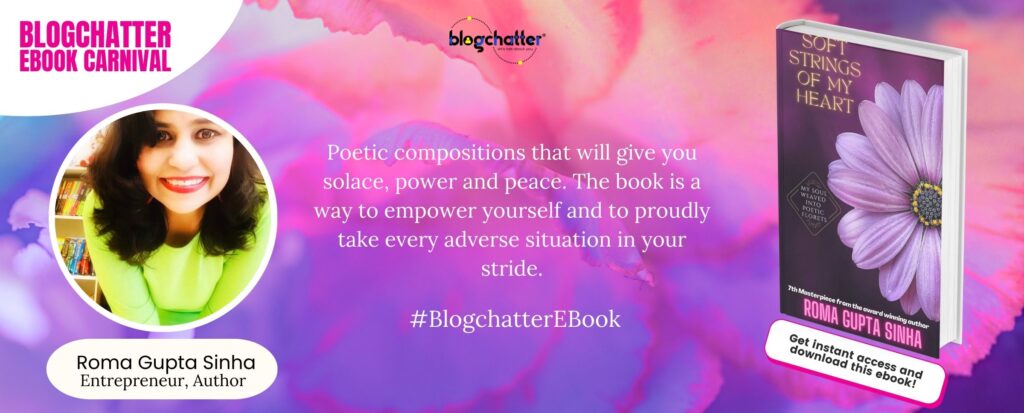
It’s hard being a writer to be vulnerable and share one’s life as is but in this #BlogchatterEBook, “Soft Strings Of My Heart”, the author Roma Gupa Singha makes it look easy. As the by-line of her book says, she has weaved her soul into poetic florets. The outstanding feature of this book is its honesty right from the start where the dedication reads, “I dedicate this book to my resilience and to my love for life…”. The poet has let the readers get a peek into her life through her verses.
To start with, the vibrant cover of the book had me fall for it instantly. The choice of colours and the floral design, give out a sense of bold and beautiful, aptly capturing the essence of the book.
The poems grouped under five chapters in the book bring about the different phases the poet has been through. Under the first chapter, “The call of the woman in me”, along with putting forth her journey as a strong woman standing for herself, Roma has also voiced out the agonies of other women who have opened up to her looking for solace. I’m sure those women who find their vulnerabilities voiced through Roma would have found solace and courage as well.
She doesn’t want to deprive them of their father’s love
The same crap I have been listening for years
I have come across so many wonderful women with battered souls
Staying under the same roof for this reason

~

Summon up all your courage my love
You have the power to weave your nest the way you want
You have the power, believe in yourself
Get up and give him back what he deserves

~
The second chapter, titled, ” “Love in its infinite forms”, captures the sweet tenderness of the poet’s love for the man of her life. Roma vivdly captures her love life in words of beauty and simplicity. Just one look into the poem, you know their love story is sophisticated in the simplicity. It’s pure joy.
The gentle sea waves kissed our feet,
As if trinkets of joy tickling us sweet
Our eyes gave each other a warm embrace,
As our fingers too spoke to each other with smiles
~
I need to tell you this, my one
when I will be gone
I don’t want to drip
down your eyes like tears
promise me you’ll rather keep me alive
in your beautiful smiles
In the third chapter, ” Maa and Motherhood” Roma introduces herself as a caring mother and also reminisces the fond memories of her late mother with verses weaved through the threads of gentleness. The straightforward lines just make it all the more relatable.
With you my little one
I have lived my childhood again multiple times
Weaved uncountable memories
Which warm my heart every time
~
Time is just flying by
And in my arms, I wish to hold you tight
Before you grow up into a handsome young man
ready to fly
~
She waits for me in the lovely morn's dew drops...
And caresses and pampers me through her silent touch,
When I walk bare feet on the wet grass
That's where I forever find my Mom
~
While the fourth chapter, ” My unending battle with chronic endometriosis” captures the author’s struggle and strength, the fifth chapter, “My beloved teacher, life’s gifts to me (in random order)”, captures the myriad shades of her life’s journey with a lens of optimism.
Surgery after surgery
My threshold to bear the pain has gone for a toss
Now my heart shatters at the slightest thought
Of undergoing it one more time

They say endometriosis has no cure
I even altered my lifestyle and lost forty pounds
But it never really stopped
Torturing me and making me weak in my mental
 resolve
~
I inched closer to the tree
With a wide smile, to be finally meeting my Lord Supreme
With every step, I felt healed
I felt He loved his people unconditionally

I walked faster
So wanting to thank Him in person
Finally, I took a sneak peek behind the tree
And can you guess who was there, exuding the divine white light...
~
The poet, Roma, has bared her soul and let us all into her life through her verses of honesty. Right from the start till the end, there is a contagious optimism that seeps through these verses and sticks forever with the reader. And I tell you, it will only help you find strength through your struggles and look forward to life with unconditional love that the author gifts us with in this book.
Baffled reading the heading that says, ‘Poetry makes nothing happen’? Well, you are not alone if you come across this for the first time. I was confused too when I heard it for the first time, especially from a renowned poet like Sampurna Chattarji while quoting it to explain the purpose of poetry. It may sound contradicting but in actuality it is not. To get the essence of it, read ahead.
Poetry is the spontaneous overflow of powerful feelings; it takes its origin from emotion recollected in tranquility.
~WilliamWordsworth
Celebrating World Poetry Day on the 21st of March, 2022 with a conversation with the poet and translator, Sampurna Chattarji, as part of the #BlogchatterWritFest2022, turned out to be a blissful and resourceful session. The one-hour session flew in a jiffy only to make us, the poetry enthusiasts, more thirsty for the poetry conversation.
What is the purpose of poetry? Does poetry essentially mean a spontaneous overflow of emotions or does it include crafting too? What are some essential basics for becoming a better poet? Can multiple formats of poetry be included in a single poetry book? Do we follow trends when it comes to writing poetry? How much can a poet experiment with the format of poetry? If these are some questions in your mind, read along to get resourceful insights gained from a conversation with the amazing poet, translator and editor Sampurna Chattarji.
Here is a quick recap of the session with key takeaways from it. The session saw Sampurna Chattarji take up participants’ questions and answer them with insights from her personal experience as a poet, translator and editor.
Purpose of Poetry
The conversation had an interesting start with the poet answering the question what is the purpose of poetry. Chattarji indulged us in a poetic conversation by saying that it’s a perennial question and quoting, “Poetry makes nothing happen”, from the famed poem ‘In Memory of W.B.Yeats’ by W.H.Auden
Chattarji went ahead to explain beautifully on how poetry survives, transcending time and in essence becoming a way of happening. She said that words are a way of happening; dynamic and not static. The happening though can either be slow and meditative or choose to explode. Ultimately, poetry is in the now.
With reference to the poem, Sampurna Chattarji highlighted that
it’s a poet’s responsibilityto be the mouth of truth but not a mouthpiece.
Poetry as a spontaneous overflow of emotions versus poetry as a craft
When asked if poetry is just about the spontaneous overflow of emotions or does it need to be crafted, pat came the reply from the poet insisting that only an overflow of emotions may just be a hot mess on paper and that there is a need for formatting and crafting.
Chattarji emphasized that both the emotions as well as the crafting be given equal importance to get captivating poetry. She went on to share the following tips generously:
Basics that a poet needs to follow to get better at the art of poetry
Know the nuts and bolts of the language: the grammar, spellings, punctuation, etc.
Have a deep love for the language and the craft. Devour others’ works before starting with yours.
Write to rewrite. Don’t be satisfied with the first draft. Develop the ability to take criticisms and work on bettering the craft.
Equip yourself to become your own editor. This comes with years of experience though.
Have patience and persistence.
PRO TIP: As suggested by Sampurna Chattarji, check out and learn about different poetry formats by searching through the glossary here.
Multiple formats of poetry in one book
On the question, of multiple formats of poetry can be included in a single book, Sampurna Chattarji explained that it can be done with careful consideration. She added that the poet must be aware of the inner logic and flow behind the intertwining of multiple formats. Chattarji went on to explain how in her book“Space Gulliver” multiple forms of poetry imbibed in one book and it was absolutely helpful.
On that note, she mentioned that her favourite poetry forms are prose poetry—for its tensile & dynamic nature—and also non-sequential, non-narrative forms of poetry.
At this point, a special mention of Inger Christensen’s book Alphabet got me even more excited as it is based on the Fibonacci Sequence. At that moment, the Mathematician & the poet in me was like- ‘Aaaaah…I can just go on & on with this conversation!’. Sampurna Chattarji also mentioned writing a poem based on the prime number 37, also a star number, and her reasons and thoughts behind it. It only got interesting and I was just wishing that the conversation doesn’t end.
On a side note, one of my recently published poetry in “The Great Indian Anthology” by the Half Baked Beans has that Mathematical touch to it, titled “Number & numeral are not the same”. (winks!!)
Experimenting with “trends” in poetry: Yay or nay?
With the constraint of time, the poet moved on to answer the next question if it was wise to go with “trends” for beginner poets. Chattarji mentioned that one should be wise enough to know that what can be trending can end up forgotten too. So, it’s better to plunge into the deep end, hone your craft first and experiment with language and forms first-hand. Clearly, her emphasis was on getting better at the craft instead of just going by the trends.
On poetry translation
Here are a few important tips that Chattarji shared when asked for advice regarding poetry translations, especially when there is a cultural difference in the languages involved:
Firstly, it is highly important to understand both languages inside out.
For words that are hard to translate, she urged the poets to be inventive. She added that of all the translators, poetry translators are the best.
When it comes to untranslatable nuances, she suggested that one gets into the skin of the other poet, strike a conversation, gets to know the back story of the poem and then come up with a translation.
In case of uncertainty when it comes to translating a poem of a dead poet, she insisted that we go with our instincts, follow our heart and trust it.
Make research and dictionary your friends.
Most importantly, she emphasized that we have the courage to walk away from translating a poem. She said not to destroy a poem by bad translation and it’s better to leave it alone.
Create strategies, try hard and find solutions, like adding footnotes for cultural references or vernacular words.
Finally yet primarily, care enough for the poem as if it is your own and do justice to it.
On pitching poetry for magazines
As Sampurna Chattarji is also a Poetry Editor, it was more than apt to know what she looks for in a poetry submission as an editor. To start with, she made a note that one should not consider submission as “pitching” as the word pitching gives a sense of selling. She said the better word would be poetry submission and mentioned that primarily she looks for a certain amount of craft in the poetry.
She added that she looks for a voice — honest, new and startling — and a willingness to work with the editor in partnership.
As a pro tip, Sampurna Chattarji suggested not to overdo the cover letter or bio and rather work harder on the poem instead. Finally, she said to keep the poem true, simple and distinct.
Towards the close of the session, when asked for poetry reading suggestions, especially for kids and beginners, Chattarji left us with the following reading list:
Coney Island of the Mind: Lawrence Ferlinghetti
Old Possum’s Book of Practical Cats: T.S. Eliot
Beastly Tales from Here and There: Vikram Seth
Revolting Rhymes: Roald Dahl
The Fried Frog and Other Funny Freaky Foodie Feisty Poems: Sampurna Chattarji
Learn from the Almond Leaf: Eunice de Souza
The Penguin Book of Indian Poets edited by Jeet Thayil (for a wide variety of themes, styles, generations: out in April)
Indian Love Poems selected and edited by Meena Alexander (Everyman Pocket Poets)
Wordygurdyboom! The Nonsense World of Sukumar Ray translated by Sampurna Chattarji (Puffin Classics)
On a final note, Sampurna Chattarji mentioned looking up for first books of those you consider established poets now and reading more anthologies.
The session then ended with a reading of her poem “Evil Eye” in her magical voice.
Overall, it was an exciting and engaging session that I just keep ruminating upon and this blog post is one way to do so. Hope you find this useful.
I just can’t thank enough the Blogchatter Team for making such conversations with poets/authors possible through the BlogchatterWritFest. As my fellow blogger Harshita would put it here, the BlogchatterWritFest is a different level of crazy!
Apart from providing us with this wonderful session where 3 to 4 of my questions got answered, Blogchatter did go one step ahead to choose me as one of the winners of a book giveaway. I am definitely on a poetic high and I’m sure you would have definitely got to know it by now.
Happy Me!
I leave you on that note and see you soon with Intuitive Poetries in the month of April (just a few more days to go!). Stay tuned.
While poetry in itself can have undertones, giving us various perspectives, a cento poem goes further ahead to bring on an entirely new dimension.
A cento poem is nothing but a collage poem with lines picked up from other sources of poetry/prose to combine and come up with patched-up poetry. It is total fun and also challenging.
To come up with a cento poem, one must read many other poems/prose pieces and come up with an idea or central theme that can hold the lines from various sources under one theme.
Here’s a cento poem that I came up with during an advanced poetry writing workshop. Hope you enjoy it. Also, I have mentioned the sources from which these lines are taken, at the end. To make the flow seamless, I have also added few lines from my side 🙂
Every Storm Brings Along a Calm, Thereafter
My desires are many and my cry is pitiful,
My body's wisdom tells and tells again
A voice inside, briefly, soothing the pain-
“These men bearing flags were thirsty for love.”

There was never a consent, nothing of me
They grow on me like leaves on a tree.

“That virus is not for you
They decayed before they were born”
nothing can mend, I’m already torn.

They never seem to stop their coming,
They grow on me like leaves on a tree,
There was never a consent, nothing of me
That I shall find my rest, my sleep, my peace
the voice fountains, thrusting brevity at ease...

“The infinite knows what you hunger for
Ask Him to carry you across”
My conflicting mind dives into a pause
From a silence, somewhere deep within.

Strength surmounts, knowing whom to let in
saving me from perils of weak, uncertain desire.

“Day by day thou art making me worthy
 of thy full acceptance”- I surrender
For men may come and men may go,
but I go on forever…
List of poems the verses are taken from; numbered per the flow of poem:
“Strong Mercy”, from Gitanjali by Rabindranath Tagore.
Taken from the book of Bhakti Poetry Eating God, edited by Arundhathi Subramaniam. This particular verse is taken from Lal Ded’s poetry and translated by Ranjit Hokote.
Taken from the book of Bhakti Poetry Eating God, edited by Arundhathi Subramaniam. This particular verse is taken from Lal Ded’s poetry and translated by Ranjit Hokote.
Taken from the book of Bhakti Poetry Eating God, edited by Arundhathi Subramaniam. This particular verse is taken from Lal Ded’s poetry and translated by Ranjit Hokote.
One needs a stronger sense of purpose to pursue a passion and live life on one’s own terms. And when I first had the idea of becoming a Poetpreneur, I found myself wondering about the purpose of poetry.
Poetry, as I see it, is the art of stringing words together in the best possible order—to tell a story, evoke an emotion, or make someone feel something deeply and intensely.
But how far can poetry go to change the world?
Can poetry calm chaos, bring a battle to a halt, comfort a desperate soul, offer hope to someone struggling to hold on to life, help us find love, make us feel loved or, more practically, pay the bills?
The questions could be endless. But finding answers to at least a few of them was vital for me if I was going to pursue poetry not merely as a passion, but as a career.
Finding Poetry in Rhymes & Chants
As someone drawn to words, their sounds, and the unseen rhythm and harmony they bring along, poetry has always been a part of my life.
It was there in the nursery rhymes sung by Preeti Sagar, in the rhythm of stressed and unstressed syllables while chanting shlokas, and even in the wordless song of silence that I feel within me.
Poetry has always enraptured me.
There was always an urge to put my feelings into words and find ways to encapsulate even everyday incidents in something extraordinary. And I did it through verse.
Believe it or not, when I started writing, I was mad enough to capture even mosquitoes and cockroaches in creative imagination, just for fun!
And, of course, nature was my first love, thanks to my alma mater, Madras Christian College, known for its beautiful scrub jungle.
What started as a passion and a way of expression soon turned into the compass of my life. Consciously or unconsciously, I began seeking poetry to understand the complexities of life.
And trust me, poetry has led me to better places.
Gitanjali — Biggest Influence on My Poetry & Life Journey
Rabindranath Tagore’s Gitanjali is one of the biggest influences on both my poetry and my life journey.
Honestly, I don’t remember how I happened to land up with this book. But one thing I clearly remember is that the very first poem brought me to tears.
Thou hast made me endless, such is thy pleasure,
This is my prayer to thee, my Lord-strike,
strike at the root of penury in my heart,
Clouds heap upon clouds and it darkens

Thou hast made me endless, such is thy pleasure
Thou hast made me endless, such is thy pleasure.
This frail vessel thou emptiest again and again,
and fillest it ever with fresh life.

This little flute of a reed thou hast carried over hills and dales,
and hast breathed through it melodies eternally new.
At the immortal touch of thy hands
my little heart loses its limits in joy
and gives birth to utterance ineffable.

Thy infinite gifts come to me
only on these very small hands of mine.
Ages pass, and still thou pourest,
and still there is room to fill.
— Tagore
Here are the opening lines:
“Thou hast made me endless, such is thy pleasure.”
I couldn’t move on to the rest of the poems and I didn’t force myself to.
I simply sat with that poem.
Some poems come to us to prepare us for an intense experience, while some arrive as an assurance that our path is headed in the right direction.
That cannot-be-worded, cannot-be-explained, cannot-be-seen kind of intense and intimate feeling that poetry brings along is what makes me want to read, write and gift poetry.
There is a certain magic in the mysticism that every poem holds. Poetry can shed light on different perspectives, and an honest poem can even make you a different person in a single verse.
Take, for instance, these famous lines from Alfred Lord Tennyson’s The Brook:
“For men may come and men may go, But I go on for ever.”
These lines have grown with me, revealing different meanings at different stages of my life.
During my school years, when I first read the poem, I took the lines literally. Human beings may visit the brook and move on, but the brook will continue to flow.
At that age, I was lured by the music of the poem—the rhyme, rhythm and flow—and I didn’t look much beyond that perspective.
When I was in college, the repetition of the line began to mean something else.
I had reached a point in life where broken relationships had left their bruises, and the words became a quiet assurance:
Men may come and go, but I can still go on with life.
The line comforted me. It helped me take things a little more lightly and move forward.
In my early twenties, the profoundness of the line left me awestruck. I began to understand its metaphorical meaning, the eternal existence of nature contrasted with the impermanence of human life.
And now, as I write this, another perspective occurs to me.
What if the “I” in the line is also a symbol of the soul?
Our bodies may perish, but the soul—the vital force of our existence—continues.
Perhaps that wasn’t what Tennyson intended. But isn’t that the beauty of poetry?
The poem remains the same. We change. And because we change, the poem changes with us.
Wow!
Poetry never fails to amaze me.
But wait. Can amazement alone bring about change?
I believe it can.
A single poem, or even a single powerful verse, is like a viable seed. It can grow within us over the years, taking root in our minds and hearts and eventually bearing the fruits of change.
That is poetry for me.
Key Takeaways
Poetry can change the world, one person at a time or, in the case of spoken-word poetry, one gathering at a time.
It can help us shed inhibitions, gain clarity and think laterally.
Poetry can bring peace or start a protest. Anything with that kind of power deserves to be handled with care.
Poetry holds different perspectives and becomes richer with time. A poem that means one thing to us today may reveal something entirely different years later.
Poetry helps us appreciate the world around us and the world within us with greater intimacy.
And if you ask me whether poetry can help pay the bills, the answer is yes. With technology at hand, poetry can certainly become a source of meaningful income. My own endeavour, Promising Poetry, is an example of that. [Explore my poetry services, here.]
Well, What Does Promising Poetry Have to Say?
If you want to know what Promising Poetry has to say, then read this:
I thought poetry was complex until I started to try understanding and identifying myself. Who am I? Do I know myself completely? I don’t think so but I’m sure I’m at least at it, trying to know. And I understand it’s ever-evolving. So here is my reflection poetry on my identity.
My first try with oil painting!
I was born in Chennai. Spent the first 6 years in Orissa. Shifted to Chennai again-childhood, teenage & higher education happened here. Marriage happened & moved to Pune. Life happened. The change took over. Here in Bangalore for the past 3 years. Am I a wanderlust? I says, neti neti.
I nest in numbers. Topology interests me. Taylor’s series terrifies me and yet I teach both. Math amuses me. Fractals find my friendship. Am I a mathematician? I says, neti neti.
I cook meals. Budget buys. Parlour papaya-peels pack. Dust doors. Scrub sinks. Wash whites & clothes colored. Am I a homemaker? I says, neti neti.
I help with homework. Tailor her timetable. Take to skates. Say stories. Share secrets. Play puddles. Dress dolls. Dream days. Nestle nights. Hug & hear. Kiss & care. Am I a mother? I says, neti neti.
I grow greens. Climbers. Creepers. Cultivate. Prune. Protect. I compost. Maintain maggots & enrich earthworms. Creepy crawlies come and go. I care for caterpillars. Behold butterflies. Water or wait for rain. Weed. Watch wandering jew grow. Am I a gardener? I says, neti neti.
I bleed. Bruises border. Platelets plummet. Purpura paints. Identify ITP. Fight fatigue. Survive steroids. Track tiredness. Deny death. Am I a warrior? I says, neti neti.
I pen poetries. Read rhapsodies. See similes. Mean metaphors. Pursue passion. Reveal reflections. Am I a poet? I says, neti neti.
I weave words. Personalize poetries. Bridge bonding. Exhibit empathy. Engineer expressions. Craft craziness. Customize cards. Sell stanzas. Experiment. Earn. Am I an entrepreneur? I says, neti neti. I says, neti neti.
Isays, neti neti.
Who is I then?
A human being?
A being?
being?
b-e-i-n-g
be-i
i.
P.S. The phrase neti neti (नेति नेति) is a Sanskrit expression which means ‘not this, not that’ and has its roots in the Vedic Upanishads.
We use cookies on our website to give you the most relevant experience by remembering your preferences and repeat visits. By clicking “Accept All”, you consent to the use of ALL the cookies. However, you may visit "Cookie Settings" to provide a controlled consent.
This website uses cookies to improve your experience while you navigate through the website. Out of these, the cookies that are categorized as necessary are stored on your browser as they are essential for the working of basic functionalities of the website. We also use third-party cookies that help us analyze and understand how you use this website. These cookies will be stored in your browser only with your consent. You also have the option to opt-out of these cookies. But opting out of some of these cookies may affect your browsing experience.
Necessary cookies are absolutely essential for the website to function properly. These cookies ensure basic functionalities and security features of the website, anonymously.
Cookie
Duration
Description
cookielawinfo-checkbox-analytics
11 months
This cookie is set by GDPR Cookie Consent plugin. The cookie is used to store the user consent for the cookies in the category "Analytics".
cookielawinfo-checkbox-functional
11 months
The cookie is set by GDPR cookie consent to record the user consent for the cookies in the category "Functional".
cookielawinfo-checkbox-necessary
11 months
This cookie is set by GDPR Cookie Consent plugin. The cookies is used to store the user consent for the cookies in the category "Necessary".
cookielawinfo-checkbox-others
11 months
This cookie is set by GDPR Cookie Consent plugin. The cookie is used to store the user consent for the cookies in the category "Other.
cookielawinfo-checkbox-performance
11 months
This cookie is set by GDPR Cookie Consent plugin. The cookie is used to store the user consent for the cookies in the category "Performance".
viewed_cookie_policy
11 months
The cookie is set by the GDPR Cookie Consent plugin and is used to store whether or not user has consented to the use of cookies. It does not store any personal data.
Functional cookies help to perform certain functionalities like sharing the content of the website on social media platforms, collect feedbacks, and other third-party features.
Performance cookies are used to understand and analyze the key performance indexes of the website which helps in delivering a better user experience for the visitors.
Analytical cookies are used to understand how visitors interact with the website. These cookies help provide information on metrics the number of visitors, bounce rate, traffic source, etc.
Advertisement cookies are used to provide visitors with relevant ads and marketing campaigns. These cookies track visitors across websites and collect information to provide customized ads.